

In brief
- Presbyopia affects about 1.8 billion people, and correcting it has become a central goal in cataract surgery and refractive lens exchange (RLE).
- The review divides the options into partial correction (monovision, monofocal plus, refractive EDOF, diffractive EDOF, pinhole lens) and full correction (multifocal lenses, combinations, an add-on lens in the sulcus).
- Each technology has its own optical price: refractive EDOF depends on the pupil and on corneal SA, diffraction adds halos, a pinhole reduces light, and monovision impairs stereopsis.
- For full correction, multifocal lenses are still the most effective option; they require precise emmetropia and correction of any astigmatism.
- In complex eyes (macular disease, Fuchs, after corneal refractive surgery) caution is required, and sometimes a reversible solution.
What does this mean for patients?
After about age 45 the eye loses its ability to focus up close. In cataract surgery a lens can be chosen that reduces dependence on reading glasses, but no lens restores the vision of a 20-year-old: every solution is a compromise between the range of vision and sharpness, contrast and halos around lights at night. The review summarizes these trade-offs for surgeons and emphasizes that the decision should be made together with the patient, according to the eye, the patient's activities and expectations. Information for patients: Presbyopia, How to Choose a Multifocal Lens, EDOF Lenses and Types of Lenses in Cataract Surgery.
About the review
In 2025, Dr. Benjamin Stern and Prof. Damien Gatinel published a review in Clinical & Experimental Ophthalmology on presbyopia correction in lens replacement surgery. It is a narrative review, not a systematic one, based on a PubMed search and on the reference lists of the papers found. It focuses on the clinical side of each technique and does not cover accommodating lenses, which in the authors' view are not a practical solution today.
The starting point: lens replacement surgery has become safe and accurate. The rate of serious complications is about 0.5%, and about 85% of patients end up within ±0.5 D of target, compared with about 60% in the early 2000s; some surgeons report more than 92%. It is this accuracy that makes it possible to talk about presbyopia correction.
Why the need is growing
- Presbyopia affects about one in four people. Life expectancy is rising, and people aged 60 and over use a smartphone for about 2.4 hours a day on average.
- Multifocal glasses have been associated with an increased risk of falls in older adults. 44% of regular contact lens wearers choose multifocal contact lenses, a far higher share than that of presbyopia-correcting intraocular lenses.
- In RLE the lens is clear, so the loss of contrast with a multifocal lens is more noticeable; the surgery is invasive, with a risk of retinal detachment, mainly in myopes. After cataract removal the trade-off is less noticeable, and satisfaction rises with the severity of the cataract.
Before choosing a lens
The decision is shared between surgeon and patient: the surgeon presents the options without being influenced by the manufacturers' marketing messages, and clarifies the patient's expectations and near-vision needs. From this follows the choice between partial correction (good intermediate vision, reading glasses now and then) and full correction.
- The patient's reference point: preoperative vision (cataract severity and refraction) is the psychological yardstick against which the improvement will be judged.
- Ocular surface: dry eye compromises the accuracy of the measurements and the performance of the lens. Treat and measure again.
- Anatomy: pupil diameter, corneal SA, and angles kappa and alpha. See Pupil Size and Corneal Aberrations and Chord Mu and Angle Alpha.
- Astigmatism: a predictable method such as a toric lens is preferable to limbal relaxing incisions (LRI).
The classification: how much correction, and by which mechanism
Lenses are classified by the depth of focus they provide: monofocal, monofocal plus (enhanced monofocal), EDOF and multifocal. To this classification the authors add the optical mechanism, refractive or diffractive, because it has clinical significance: diffractive lenses are associated with more halos, and refractive lenses are more pupil-dependent.
The authors warn against confusion in terminology: some manufacturers label lenses “EDOF” to distance them from the halo image of multifocal lenses, and “wavefront shaping” is mainly a marketing label, since every refractive EDOF lens shapes the wavefront. See Classifying EDOF Lenses.
| Technique | Level of correction | Advantages | Disadvantages |
|---|---|---|---|
| Monovision (blended vision) | Partial | Long-established and simple | Reduced stereopsis; anisometropia; requires an accurate refractive outcome in the dominant eye |
| Monofocal plus | Partial | Good distance and improved intermediate vision; low risk and few contraindications | Limited improvement at near; the difference from a standard monofocal may not be noticeable |
| Refractive EDOF | Partial | Less dysphotopsia than a multifocal; good intermediate vision; stereopsis preserved | High pupil dependence; sensitivity to SA; myopic shift depending on lighting |
| Diffractive EDOF | Partial | Less dependent on the pupil and on corneal SA | More dysphotopsia than refractive EDOF; modest benefit compared with a multifocal |
| Pinhole lens (small aperture) | Partial | Less affected by astigmatism and aberrations; suitable for irregular corneas | Less light reaching the retina; poor night vision; contraindicated in retinal disease |
| Diffractive multifocal | Full | High spectacle independence; good intermediate and near vision | Halos, glare and starbursts, mainly in dim light; slight loss of contrast; sensitivity to residual myopia and astigmatism |
| Symmetric refractive multifocal | Full | Fewer halos than diffractive; new prototypes are less pupil-dependent | Weak intermediate vision in the older bifocal models |
| Asymmetric refractive multifocal (sectorial, spiral) | Full | Fewer halos than diffractive; the spiral adds a focus | Image distortion, ghost images and coma; the spiral lenses are new and still under evaluation |
| Complementary lens pair | Full | A binocular solution: one eye is aimed more at intermediate and the other at near | Possible reduction in distance vision; no proven advantage over two identical lenses |
| Mix-and-match | Full | Makes use of the advantages of different technologies; customization | Stereopsis may be impaired at certain distances; requires careful patient selection; limited evidence |
| Add-on lens in the sulcus (duet) | Full | Reversible multifocality; an upgrade after a monofocal lens without exchanging it | More complex surgery; risk of pigment dispersion, iris damage and interlenticular opacification; additional light-reflecting surfaces |
Partial correction
Monovision
The oldest method (described in 1984): myopia is induced in the non-dominant eye. The review stresses that its drawbacks are often underestimated:
- Dominance changes after cataract removal in 20–40% of cases, resulting in crossed monovision. This does not appear to have a significant effect on the outcome.
- Stereopsis decreases. Poor depth perception is a recognized risk factor for falls and hip fractures in older adults.
- Anisometropia impairs binocular summation: reduced contrast sensitivity and reduced reported quality of vision have been described with a difference of as little as 0.75 D.
- The dominant eye requires precise emmetropia and correction of any astigmatism. In the non-dominant eye, low astigmatism, mainly against-the-rule, may even improve near vision.
- In patients with a history of strabismus or significant phoria, decompensation may occur, sometimes years after surgery.
- Mini-monovision (−0.75 to −1.25 D) preserves stereopsis better, at the cost of a lower rate of spectacle independence. It can be combined with EDOF lenses; the results in the literature are mixed.
Further reading: Monovision.
Monofocal plus
Excellent distance vision and an improvement at intermediate, less than with an EDOF lens or a trifocal lens. The improvement over a standard monofocal lens may be so subtle that the patient does not notice it. Surgeons value the low risk and the few contraindications. Further reading: Enhanced Monofocal IOLs.
Refractive EDOF
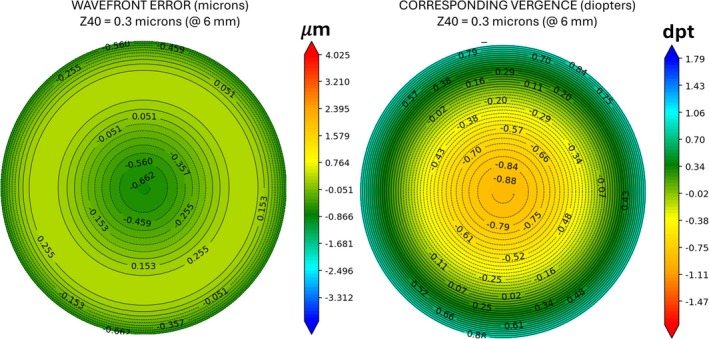
Most of these lenses add optical power in the center of the lens: a small central “button,” a ring or a more complex pattern. Lenses that increase negative SA work on the same principle, with a smoother profile. The main drawback is the dependence on the pupil and on SA:
- With a small photopic pupil, a myopic surprise or “daytime myopia” may occur.
- With a large pupil the effect of the central zone weakens, and the patient may complain of poor intermediate vision.
- High positive corneal SA can cancel the extension of focus, and low or negative SA increases it but degrades quality of vision.
Diffractive EDOF
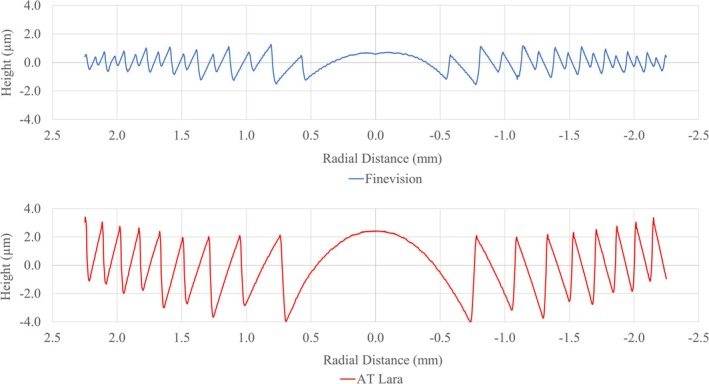
A diffraction grating with wider (and therefore fewer) steps gives a lower add power than that of a multifocal lens. The steps are higher, in order to offset chromatic aberration: in refraction, blue light is bent more strongly than red, and in diffraction the opposite is true. The clinical difficulty: the patient gets halos without the near benefit of a multifocal lens, and so finds them harder to accept.
Pinhole lens
A small aperture filters out the peripheral rays and increases depth of field, like a high f-number on a camera. The price: less light reaches the retina, and vision in dim light may suffer. The lens is therefore unsuitable when retinal sensitivity is impaired. Further reading: Small-Aperture IOLs.
Full correction
Full correction is achieved with multifocal lenses in both eyes, with a mix-and-match approach, or with monovision using EDOF lenses. Two requirements are common to multifocal lenses:
- Refractive target: do not aim for mild myopia as a safety margin, because even a small residual myopia degrades performance. Aim for emmetropia, or even slight hyperopia. In a series of more than 50,000 lenses (Schallhorn and colleagues, 2024), residual myopia of 0.25 D already reduced distance visual acuity, and with multifocal lenses, unlike monofocal lenses, it hardly improved near vision.
- Astigmatism: multifocal lenses are more sensitive to it than EDOF lenses, and even minimal astigmatism degrades performance.
Diffractive multifocals
The move from bifocal to trifocal lenses improved intermediate vision without giving up distance and near. Diffraction is less pupil-dependent, and apodization (steps whose height decreases toward the periphery) exploits a controlled dependence: in dim light more light is directed to distance, for example for night driving. The price: multiple diffraction orders scatter light and cause a slight loss of contrast. Further reading: Multifocal IOL Selection.
Refractive multifocals
- Symmetric: new prototypes with many concentric rings (“periodic refractive”) reach a depth of field of up to 2.25 D and therefore belong clinically with the multifocals. They are less pupil-dependent than a classic refractive EDOF and produce fewer halos than a diffractive lens.
- Asymmetric sectorial: a different dysphotopsia profile, with starbursts and ghost images and fewer halos.
- Spiral: refractive structures of different powers that “wind” around one another and create an elongated focal zone; in the first commercial lens, a central zone for distance was added. See the optical characterization of the spiral lens.
Complementary lenses and mix-and-match
Complementary lenses are a pair of trifocal lenses designed for binocular implantation: one is aimed more at intermediate and the other at near. The results are mixed, and no advantage over two identical lenses has been shown. In mix-and-match, different lens types are combined: a monofocal in the dominant eye and a presbyopia-correcting lens in the other (“hybrid monovision”), or two different premium lenses (“premium monovision”). The combinations are many, and the evidence is limited.
Add-on lens in the sulcus
Modern polypseudophakia differs from the old piggyback, in which both lenses were implanted in the capsular bag. Add-on lenses are designed for the sulcus: a diameter of 13–14 mm, most of them hydrophilic, with angulated haptics and rounded edges. In the duet procedure, a monofocal (or toric) lens is implanted in the bag and a multifocal add-on lens in the sulcus during the same operation. The advantage is reversible multifocality: if the patient suffers from photic phenomena, only the add-on lens is removed. In moderate myopes who are used to excellent near vision, the lens in the bag can be aimed at a myopic target and compensated with a negative add-on lens; if that lens is removed, the myopia remains. Further reading: IOL Exchange and Add-On Lenses.
Complex eyes
Presbyopia-correcting lenses superimpose images focused for different distances and can therefore reduce contrast. In an eye with disease, or after previous surgery, the price may be higher. The review presents three scenarios:
Three cases from the review
Age-related macular degeneration. A patient in their 70s with stable AMD received a monofocal lens in the bag and a multifocal add-on lens in the sulcus, and saw well at all distances. When the disease progressed to the wet form, the add-on lens was removed in a simple procedure, and contrast sensitivity returned to its best.
Fuchs. A patient in their 60s with moderate dystrophy and a low endothelial cell count (1,200 cells/mm²) received a trifocal lens. A year later, corneal edema developed. DMEK restored clarity, but a refractive error remained, and the cornea was too thin for laser correction. The only solution was glasses.
After PresbyLASIK. A patient in their 60s, with high expectations, was a candidate for an EDOF lens. The workup showed significant negative corneal SA, which already provided extended depth of focus. A monofocal lens with neutral SA was chosen, and the result was good distance and intermediate vision, with few photic phenomena.
- Diseases that may progress, such as AMD and epiretinal membrane, are a relative contraindication, because their course is unpredictable. Reversible multifocality may be a safer alternative than an IOL exchange. See Cataract and Macular Degeneration.
- Mild to moderate macular disease: the clinical evidence for reduced contrast after a multifocal lens is limited, and adaptation appears to be possible, but caution is required.
- Fuchs: use is controversial. Some recommend avoiding these lenses, and others propose a staged approach, DMEK first and lens implantation afterward.
- After corneal refractive surgery: the SA created by the surgery may cancel the effect of a refractive EDOF, to the point that it functions like a monofocal lens. Diffractive lenses may worsen photic phenomena that are already present; in a small study (39 patients after myopic refractive surgery), halos were reported in 39% to 59% of eyes, depending on the lens type. See Presbyopia-Correcting IOLs After LASIK and Cataract Surgery After Laser Eye Surgery.
The debate over the functional classification
In 2024 the ESCRS working group proposed a functional classification for simultaneous vision lenses, based on the range of focus in the visual acuity defocus curve: partial range of field (narrow, enhanced or extended) and full range of field. In the review, Stern and Gatinel wrote that a classification should also include the optical mechanism. In a letter to the editor (J Cataract Refract Surg, 2026) they added a methodological reservation:
- The defocus curve is a measure of the whole system, not of the lens alone: the cornea (about two thirds of the refractive power, with wide variability in aberrations), the biometry, the pupil and the lens position all affect it.
- Visual acuity measurement varies even in the same eye, and the published curves are smoothed population averages, which hide large standard deviations and may show a range that no individual eye achieves.
- Their proposal: individualized optical modeling (ray tracing or wavefront simulation) using the measured cornea, biometry and centration, under standardized pupil conditions.
The working group published a reply in the same issue.
Limitations of the review
- A narrative review, not a systematic one: the selection of sources is not exhaustive and it contains no meta-analysis.
- For some approaches (complementary lenses, mix-and-match, spiral lenses, new refractive lenses) the clinical evidence is still limited, and the authors call for further research.
- The field is changing fast; the review reflects the literature up to 2025.
- Prof. Gatinel is a consultant to BVI; Dr. Stern has no conflict of interest. The review was written without dedicated funding.
Take-home messages
- Start with the patient: needs, expectations and personality. Then partial or full correction, and only then the technology.
- Monovision is not “free”: stereopsis, binocular summation and the risk of strabismus decompensation.
- With a refractive EDOF lens, check the pupil and corneal SA; with a diffractive lens, discuss halos in advance.
- With a multifocal lens the target is emmetropia, with no residual astigmatism.
- When the eye is not entirely healthy, or the disease may progress, consider a conservative or reversible solution.
The paper: Stern B, Gatinel D. Presbyopia correction in lens replacement surgery: a review. Clin Exp Ophthalmol. 2025;53(6):668–681. Go to the full paper (open access). The letter: Stern B, Gatinel D. Comment on: Evidence-based functional classification of simultaneous vision intraocular lenses. J Cataract Refract Surg. 2026;52(5):523.
Frequently asked questions
What is the difference between partial and full correction of presbyopia?
Partial correction (monovision, monofocal plus, EDOF lenses, a pinhole lens) mainly improves intermediate vision, and reading glasses are usually still needed for near tasks. Full correction (multifocal lenses, lens combinations or a multifocal add-on lens) also improves near vision and provides spectacle independence, at the cost of more photic phenomena and a slight loss of contrast.
Why not aim for a mildly myopic target with a multifocal lens?
Because even a small residual myopia degrades the optical performance of a multifocal lens, and it adds almost nothing at near. The review recommends an emmetropic, or even slightly hyperopic, target and precise correction of astigmatism.
When should a multifocal add-on lens in the sulcus be considered?
When you want multifocality that can be undone: in a patient who is not sure they will adapt to the photic phenomena, when there is a disease that may progress (for example in the macula), in a moderate myope who is used to excellent near vision, or as an upgrade after cataract surgery with a monofocal lens. The price is more complex surgery and specific risks such as pigment dispersion.
Does the review recommend a particular lens?
No. It classifies the options by level of correction and optical mechanism, and emphasizes that the choice is individual: according to the patient's needs and expectations, the anatomy of the eye (pupil, corneal aberrations, astigmatism) and coexisting diseases.
References
- Stern B, Gatinel D. Presbyopia correction in lens replacement surgery: a review. Clin Exp Ophthalmol. 2025;53(6):668-681. Link
- Rampat R, Gatinel D. Multifocal and extended depth-of-focus intraocular lenses in 2020. Ophthalmology. 2021;128(11):e164-e185. Link
- Ribeiro F, Dick HB, Kohnen T, et al. Evidence-based functional classification of simultaneous vision intraocular lenses: seeking a global consensus by the ESCRS Functional Vision Working Group. J Cataract Refract Surg. 2024;50(8):794-798. Link
- Stern B, Gatinel D. Comment on: Evidence-based functional classification of simultaneous vision intraocular lenses: seeking a global consensus by the ESCRS Functional Vision Working Group. J Cataract Refract Surg. 2026;52(5):523. Link
- Fricke TR, Tahhan N, Resnikoff S, et al. Global prevalence of presbyopia and vision impairment from uncorrected presbyopia: systematic review, meta-analysis, and modelling. Ophthalmology. 2018;125(10):1492-1499. Link
- Schallhorn SC, Hettinger KA, Hannan SJ, Venter JA, Teenan D, Schallhorn JM. Effect of residual sphere on uncorrected visual acuity and satisfaction in patients with monofocal and multifocal intraocular lenses. J Cataract Refract Surg. 2024;50(6):591-598. Link
- Baur ID, Auffarth GU, Köppe MK, Łabuz G, Khoramnia R. Rotational stability of toric capsular bag-fixated intraocular lenses in duet procedure for reversible trifocality. Am J Ophthalmol. 2023;256:156-163. Link
- Ni S, Zhuo B, Cai L, et al. Visual outcomes and patient satisfaction after implantations of three types of presbyopia-correcting intraocular lenses that have undergone corneal refractive surgery. Sci Rep. 2024;14:8386. Link