

In brief
- An intraocular lens is meant to stay in the eye for life. Exchanging it is rare: in a large series it was needed in about 2 of every 1,000 surgeries.
- The main reasons for an exchange: a lens power that is not right (a “refractive surprise”), light phenomena that cannot be tolerated with a multifocal lens, a lens that has moved out of place, and a lens that has turned cloudy.
- There are three ways to correct the prescription: laser on the cornea, a thin add-on lens in front of the existing lens, or exchanging the lens.
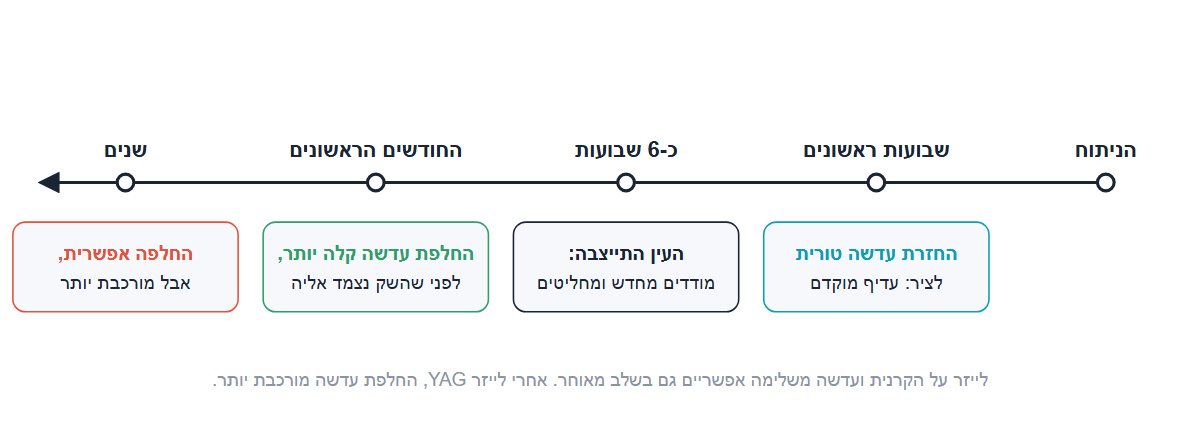
- Timing matters. First the eye is given time to stabilize, but a lens exchange is easier in the first months, before the capsular bag adheres to the lens.
- Any further surgery inside the eye carries risks, so a simple solution is sought first: glasses, treating dry eye, or YAG laser, when it is appropriate.
When is an intraocular lens exchanged, or a lens added?
In the vast majority of surgeries the lens stays in the eye for life, with no need to touch it at all. When an intervention is needed after all, it is usually in one of four situations:
- Refractive surprise: the eye is far from the planned target, for example it has ended up nearsighted or farsighted to a degree that is bothersome. This happens mainly in eyes that are hard to measure, such as eyes that have had laser eye surgery or very short or very long eyes (see Lens Power Calculation).
- A multifocal lens you cannot adapt to: halos, “cobwebs” around lights or “waxy” vision that persist for months.
- A lens that has shifted: sometimes years after surgery. See the page Dislocated Intraocular Lens.
- A lens that has turned cloudy: rare. It has been seen mainly in some lenses made of hydrophilic acrylic material, for example after surgeries in which air or gas was injected into the eye. In series from referral centers this is one of the common reasons for an exchange.
Clouding that appears behind the lens, in the capsule, is not a reason to exchange the lens. This is a secondary cataract, and it is treated with YAG laser in the clinic.
Before deciding: diagnosis and time
- Waiting for the eye to stabilize. The prescription usually stabilizes about six weeks after surgery, and light phenomena also fade over the first months.
- Looking for a treatable cause. Dry eye, residual astigmatism, secondary cataract or macular edema often cause the same complaints. In a study of patients who were dissatisfied with a multifocal lens, a treatable cause was found in more than 80%, and the lens was exchanged in only about 4%.
- Measuring again: refraction, biometry, a corneal map, and for a toric lens its axis as well.
If at the end of this process the decision is to treat, there are three main ways.
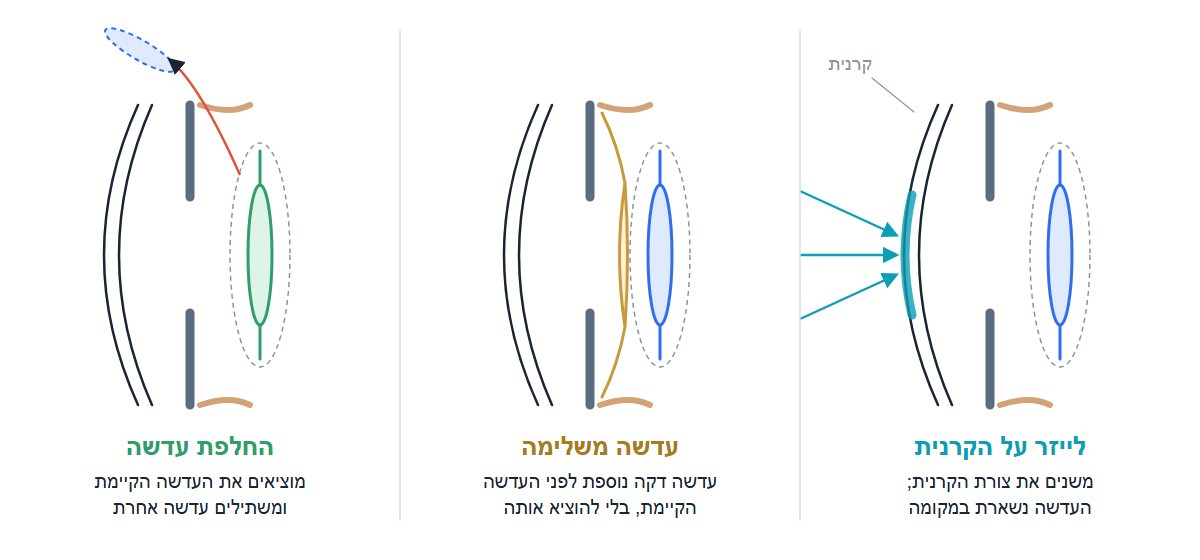
Laser on the cornea (LASIK or PRK)
When the residual prescription is small to moderate and the cornea is suitable, it can be corrected with laser on the cornea, as in laser vision correction. The big advantage: there is no need to go back inside the eye. The conditions: a stable prescription, a cornea of suitable thickness and shape, and an eye surface that is not too dry, because laser can make dry eye worse. On laser surgery, see The Guide to Laser Vision Correction.
An add-on (“piggyback”) lens: adding without removing
Instead of removing the existing lens, an additional thin lens is implanted in front of it. The additional lens sits in the narrow space between the iris and the capsular bag (sulcus). In the past, two standard lenses were implanted one against the other inside the capsular bag, and cloudy deposits and changes in the prescription often developed between them. Today's add-on lenses were designed specifically for this location: they are wider, with rounded edges, so as not to rub against the iris.
- Why it is a good option: it is suitable for correcting a prescription or astigmatism, the surgery is relatively simple, and the decision is reversible: if necessary, the add-on lens alone can be removed.
- Adding near vision: there are also multifocal add-on lenses. This way, someone who previously had surgery with a monofocal lens can add near vision without exchanging the lens.
- The risks: rubbing of the iris and pigment dispersion, a rise in intraocular pressure, inflammation, and more rarely clouding between the two lenses.
A case from Dr. Stern's review
A patient in his 70s, with stable macular degeneration, received a monofocal lens in the capsular bag and a multifocal add-on lens in front of it, and saw well at distance, intermediate and near. After the surgery the retinal disease worsened. The add-on lens was removed in a simple operation, and contrast and quality of vision returned. The case, published in the review by Dr. Stern and Prof. Gatinel (2025), illustrates the advantage of a reversible solution in an eye whose condition may change.
Lens exchange
In an exchange, the existing lens is removed, usually after it is folded or cut inside the eye so that it can be taken out through a small incision, and a different lens is implanted. This is the right approach when the problem is the lens itself: a lens that has turned cloudy, a multifocal lens you cannot adapt to, or a large error in lens power.
- Results: in large series, vision improved in most eyes. In a series of 64 eyes in which a multifocal or diffractive EDOF lens was exchanged for a monofocal lens, the diffractive light phenomena disappeared in all eyes.
- Timing: in the first months the lens can still be freed from the capsular bag relatively easily. Over time the bag fuses around it, and the exchange becomes more complex, although still possible.
- Risks: this is full intraocular surgery, with the risks of cataract surgery and sometimes slightly more: macular edema (in about 8% in a large series), vitreous leakage, and sometimes the need to fix the new lens in place in a different way than usual. The exchange is more complex once YAG laser has been performed, so if an exchange is being considered, that decision is made before the laser.
Which option, and when?
| The situation | What is usually considered |
|---|---|
| A small residual prescription | Glasses or contact lenses; sometimes laser on the cornea |
| A moderate residual prescription, suitable cornea | Laser on the cornea or an add-on lens |
| A large error in lens power | Lens exchange (preferably early) or an add-on lens |
| A toric lens that has rotated | Rotating it back to its axis in the first weeks (Toric Lenses) |
| A multifocal lens that cannot be tolerated | First treating other causes and allowing time to adapt; then exchange for a monofocal lens |
| A lens that has moved or turned cloudy | Refixation or exchange |
There is also a lens whose power can be adjusted with light after surgery, so that the correction is made without further surgery. See The Light Adjustable Lens.
When should you see a doctor?
If your vision after cataract surgery is far from what you expected, do not quietly put up with it: mention it at your follow-up visit. Looking into it early makes it possible to choose the simplest solution at the right time. A sudden drop in vision, new double vision in one eye, pain or increasing redness call for an urgent exam by an ophthalmologist.
Dr. Stern examines the eye, recalculates its optics and explains which options are suitable. More on the page Vision Correction After Cataract Surgery, and for the surgery itself see Cataract Surgery in Jerusalem. Physicians will find details on the page Management of Refractive Surprise.
Frequently asked questions
Can an intraocular lens be exchanged?
Yes. The lens can be removed and a different one implanted, but this is full intraocular surgery, so it is reserved for situations in which the problem is the lens itself. Often there is a simpler solution, such as glasses, laser on the cornea or an add-on lens.
What is an add-on (piggyback) lens?
An additional thin lens implanted in front of the existing lens, between the iris and the capsular bag, without removing the first lens. It corrects a prescription or astigmatism, and there is also a version that adds near vision. If necessary, it can be removed.
When is the best time to exchange a lens?
First there is a wait of about six weeks for the eye to stabilize, and the cause is investigated. If the decision is to exchange, the exchange is easier in the first months, before the capsular bag adheres to the lens. It is possible even years later, but more complex.
Can a multifocal lens be exchanged for a standard lens?
Yes. When the halos or the quality of vision remain intolerable even after other causes have been treated and time has been allowed for adaptation, the lens is sometimes exchanged for a monofocal lens. In published series, the diffractive light phenomena disappeared after the exchange. This is needed in a small minority of patients.
What are the risks of a lens exchange?
The risks are similar to those of cataract surgery and sometimes slightly higher: macular edema, vitreous leakage, a rise in intraocular pressure, and sometimes the need to fix the new lens in place in a different way. After YAG laser the exchange is more complex.
References
- Stern B, Gatinel D. Presbyopia correction in lens replacement surgery: a review. Clin Exp Ophthalmol. 2025;53(6):668-681. Link
- American Academy of Ophthalmology. Basic and Clinical Science Course, Section 11: Lens and Cataract. 2022-2023 ed.
- Fernández-Buenaga R, Alió JL. Intraocular lens explantation after cataract surgery: indications, results, and explantation techniques. Asia Pac J Ophthalmol (Phila). 2017;6(4):372-380. Link
- Goemaere J, Trigaux C, Denissen L, Dragnea D, Hua MT, Tassignon MJ, et al. Fifteen years of IOL exchange: indications, outcomes, and complications. J Cataract Refract Surg. 2020;46(12):1596-1603. Link
- Patel V, Pakravan P, Lai J, Watane A, Mehra D, Eatz TA, et al. Intraocular lens exchange: indications, comparative outcomes by technique, and complications. Clin Ophthalmol. 2023;17:941-951. Link
- Alsetri H, Pham D, Masket S, Fram NR, Naids S, Lee A. Diffractive optic intraocular lens exchange: indications and outcomes. J Cataract Refract Surg. 2022;48(6):673-678. Link
- Abdalla Elsayed MEA, Ahmad K, Al-Abdullah AA, Malik R, Khandekar R, Martinez-Osorio H, et al. Incidence of intraocular lens exchange after cataract surgery. Sci Rep. 2019;9:12877. Link
- Gurnani B, Kaur K. Refractive surprises after cataract surgery: identification and management in optometric practice - a comprehensive review. Clin Optom (Auckl). 2026;18:572733. Link