

In brief
- In cataract surgery, a multifocal lens replaces the natural lens and lets you see at distance, at intermediate range and up close with less dependence on glasses.
- There is no “best lens”: the same lens performs differently in different eyes, because of differences in the cornea and in pupil size.
- The optical price is a slight loss of sharpness and contrast, and halos around lights at night. In most patients the brain learns to ignore them.
- Before choosing, the shape of the entire cornea, the pupil size and the health of the retina are checked, not just the lens power.
What is a multifocal lens?
In cataract surgery the natural lens that has become cloudy is removed and an intraocular lens is implanted in its place. A standard (monofocal) lens focuses light to a single point, so it gives sharp vision at one distance, usually far, and the reading glasses stay.
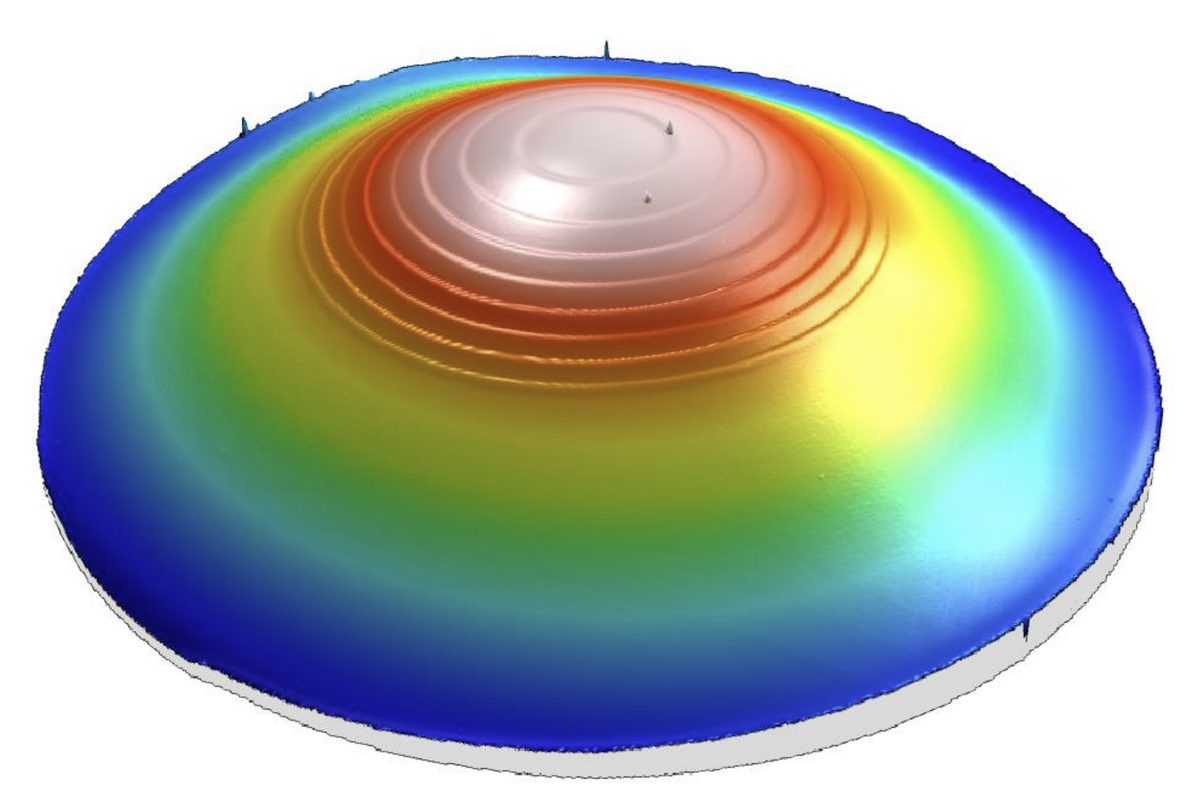
A multifocal lens is built differently. On the surface of the lens there are tiny rings, just a few microns high, that split the light into several focal points at once: for distance, for intermediate range (computer) and for near (reading, phone). The eye receives several images in parallel, and the brain learns to pick the sharp one at each moment.
Why is an optical “trick” like this needed? Because of presbyopia (age-related loss of near focus): around age 40 the natural lens loses its ability to change shape and focus up close. Lenses that are meant to change focus like the young natural lens (accommodating lenses) have been tried over the past twenty years with only limited success, and are still not a practical solution. That is why today's solutions are based on dividing the light or on elongating the focus.
The height of the rings determines how the light is divided
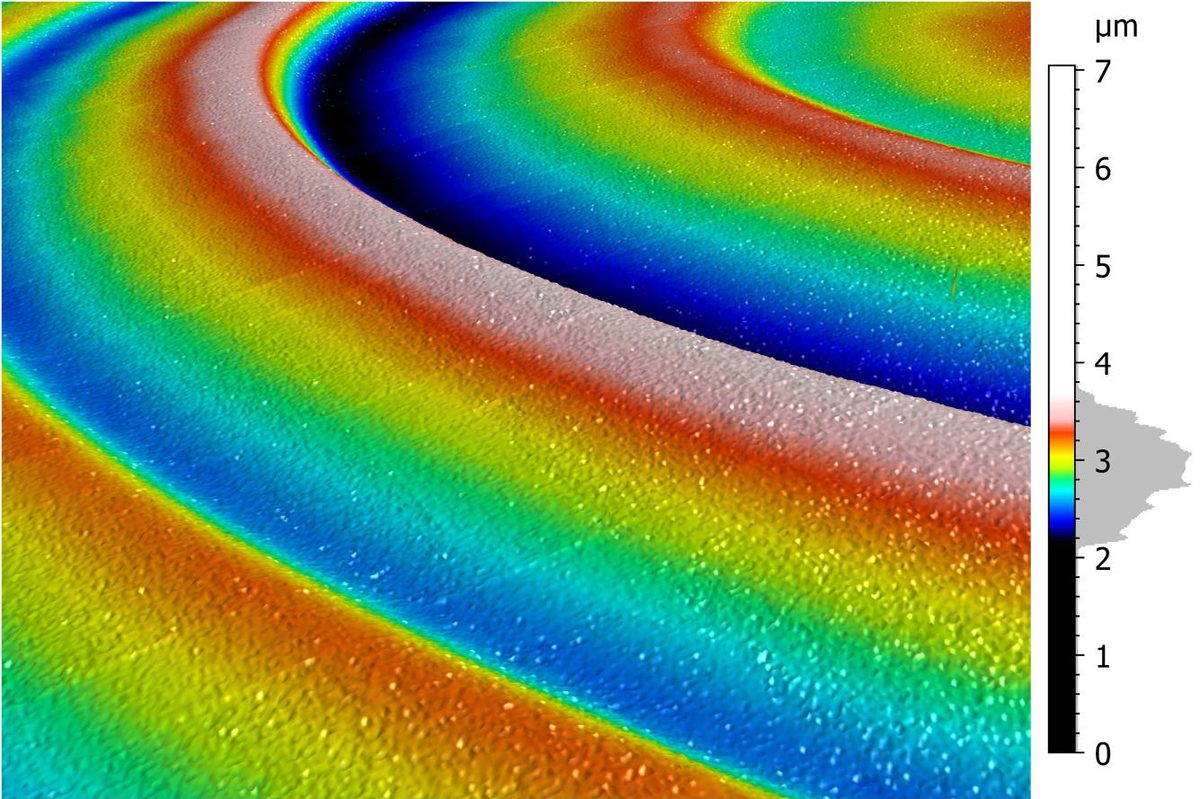
In a diffractive lens, the height of each step determines how much of the light reaches each focal point, and the width of the rings determines the reading distance. That is why two “trifocal” lenses can behave completely differently: one gives priority to distance, and another to near or to intermediate range.
Which multifocal lens is the best?
This is the question Dr. Stern is asked most often, and his honest answer is: it depends. To illustrate, he compares it to choosing the lens power. Before the calculation formulas were developed (the first was published in 1967), a lens of one standard power was often implanted, and the rest was corrected with glasses. No surgeon would do that today: every eye is measured and a power of its own is calculated for it. With the lens model it is the same, and even more complex.
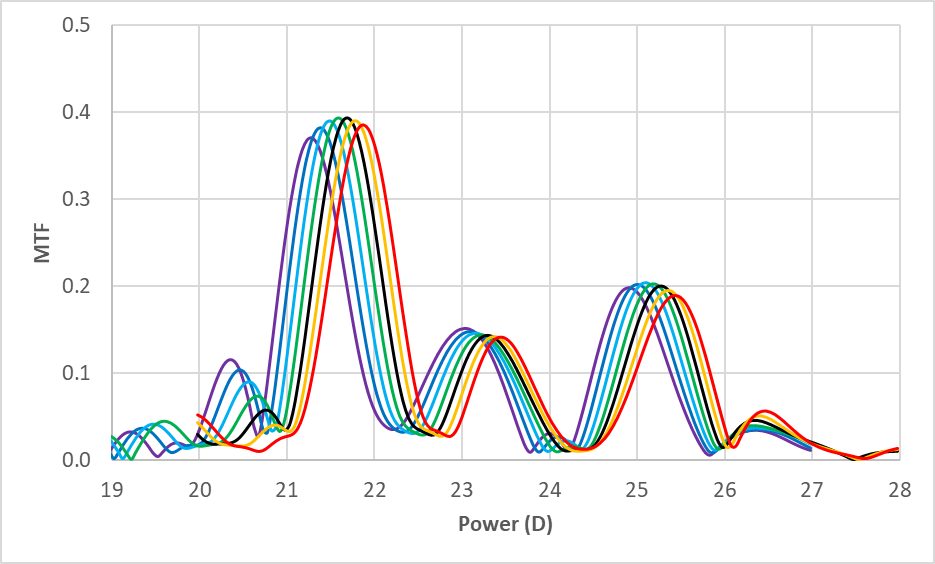
Every person has a different optical system. The cornea, which accounts for about two-thirds of the eye's focusing power, differs in shape from person to person. The pupil, the aperture of the eye, also differs in size and changes all the time with the lighting. The intraocular lens works within this system, so the same lens can give an excellent result in one eye and a less good result in another.
So it is not a good idea to choose a lens based on an advertisement, on what suited your neighbor or on a new brand name. The choice should be made according to the measurements of your own eye.
Trifocal, EDOF or monofocal: what is the difference?
There are several ways to reduce dependence on glasses after cataract surgery, and each has its advantages and its price:
| Type | How it works | Distance | Intermediate (computer) | Near (reading) | Halos at night |
|---|---|---|---|---|---|
| Monofocal | Single focus | Excellent | Usually with glasses | With glasses | Minimal |
| Monofocal plus | Single focus, slightly elongated | Excellent | Slightly improved | With glasses | Minimal |
| EDOF | Focus elongated into a continuous range | Excellent | Very good | Moderate – large print | Relatively few, depending on the model |
| Multifocal / trifocal | Light split into several focal points | Good | Good | Good | More common |
| Monovision | One eye for distance, the other −1.50 D | In the dominant eye | In the other eye | Partial: phone; glasses for small print | Minimal |
The table is a general overview, and the actual result depends on the model and on the eye. For a full comparison, see the page types of intraocular lenses, and for extended depth of focus lenses, see the page EDOF lenses.
Halos, glare and contrast
Splitting the light is also the price of the lens: some of the light always goes to focal points that are not in use at that moment. As a result:
- Halos and glare: rings of light or “rays” around headlights and traffic lights, mainly at night and when driving in the dark.
- Slightly lower contrast: in dim light the image may look less sharp than with a monofocal lens.
In most patients these effects become less and less bothersome over the first months, not because the lens changes, but because the brain learns to ignore them. In a minority they continue to be bothersome. With EDOF lenses there are usually fewer halos, but near vision is also weaker.
How the brain adapts (neuroadaptation)
A multifocal lens works only thanks to the brain. The eye sends it several images at once, and the brain picks the sharp one and suppresses the others. This ability is retained even at an older age, but it takes time: most of the improvement is usually felt within three to six months, and sometimes it continues for up to a year.
Dr. Stern sees cognitive status and the flexibility of the brain as a central ingredient of success, so he addresses them in the conversation before the choice is made. In large studies a large majority of patients are satisfied, but about one in ten is not satisfied with the result. In most cases there is a cause that can be treated: a residual prescription or residual astigmatism, secondary cataract or dry eye. So if your vision is still bothering you after a few months, see your ophthalmologist for an exam.
Who is a multifocal lens suitable for?
Good candidates are usually:
- People who very much want to reduce their dependence on glasses, including for reading and for the computer.
- A healthy eye: a regular cornea, a healthy retina and macula, and no glaucoma.
- Realistic expectations: a willingness to accept some halos at night and a period of adaptation.
A multifocal lens is usually not recommended when there is uncontrolled dry eye disease, corneal scars, glaucoma, macular degeneration or an epiretinal membrane: in these conditions the eye is already losing contrast, and the lens may add to that. “Complex” eyes, such as an irregular cornea (keratoconus), an eye that has had laser vision correction, or very high myopia, require especially precise planning, because the result in them is less predictable. See also Cataract Surgery After Laser Eye Surgery.
Which tests are done before choosing the lens, and what do they measure?
- Biometry: measures the length of the eye and the power of the cornea, in order to calculate the lens power. The devices measure the power of the cornea only in a small central zone, about 2.5 mm in diameter or less.
- Corneal topography or tomography: maps the entire cornea, including the periphery. This is how regular or irregular astigmatism is identified, and how the “spherical aberration” of the cornea is assessed, a value that strongly affects premium lenses.
- Pupil size: measured in light and in the dark, before the pupil is dilated with drops. This is one of the most important values, and yet it is not always checked.
- OCT of the macula: a scan of the layers of the retina, to detect hidden disease at the center of vision that could compromise the result.
- Tear film testing: dryness distorts the measurements and the quality of vision, and sometimes it is treated before the final measurements.
On preparing for surgery, see the page Before Cataract Surgery.
How Dr. Stern chooses a lens
Dr. Stern has been studying the optics of intraocular lenses since his fellowship at the Rothschild Foundation Hospital in Paris, under Prof. Damien Gatinel, and he founded a biomedical optics research laboratory at Hadassah Ein Kerem. The laboratory tests how different lenses behave with different corneas and at different pupil sizes, instead of relying on the manufacturers' marketing materials.
At the planning visit he combines three things: the measurements of your eye, the health of the eye, and what matters to you day to day, such as night driving, reading and working at a screen. Sometimes the conclusion is a multifocal lens, sometimes an EDOF lens or monovision, and sometimes a monofocal lens after all.
Frequently asked questions
After a multifocal lens, will I not need glasses at all?
Most patients manage without glasses for most everyday activities, but there is no guarantee. For prolonged reading of small print or in dim light, some patients still use glasses.
Do the halos around lights go away?
The halos are an optical property of the lens and do not disappear completely, but in most patients the brain learns to ignore them, and they become less and less bothersome over the first months.
How long does it take to get used to a multifocal lens?
Usually three to six months, and sometimes up to a year. It is best to judge the result only after surgery on the second eye and after a period of adaptation.
Can I have a multifocal lens after laser eye surgery (LASIK or PRK)?
Sometimes yes, but this is a more complex eye: the laser changed the shape of the cornea, and that changes the way premium lenses perform. The decision requires a full measurement of the cornea and tailoring the lens model to the individual eye.
What can be done if I do not adapt to the lens?
First, a treatable cause is looked for: dry eye, a residual prescription or secondary cataract. Treating these usually improves vision. In selected cases, exchanging the lens can be considered, in consultation with the surgeon.
References
- Stern B, Gatinel D. Presbyopia Correction in Lens Replacement Surgery: A Review. Clin Exp Ophthalmol. 2025;53(6):668-681. Link
- Alio JL, Plaza-Puche AB, Férnandez-Buenaga R, Pikkel J, Maldonado M. Multifocal intraocular lenses: An overview. Surv Ophthalmol. 2017;62(5):611-634. Link
- de Vries NE, Webers CA, Touwslager WR, et al. Dissatisfaction after implantation of multifocal intraocular lenses. J Cataract Refract Surg. 2011;37(5):859-865. Link
- Zhong Y, Wang K, Yu X, Liu X, Yao K. Comparison of trifocal or hybrid multifocal-extended depth of focus intraocular lenses: a systematic review and meta-analysis. Sci Rep. 2021;11:6699. Link
- Schallhorn SC, Hettinger KA, Hannan SJ, Venter JA, Teenan D, Schallhorn JM. Effect of residual sphere on uncorrected visual acuity and satisfaction in patients with monofocal and multifocal intraocular lenses. J Cataract Refract Surg. 2024;50(6):591-598. Link
- O'Brart D. The future of cataract surgery. Eye. 2025;39(8):1451-1456. Link