

In brief
- Presbyopia is a gradual loss of the ability to focus up close. It happens to everyone, and is usually noticed from age 40 to 45.
- The cause: the natural lens grows and stiffens over the years, and can no longer become rounder when you look at something close.
- The simple solutions are reading glasses, multifocal glasses and contact lenses. Another option is monovision.
- In cataract surgery, or in lens exchange, a multifocal or EDOF lens can be chosen, after an evaluation that matches the lens to the eye and to your lifestyle.
What is presbyopia?
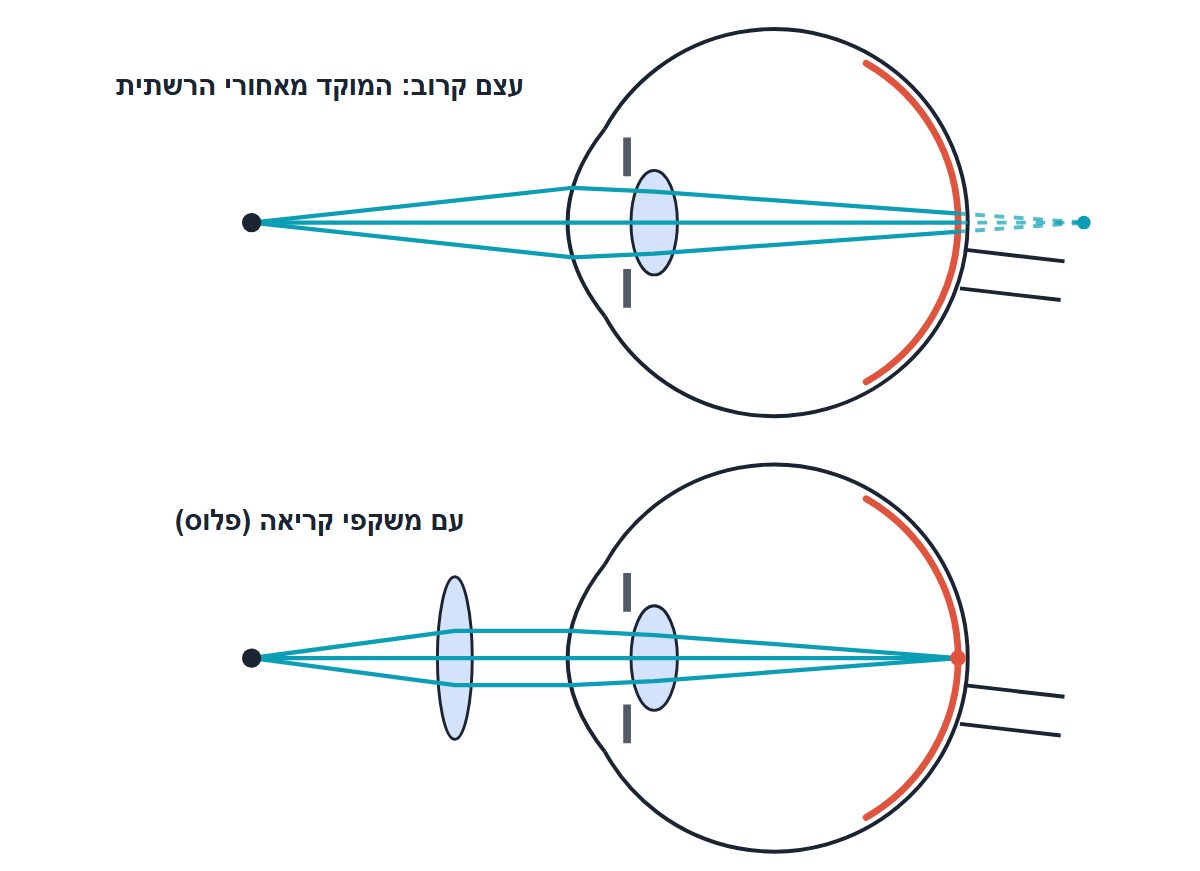
To see clearly up close, the eye needs to add focusing power. This is the job of the natural lens: when you look at something close, the ciliary muscle around it contracts, the fine fibers that hold it (the zonules) relax, and the flexible lens becomes rounder. This ability is called “accommodation.”
The lens keeps growing throughout life: its diameter is about 6.4 mm at birth and about 9 to 10 mm in an adult, and it continues to thicken after that as well. It also stiffens, and the ability to accommodate declines from a young age. As long as enough power remains, you do not notice it. To read at a distance of 40 cm the eye needs to add about 2.5 diopters (1 divided by 0.4 meters), and around age 40 to 45 the power that remains is no longer enough for comfortable reading. This is when people start holding the phone farther away. The process continues until about age 60 and then stabilizes.
Presbyopia is not a disease and not a sign of a problem in the eye. It is part of the natural aging of the lens, and it happens even to people who have seen perfectly all their lives.
Symptoms of presbyopia
- You hold the phone, the menu or the book farther away in order to read.
- You need more light to read, and reading is harder in the evening.
- Eye fatigue or headache after reading or close work.
- Slow refocusing when you shift your gaze between far and near.
How it feels depends on the prescription you had before. People with farsightedness notice presbyopia earlier. People with mild nearsightedness can sometimes simply take off their glasses to read, and notice it less.
Why is it easier to read in bright light?
In bright light the pupil constricts. A small pupil acts like the small hole of an old pinhole camera: the depth of focus increases, and the text stays relatively sharp even when the focus is not perfect. That is why a good reading lamp helps, and why reading is harder in the evening, when the pupil is wide. This principle is explained on the How Does the Eye See? page.
Ways to correct it without surgery
Reading glasses
A converging (plus) lens adds the power that the natural lens no longer provides. People usually start with a low power, and it rises gradually until about age 60. Reading glasses are suitable only for the near range, and distance vision through them is blurred.
Multifocal glasses and office glasses
Multifocal (progressive) lenses contain several zones: the top for distance, the middle for the intermediate range and the bottom for reading. It takes time, usually days to a few weeks, to get used to moving your head and not only your eyes. For people who work for hours at a computer there are also “office” lenses, which are designed for the intermediate range and for near.
Contact lenses
There are multifocal contact lenses, and some people prefer monovision with contact lenses: one eye is set for distance and the other for near. This is also a good way to find out whether monovision suits you, before any decision about surgery.
Monovision: one eye for distance and one eye for intermediate vision
In monovision the dominant eye is usually set for distance vision, and the other eye for mild nearsightedness, so that it sees better up close. The brain learns to combine the two images. A small difference between the eyes better preserves depth perception; a large difference gives better near vision, but reduces depth perception more. In Dr. Stern's practice the other eye is set for nearsightedness of −1.50 D, and no more: this gives good vision in the intermediate range, for example at a computer, and makes reading on a phone easier, but small print and prolonged reading of a book still require glasses. A smaller difference than this is called mini-monovision. Dr. Stern does not offer monovision to anyone with a latent strabismus, because the difference could make it worse, and the method is not suitable for people who read small print for hours. Monovision can be achieved with contact lenses, with laser eye surgery (The Guide to Laser Vision Correction) or through the choice of lenses in cataract surgery. Laser surgery on the cornea does not “cure” presbyopia, because the problem is in the lens and not in the cornea.
Surgical solutions: multifocal and EDOF lenses
In cataract surgery the natural lens is replaced with an intraocular lens. For some people of the right age, lens exchange is considered even before a significant cataract has developed, in order to reduce dependence on glasses. There are several options when choosing the lens:
- Monofocal lens: sharp distance vision, and glasses for reading.
- Monovision with monofocal lenses: the dominant eye for distance, and the other eye with mild nearsightedness of −1.50 D. The range is similar to that of an EDOF lens.
- Multifocal (trifocal) lens: splits the light into several focal points. When a trifocal lens is tested on an optical bench, a laboratory test of image quality, three peaks of sharpness are seen: for distance, for the intermediate range and for near (Testing Lenses on an Optical Bench).
- EDOF lens (extended depth of focus): extends the range of sharp vision from distance to the intermediate range, usually with fewer halos than a multifocal lens (mainly in non-diffractive models), but weak reading glasses are often needed for reading small print (EDOF Lenses).
The advanced lenses also have optical drawbacks: halos around lights at night and some reduction in contrast, which most people get used to. They are not suitable for every eye. Disease of the macula, an irregular cornea or glaucoma may make them a poor choice. Pupil size also matters, mainly with non-diffractive EDOF lenses: when the pupil is very small the eye may become slightly nearsighted in daylight, and when it is very large the added intermediate vision weakens. For this reason pupil size and the shape of the cornea are measured before the choice is made.
How a lens is chosen is explained on the pages How to Choose a Multifocal Lens and Types of Lenses in Cataract Surgery.
Lens exchange in an eye without a significant cataract is intraocular surgery in every respect, with the risks of such surgery. The decision is made only after a comprehensive evaluation and a conversation about expectations, benefits and drawbacks.
Frequently asked questions
At what age does presbyopia begin?
The ability to focus up close declines gradually from a young age, but it is usually noticed around age 40 to 45. People with farsightedness notice it earlier. The process stabilizes around age 60.
Can eye exercises delay presbyopia?
No. Presbyopia is caused by stiffening of the natural lens with age, and there is no evidence that exercises, diet or avoiding reading glasses delay it. Wearing reading glasses does not weaken the eyes, either.
Are over-the-counter reading glasses good enough?
When the prescription is the same in both eyes and there is no astigmatism, ready-made reading glasses can be enough. Even so, around age 40 it is worth having a full eye exam, which checks eye pressure and the condition of the retina as well, and not only the prescription.
Does laser eye surgery correct presbyopia?
Laser treatment of the cornea does not restore the flexibility of the lens, so it does not cure presbyopia. It can be used to create monovision: one eye for distance, and mild nearsightedness in the other eye.
Which is better: a multifocal lens or an EDOF lens?
There is no single answer. A multifocal lens usually gives more independence up close, but generally with more halos at night. An EDOF lens gives good distance-to-intermediate range, usually with fewer halos, but glasses are often needed for reading small print. The choice depends on the eye, on pupil size and on lifestyle.
References
- Stern B, Gatinel D. Presbyopia Correction in Lens Replacement Surgery: A Review. Clin Exp Ophthalmol. 2025;53(6):668-681. Link
- Wolffsohn JS, Davies LN, Sheppard AL. New insights in presbyopia: impact of correction strategies. BMJ Open Ophthalmol. 2023;8(1):e001122. Link
- American Academy of Ophthalmology. Basic and Clinical Science Course (BCSC), Section 11: Lens and Cataract. San Francisco: American Academy of Ophthalmology; 2018–2019.
- Karam M, Alkhowaiter N, Alkhabbaz A, et al. Extended Depth of Focus Versus Trifocal for Intraocular Lens Implantation: An Updated Systematic Review and Meta-Analysis. Am J Ophthalmol. 2023;251:52-70. Link
- Chuck RS, Jacobs DS, Lee JK, et al. Refractive Errors & Refractive Surgery Preferred Practice Pattern. Ophthalmology. 2018;125(1):P1-P104. Link