

In brief
- In monovision the dominant eye is set for distance and the other eye is left slightly nearsighted, using standard (monofocal) intraocular lenses.
- For Dr. Stern, monovision means that the other eye is set to nearsightedness of −1.50 D: good vision at the intermediate range (computer) and easier reading on a phone, a range similar to that of an EDOF lens. Small print and prolonged reading of a book still require glasses.
- Dr. Stern does not aim for more than one and a half diopters. A smaller difference is called mini-monovision, and he uses it in some cases.
- The advantage: sharp vision with good contrast, and very few halos and very little glare.
- The main downside is reduced depth perception, and sometimes difficulty with night driving. The larger the difference between the eyes, the greater the downside.
- Not everyone adapts. The feeling can be tried out in advance, with a contact lens or with a trial lens in the clinic. Monovision is not suitable for people with latent strabismus (a hidden eye misalignment), nor for people who read small print for hours.
What is monovision, and how does it work?
A standard intraocular lens focuses light for one distance. If both eyes are set for distance, you see well for driving and television, but you need glasses for the computer and for reading. Monovision (also called blended vision) divides the work between the eyes: one eye, usually the dominant one, is set for distance, and the other eye receives a lens that leaves it slightly nearsighted, so that it is sharp at a closer distance.
Both eyes are open all the time, and at each moment the brain relies on the sharper image. The method has been familiar for decades from contact lenses and laser eye surgery, and in cataract surgery it is the longest-established way to reduce dependence on glasses.
For Dr. Stern, monovision means that the dominant eye is set for distance, and the other eye is set to mild nearsightedness of −1.50 D. This gives good vision at the intermediate range, for example at a computer, and makes it easier to read on a phone. Small print and prolonged reading of a book still require glasses. The resulting range is similar to that of an EDOF lens.
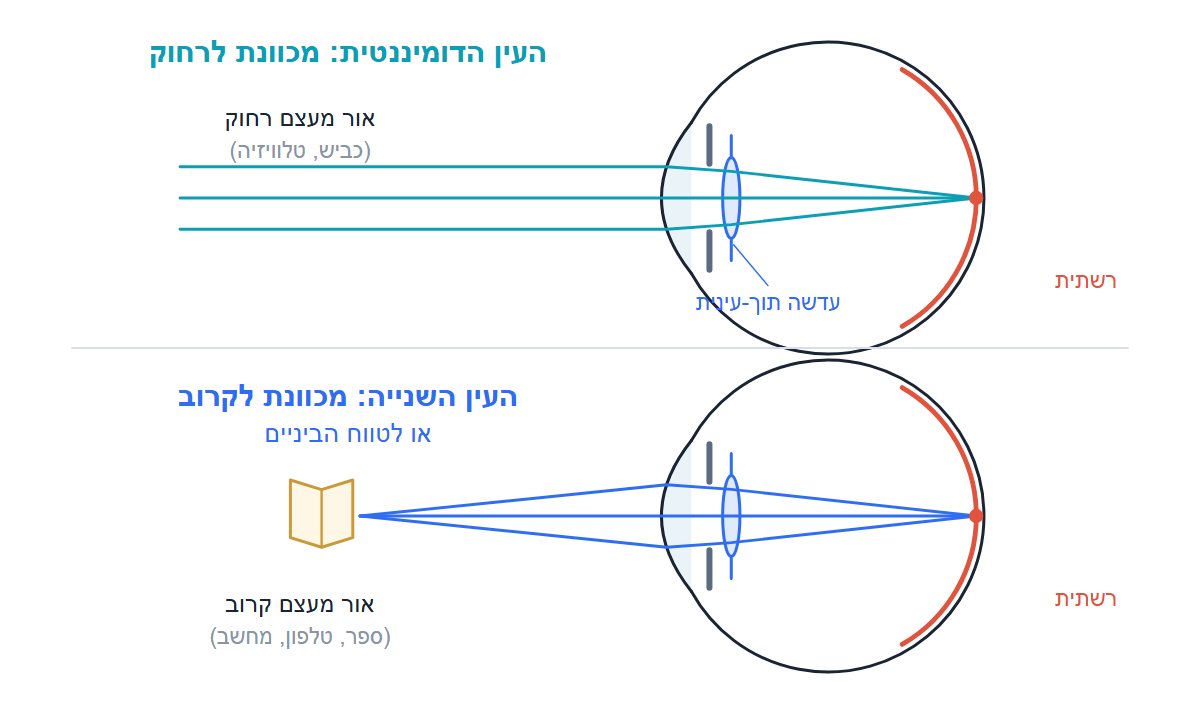
Monovision and mini-monovision: what is the difference?
The difference is in the size of the gap between the two eyes. The definitions are not the same for all surgeons. This is how Dr. Stern defines them:
- Monovision: the other eye is set to nearsightedness of −1.50 D. It is sharp at the intermediate range: the computer, the dashboard and supermarket shelves, and reading on a phone is easier with it. Small print and prolonged reading of a book still require reading glasses. The range is similar to that of an EDOF lens.
- Mini-monovision: nearsightedness of less than one and a half diopters in the other eye. Distance vision and depth perception are better preserved, but near vision is weaker. Dr. Stern uses it in some cases.
Some surgeons set the other eye to greater nearsightedness, to allow reading without glasses, at the cost of a greater loss of depth perception and of distance vision. Dr. Stern does not aim for more than one and a half diopters.
How large a difference is best? A Japanese study that tested this in a controlled way found that a difference of about one and a half diopters gives useful vision from distance to near, and that with a difference of 2 diopters depth perception is already noticeably impaired. Another study by the same group found that with a difference of 0.75 diopters vision is excellent from distance to the intermediate range and depth perception is better preserved, but near vision is weaker.
Who is monovision suitable for, and who adapts to it well?
Good candidates:
- People who have already done well with monovision in contact lenses or after laser eye surgery.
- People with long-standing nearsightedness, who are used to seeing up close without glasses and do not want to give that up.
- People who want to wear glasses less, but are worried about halos when driving at night, or whose eye is not suitable for a multifocal lens.
Monovision is less suitable:
- For people who have or have had strabismus, latent strabismus or double vision. The difference between the eyes may worsen latent strabismus, sometimes years after surgery, which is why Dr. Stern does not offer monovision in this situation.
- For people who read small print for hours, for example those who study Talmud with Rashi script.
- When one eye is weak, for example a lazy eye or a retinal disease. The method relies on two good eyes.
- For people who need precise depth perception or sharp distance vision in both eyes, for example professional drivers and pilots.
Which eye for distance? Usually the dominant eye, which is identified with a simple test in the clinic. Dominance is not fixed: according to the review by Dr. Stern and Prof. Gatinel (2025), in 20% to 40% of patients it switches after cataract surgery, and it appears that even then the result is not significantly affected.
How can it be tested in advance? A contact lens trial
Monovision is a matter of how it feels, so it is worth trying it before deciding:
- A demonstration in the clinic: a weak trial lens is placed in front of one eye, and you check how it feels while sitting, walking and reading.
- A contact lens trial: for a few days you wear a contact lens that creates the difference, at home, at work and while driving. This is a trial closer to real life.
- Deciding after the first eye: the eye intended for distance can be operated on first, and the target for the other eye decided only after you see how you manage.
When the cataract is already blurring vision, the contact lens trial is less reliable, and it cannot always be done. Many surgeons then make do with a demonstration in the clinic and a conversation about your visual habits.
The disadvantages: depth perception, night driving and glasses
- Depth perception (three-dimensional vision): this is the main disadvantage. Precise depth perception relies on two sharp images, and in monovision one of them is blurred. In older adults, poor depth perception is a recognized risk factor for falls, so this is weighed carefully in people who are unsteady on their feet.
- Quality of vision with both eyes together: two eyes usually see better together than one eye alone. The difference weakens this advantage, and a drop in contrast sensitivity has been measured even with small differences.
- Night driving: the eye that is set for near is blurred at distance, and in the dark this may show up as glare and halos around lights. The usual solution is glasses for night driving, which correct that eye for distance.
- Glasses do not disappear completely: in a British controlled trial, in which a difference of about 1.25 diopters was targeted, about a quarter of the patients reported that they did not wear glasses at all, compared with about 70% in the group that received multifocal lenses.
- Accuracy is required: the distance eye needs to be accurate, including correction of its astigmatism. See Toric Lenses and Lens Power Calculation.
Monovision compared with a multifocal lens and an EDOF lens
| Monovision (monofocal lenses) | EDOF lens | Multifocal lens | |
|---|---|---|---|
| Distance and intermediate | Good | Good | Good |
| Reading | Phone: easier. Small print and prolonged reading: with glasses | Usually with glasses for small print | Usually without glasses |
| Halos and glare | Low risk | Depends on the type of lens | More common |
| Depth perception | Reduced, depending on the size of the difference | Preserved | Preserved |
| If you do not adapt | Glasses cancel the difference | Glasses for reading; the halos are not corrected by glasses | Rarely, a lens exchange is needed |
A Cochrane review (2016) and a 2025 meta-analysis reached the same conclusion: multifocal lenses free more patients from glasses, and monovision causes less glare. In the same British trial, the lens was exchanged in the first year in six patients in the multifocal lens group, and in none in the monovision group. No method is the best for everyone, and the choice depends on what matters more to you.
A combination is also possible: mini-monovision with an enhanced monofocal lens or with an EDOF lens extends the range further, although the results in studies are not uniform. The full comparison of the lens types appears on the pages Types of Lenses in Cataract Surgery and How to Choose a Multifocal Lens.
And what if you do not get used to it?
Most people get used to monovision within a few weeks, and satisfaction continues to rise gradually. The great advantage of the method is that it is easily reversible: glasses that correct the near eye for distance, or the distance eye for reading, restore full vision in both eyes. When the difference continues to bother you even with glasses, a permanent correction of one of the eyes can be considered, with laser on the cornea or with an add-on lens. See Lens Exchange and Add-On Lenses.
If double vision appears after surgery, or a feeling that the eyes are “not working together,” tell your ophthalmologist. At the planning visit, Dr. Stern checks which of the options suit your eyes and your lifestyle. On the surgery itself, see Cataract Surgery in Jerusalem.
Frequently asked questions
What is the difference between monovision and mini-monovision?
The difference is in the size of the gap between the eyes. For Dr. Stern, monovision means that the other eye is set to minus 1.5 diopters: good vision at the intermediate range and easier reading on a phone, a range similar to that of an EDOF lens. A smaller difference is mini-monovision, which preserves depth perception better and suits some cases. Dr. Stern does not aim for more than one and a half diopters.
With monovision, do you not need glasses at all?
Most patients need glasses less, but only a small proportion get rid of them completely. In a controlled trial, about a quarter of the patients with mild monovision reported that they did not wear glasses at all. Glasses for small print or for night driving remain common.
Does monovision interfere with night driving?
In some patients, yes. The eye that is set for near is blurred at distance, and in the dark this may cause glare and halos around lights. The usual solution is glasses for night driving that correct that eye for distance.
How long does it take to get used to monovision?
Most people get used to it within a few weeks, and satisfaction continues to rise gradually. If the difference continues to bother you, it can be canceled with glasses.
Which eye is set for distance?
Usually the dominant eye, which is identified with a simple test in the clinic. Dominance can switch after cataract surgery, and it appears that even then the result is not significantly affected.
Can monovision be reversed if you do not get along with it?
Yes. Glasses cancel the difference between the eyes at any moment. If you want a permanent solution, correction of one of the eyes with laser on the cornea or with an add-on lens can be considered, depending on the eye exam.
References
- Stern B, Gatinel D. Presbyopia correction in lens replacement surgery: a review. Clin Exp Ophthalmol. 2025;53(6):668-681. Link
- Wanten JC, Till V, Findl O, Cochener-Lamard B, Kohnen T, Nuijts RM. ESCRS guideline for cataract surgery 2024: executive summary. J Cataract Refract Surg. 2026;52(9):e1-e13. Link
- Wilkins MR, Allan BD, Rubin GS, Findl O, Hollick EJ, Bunce C, et al. Randomized trial of multifocal intraocular lenses versus monovision after bilateral cataract surgery. Ophthalmology. 2013;120(12):2449-2455. Link
- de Silva SR, Evans JR, Kirthi V, Ziaei M, Leyland M. Multifocal versus monofocal intraocular lenses after cataract extraction. Cochrane Database Syst Rev. 2016;12:CD003169. Link
- Hong ASY, Jin E, Shen L, Chen DZ. Monovision versus multifocality for presbyopia during primary phacoemulsification: systematic review and network meta-analysis. Eye (Lond). 2025;39(2):251-261. Link
- Hayashi K, Yoshida M, Manabe S, Hayashi H. Optimal amount of anisometropia for pseudophakic monovision. J Refract Surg. 2011;27(5):332-338. Link
- Hayashi K, Ogawa S, Manabe S, Yoshimura K. Binocular visual function of modified pseudophakic monovision. Am J Ophthalmol. 2015;159(2):232-240. Link
- American Academy of Ophthalmology. Basic and Clinical Science Course, Section 13: Refractive Surgery. 2022-2023 ed.