

In brief
- RayOne Galaxy showed a continuous depth of field. According to qualitative simulations of the retinal image, the usable range is on the order of 2.5–3.0 D under the test conditions.
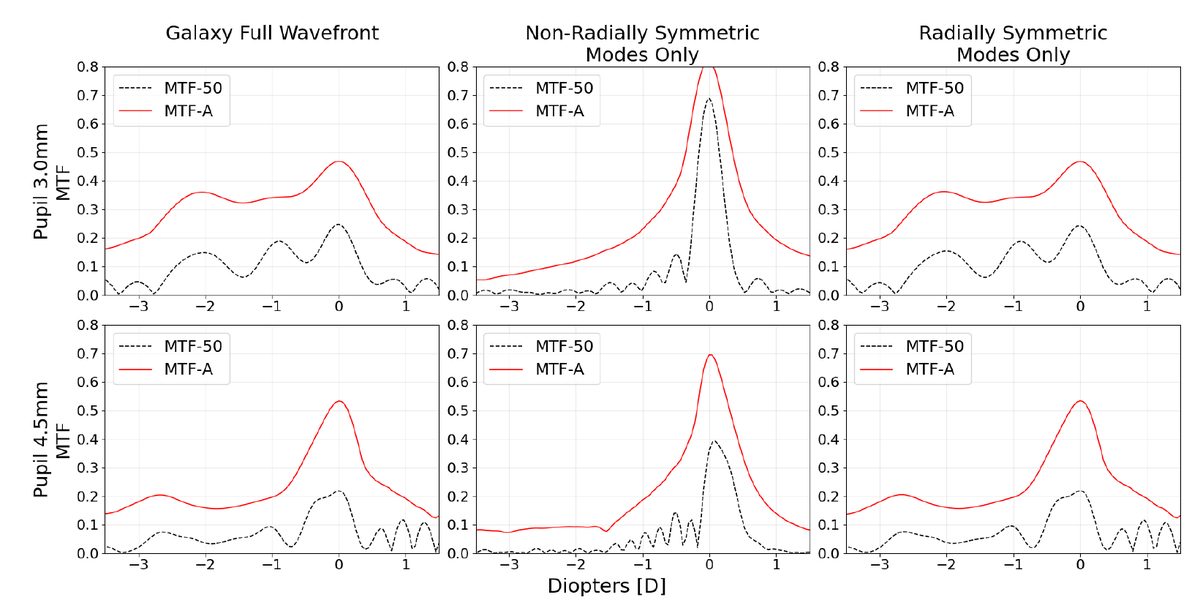
- Decomposition of the wavefront showed that the rotationally symmetric modes (m = 0) alone reproduce the entire EDOF behavior.
- The amplitude of the spiral component (about one micron) is about one order of magnitude smaller than that of the symmetric profile (about 6 microns): the spiral plays a secondary role in the depth of field.
- Compared with a diffractive trifocal lens, the through-focus curve of Galaxy is smoother and more continuous, at the price of a peak contrast lower than that of a monofocal lens.
What does this mean for patients?
This is a laboratory study, not a study in patients. It explains how a new lens of the “extended range of vision” type spreads light to allow vision at a variety of distances, and what the optical price of this is (slightly lower contrast than with a monofocal (single-focus) lens). It does not determine which lens suits whom: that is decided at the examination, according to the eye and your needs. General information for patients: EDOF Lenses and Types of Lenses in Cataract Surgery.
The study
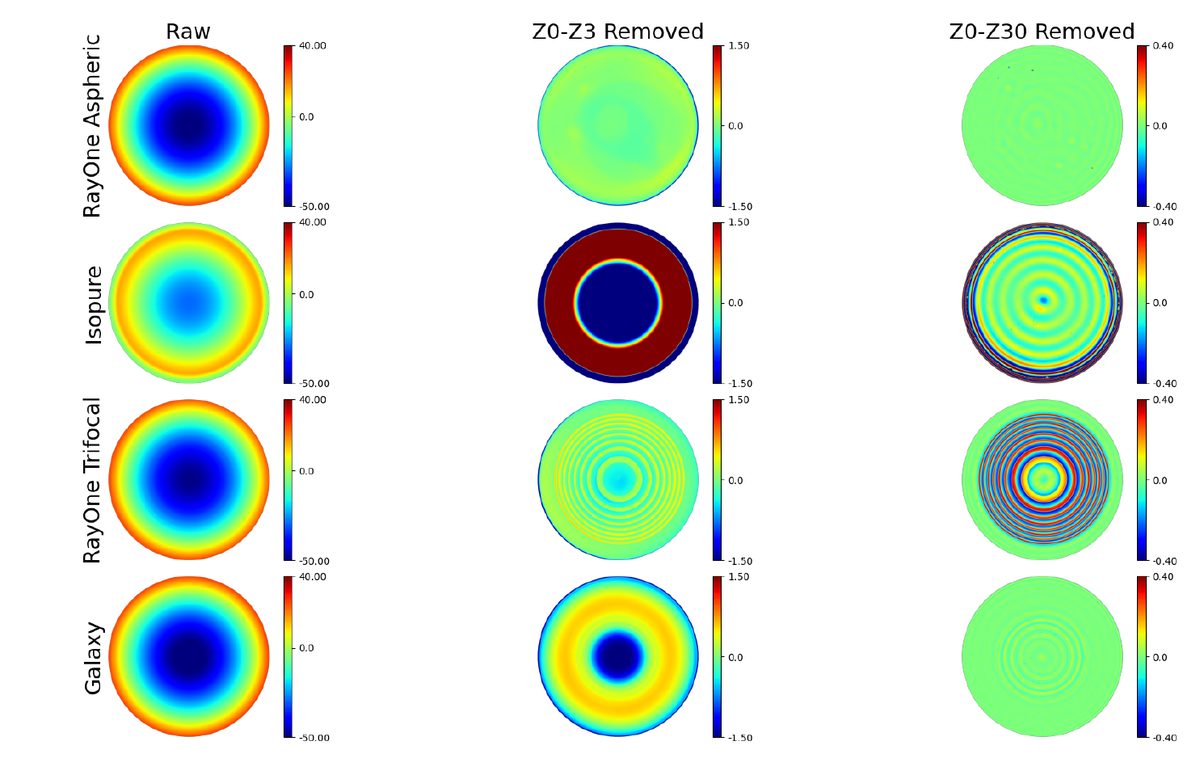
To the best of the authors' knowledge, this is the first independent in vitro optical characterization of the RayOne Galaxy, an intraocular lens with a refractive spiral surface (the manufacturer does not publish the specifications of the spiral). The work is a collaboration between Prof. Damien Gatinel, Amy Entin and Dr. Benjamin Stern. One lens of each model was measured with a high-resolution Mach–Zehnder interferometer (NIMO TEMPO, 3000×3000 sampling points, 543 nm), and the four models were compared with one another:
| Lens | Material | RI | Abbe | EDOF mechanism | Monochromatic aberrations |
|---|---|---|---|---|---|
| RayOne Aspheric | Hydrophilic acrylic | 1.46 | 56 | None (monofocal) | Neutral |
| Isopure | Hydrophobic acrylic | 1.53 | 42 | Controlled SA | Aberration-inducing |
| RayOne Trifocal | Hydrophilic acrylic | 1.46 | 56 | Trifocal diffractive pattern | Neutral |
| RayOne Galaxy | Hydrophilic acrylic | 1.46 | 56 | Refractive spiral phase modulation | Aberration-correcting |
The powers measured: Galaxy 22 D, RayOne Aspheric 20 D, RayOne Trifocal 20 D and Isopure 19 D; the differences were offset with an equivalent paraxial lens, so that all the lenses were simulated at a power of 22 D. The wavefront was decomposed into Zernike polynomials up to radial order 30 (496 modes).
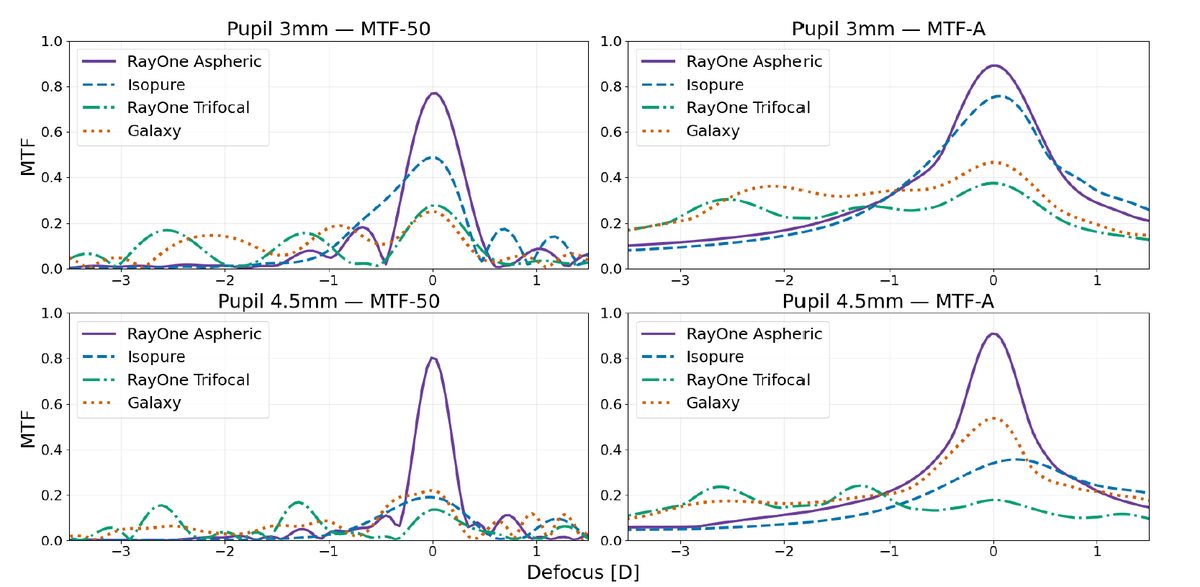
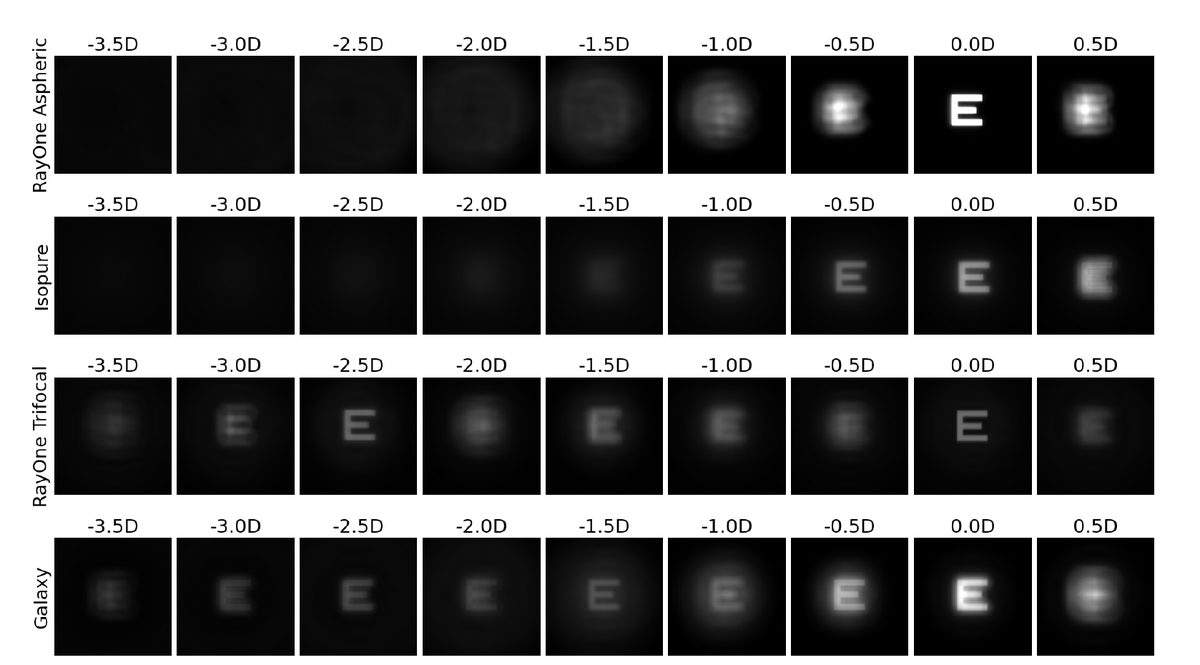
Through-focus curves (MTF at 50 lp/mm and MTFa, the mean over 0–50 lp/mm) were computed in monochromatic light (543 nm) in the Arizona pseudophakic eye model, at apertures of 3.0 mm (photopic) and 4.5 mm (mesopic), between −3.5 and +1.5 D. In addition, simulated retinal images of the letter E (Sloan, 10 arcminutes) were computed by convolution with the PSF of each lens, as were PSF maps and encircled energy curves.
Results
Through-focus curves
The peak of the curve at the distance focus, as reported in the paper:
| Lens | Peak MTF(50 lp/mm), 3.0 mm | Peak MTFa, 3.0 mm | Peak MTF(50 lp/mm), 4.5 mm | Peak MTFa, 4.5 mm |
|---|---|---|---|---|
| RayOne Aspheric | 0.77 | 0.89 | 0.80 | 0.91 |
| Isopure | 0.49 | 0.76 | 0.19 | 0.36 |
| RayOne Trifocal | 0.28 | 0.38 | 0.17 | 0.24 |
| Galaxy | 0.25 | 0.47 | 0.22 | 0.54 |
At a 3 mm aperture the distance peak of Galaxy is lower than that of the monofocal lens and of Isopure, but the curve is broader and more continuous, mainly in the intermediate range. Unlike the trifocal lens, it has no separate secondary peaks: two low secondary peaks are seen, which merge into a continuous distribution of optical quality along the defocus axis. At a 4.5 mm aperture the MTF(50 lp/mm) peak of Galaxy remained almost stable (0.25 versus 0.22) and the MTFa changed slightly (from 0.47 to 0.54), that is, refractive EDOF behavior with moderate pupil dependence. With Isopure the decline with pupil enlargement is steeper (from 0.49 to 0.19).
Simulated retinal images
At a 3 mm aperture the letter E remained recognizable with the monofocal lens only between 0 and approximately −0.5 D, with Isopure between 0 and −1.5 D, and with the trifocal lens at the distance focus and again around −1.5 to −2.5 D, with a dip in between. With Galaxy it remained recognizable continuously from 0 to approximately −2.5 D. At a 4.5 mm aperture the range of Isopure narrowed to about 1.0 D, whereas Galaxy maintained a continuous range of about 3 D, at lower contrast. The authors emphasize that this is a qualitative assessment that should be interpreted with caution.
The PSF maps and the encircled energy curves support the same picture: with the trifocal lens the light spreads into concentric rings, which are more prominent at a 4.5 mm pupil, whereas with Galaxy the energy distribution is smooth and more concentrated at the center. Its central energy concentration is lower than that of the monofocal lens and higher than that of the trifocal.
What creates the depth of field?
Zernike coefficients of SA (radial orders 4–10, over a 4.9 mm pupil, in µm, L2 normalization, Noll convention):
| SA | RayOne Aspheric | Isopure | RayOne Trifocal | Galaxy |
|---|---|---|---|---|
| Primary (Z(4,0)) | −0.002 | −1.316 | −0.073 | −0.443 |
| Secondary (Z(6,0)) | −0.007 | −0.363 | −0.019 | +0.137 |
| Tertiary (Z(8,0)) | +0.012 | −0.119 | −0.029 | −0.051 |
| Quaternary (Z(10,0)) | −0.009 | −0.026 | +0.027 | −0.007 |
Galaxy has negative primary SA (−0.443 µm) and positive secondary SA (+0.137 µm), unlike Isopure, in which all the orders are negative. According to the authors, this sign reversal increases the relative optical power at the center and may contribute to the extension of focus.
Three complementary analyses were performed. When the wavefront was split into low orders (n = 0–8) and high orders, the behavior of Isopure was reproduced almost entirely from the low orders, that of the trifocal only from the high-order residual (the diffractive rings), whereas Galaxy required both components. When the orders were built up progressively, Galaxy was already well reproduced up to n = 20, whereas the trifocal was not reproduced even at n = 30. The double spiral itself became visible only after removal of terms up to n = 40 in the central 3 mm.
Finally, the wavefront was decomposed into rotationally symmetric modes (m = 0) and non-symmetric modes (m ≠ 0), which contain the spiral, over radial orders 3–30, and each group was combined with an equivalent paraxial lens. The symmetric modes alone reproduced the entire EDOF behavior at both aperture sizes; the non-symmetric modes alone gave a narrow, high peak at the distance focus. In the wavefront maps the amplitude of the spiral component is on the order of a micron, compared with about 6 microns for the symmetric profile.
Study limitations
- One lens of each model was measured, so the variability between lenses is unknown, and the nominal powers were different (19–22 D).
- All the simulations are monochromatic (543 nm). Without chromatic aberration, the reported contrast is probably an upper limit of what can be expected in the eye.
- The lenses were analyzed without individual corneal aberrations (beyond the asphericity of the Arizona model), and sensitivity to decentration and tilt was not tested; the tolerance of a spiral surface may differ from that of a symmetric lens.
- The analysis was limited to a diameter of 4.9 mm, that is, a margin of only 0.2 mm beyond the 4.5 mm simulation aperture.
- The authors declared that they have no conflict of interest related to the paper; Prof. Gatinel is a consultant to BVI (the manufacturer of Isopure) and receives royalties.
Clinical significance
- In these measurements Galaxy behaves as a refractive EDOF lens based mainly on symmetric SA, with a wider range than that of a lens based on SA alone, a smoother and more continuous curve than that of a diffractive trifocal, and a distance peak lower than that of a monofocal.
- The findings are consistent with the first clinical data: in a multicenter series (146 eyes of 73 patients, funded by the manufacturer) the binocular defocus curve remained at 0.2 logMAR or better from +1.00 to −2.80 D, and more than 95% of the patients reported mild halos or none.
- Because the main mechanism is SA, it is reasonable to consider this lens, like other refractive EDOF lenses, in relation to the SA of the cornea and to pupil size as well; the paper itself did not test this.
- These are in vitro data, in monochromatic light and in a single model eye. They complement clinical data and do not replace them; the authors call for clinical studies of performance at different pupil sizes, of dysphotopsia and of tolerance to decentration and tilt.
The paper: Gatinel D, Entin A, Stern B. In vitro optical characterization of the RayOne Galaxy spiral extended depth-of-focus intraocular lens using high-resolution Mach–Zehnder interferometry. Biomed Opt Express. 2026;17(7):3984–4001. Read the full paper.
References
- Gatinel D, Entin A, Stern B. In vitro optical characterization of the RayOne Galaxy spiral extended depth-of-focus intraocular lens using high-resolution Mach–Zehnder interferometry. Biomed Opt Express. 2026;17(7):3984-4001. Link
- Abela-Formanek C, Amon M, Auffarth GU, et al. Performance of the first spiral refractive intraocular lens for continuous full range of vision. J Refract Surg. 2025;41(11):e1213-e1222. Link
- Villemagne N, Joannes L, Stern B, Gatinel D. On bench evaluation of intraocular lenses: performance of a commercial interferometer. Biomed Opt Express. 2024;15(11):6588-6605. Link
- Stern B, Saad A, Flamant R, Joannes L, Gatinel D. Intra-observer and inter-observer variability of intraocular lens measurements using an interferometry metrology device. Diagnostics. 2024;14(2):216. Link
- Galinier L, Renaud-Goud P, Brusau J, Kergadallan L, Augereau J, Simon B. Spiral diopter: freeform lenses with enhanced multifocal behavior. Optica. 2024;11(2):238. Link