

In brief
- EDOF stands for Extended Depth of Focus: the lens stretches a single focus into a continuous range, instead of splitting the light into several separate focal points.
- It gives very good distance and intermediate vision (computer, car dashboard), usually with fewer halos than a multifocal lens.
- Reading small print often requires weak reading glasses.
- Most refractive EDOF lenses are sensitive to pupil size and to the shape of the cornea, so the measurements before surgery are especially important.
What is an EDOF lens?
A standard monofocal lens focuses light to a single sharp point. A multifocal lens splits it into two or three separate points. An EDOF lens does a third thing: it elongates the zone of focus, so that instead of a single point there is a “stretch” of good vision, from distance down to computer distance.
Like all premium lenses, an EDOF lens is an optical compromise: you give up a little sharpness at one point in order to gain a deeper range. When the compromise is made in the right dose, the brain fills in the rest.
How does an EDOF lens work?
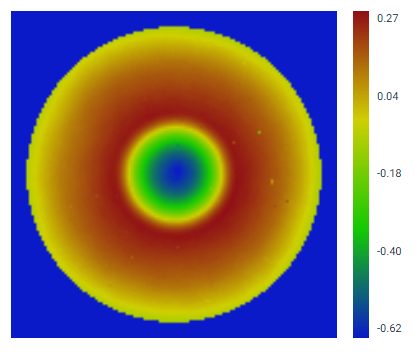
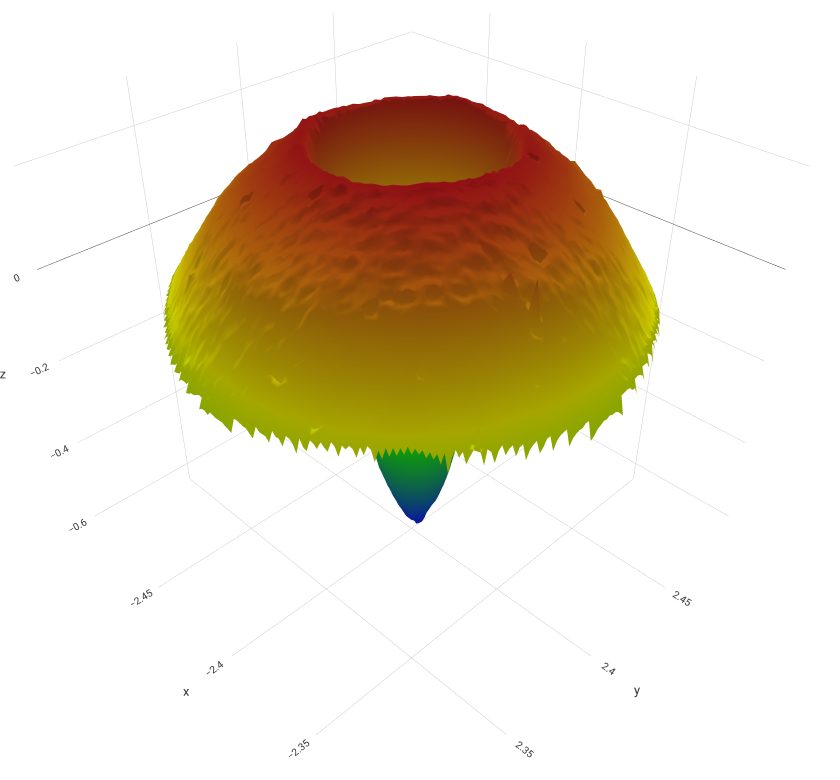
Many of the newer EDOF lenses are refractive: they have no diffractive rings, only a subtle change in curvature at the center of the lens. The central zone, about 2 mm in diameter in some models, is slightly stronger than the rest of the lens. Optically, this creates a controlled “spherical aberration,” a distortion that elongates the focus without distorting the image very much.
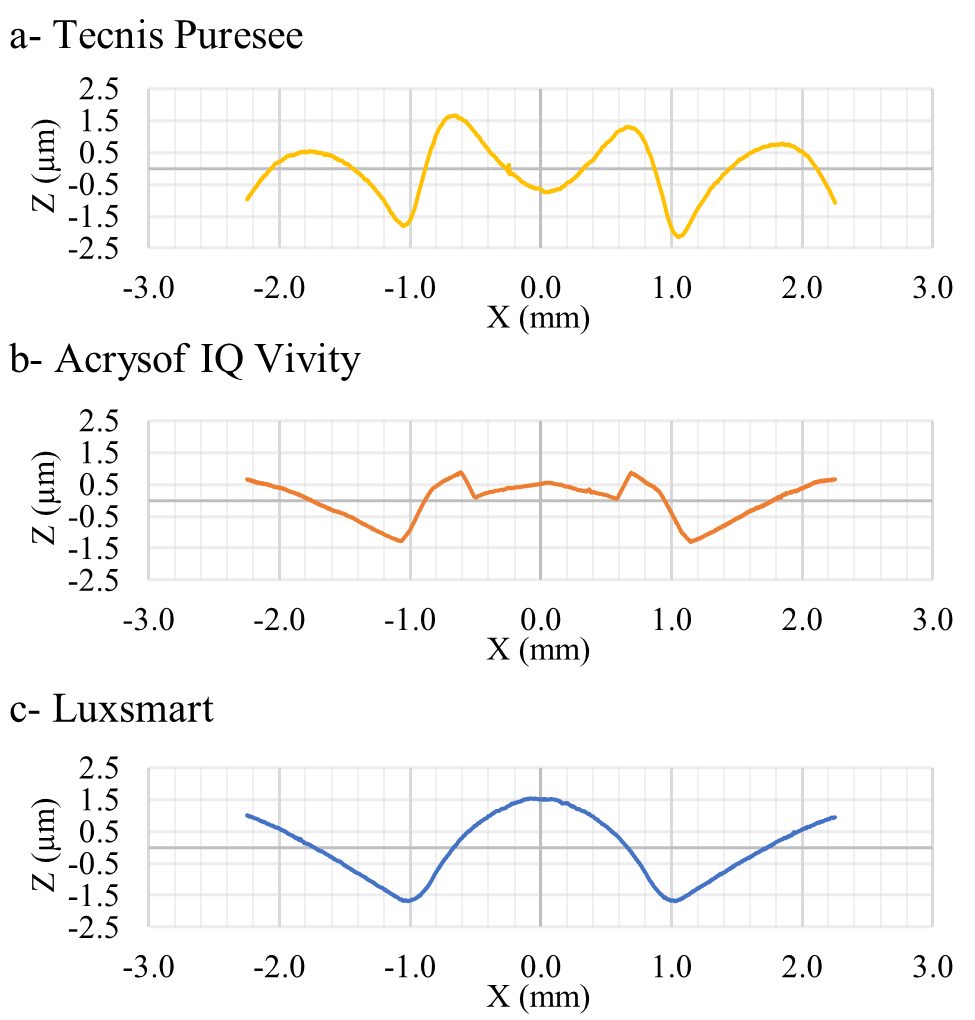
This kind of design has a further advantage: when you look at something close, the pupil naturally constricts, and more of the light passes through the strong center of the lens, exactly when it is needed.
There are also diffractive EDOF lenses, with fewer and wider rings than a multifocal lens (with these, halos are more common than with the refractive lenses), and “monofocal plus” lenses: enhanced monofocal lenses that add only a small amount of depth of focus, with almost no halos.
EDOF versus multifocal and monofocal lenses
| EDOF | Multifocal (trifocal) | Monofocal | |
|---|---|---|---|
| Principle | One elongated focus | Several separate focal points | One sharp focus |
| Distance | Excellent | Good | Excellent |
| Intermediate (computer) | Very good | Good | Usually with glasses |
| Near (reading) | Moderate – large print | Good | With glasses |
| Halos and glare | Few | More common | Minimal |
| Sensitivity to pupil size | Usually high | Moderate | Relatively low |
Advantages and disadvantages of an EDOF lens
Advantages
- Continuous vision from distance down to the computer, with no “jump” between focal points.
- Fewer halos and less glare than with a multifocal lens.
- Little loss of contrast: with refractive EDOF lenses it is close to that of a monofocal lens, and usually better than that of a multifocal lens.
Disadvantages and limitations
- Moderate near vision: small text or reading in dim light often requires weak reading glasses.
- Slightly less sharpness than a monofocal lens, at the focus itself.
- Sensitivity to pupil size: with some lenses, when the pupil is very small, for example in bright sunlight, the eye may become slightly nearsighted (“daytime nearsightedness”). When the pupil is very large, the effect of the central zone weakens, and intermediate vision may be less good.
- Sensitivity to the shape of the cornea: the same lens performs differently in a cornea with different aberrations.
Dr. Stern has studied the last two points in the laboratory.
Marketing names and what lies behind them
Lens manufacturers compete in a large market, and every new lens comes with a new marketing term: “wavefront stretching,” “pure refractive optics” and so on. When the lenses are tested in the laboratory, it turns out that most of them are based on the same familiar optical principles, each with its own profile. That is why Dr. Stern recommends judging a lens by how it will behave in your eye, not by its name.
An EDOF lens after laser eye surgery: a common myth
It is commonly thought that after laser vision correction (LASIK or PRK) it is better to choose an EDOF lens, because it is more “forgiving” of a small error in the lens power calculation. Sometimes that is true, and sometimes it is not.
After laser treatment for nearsightedness, the cornea itself usually has more spherical aberration of one type (positive), and many EDOF lenses add aberration of the opposite type. The two effects can cancel each other out, and then the eye behaves almost as if a standard monofocal lens had been implanted, without the depth of focus that was expected. After laser treatment for farsightedness the situation is reversed: the cornea and the lens may amplify each other. That is why, in an eye that has had laser surgery, the model is chosen on the basis of a full measurement of the cornea. See Cataract Surgery After Laser Eye Surgery.
Who is an EDOF lens suitable for?
- People who want good distance and computer vision without glasses, and are willing to use reading glasses for small text.
- People who drive a lot at night or are worried about halos.
- Sometimes also eyes that are not suitable for a multifocal lens, at the surgeon's discretion.
To improve near vision, the non-dominant eye can sometimes be targeted for mild nearsightedness (mini-monovision). As with any premium lens, an eye with a disease of the retina or optic nerve, or an irregular cornea, calls for careful consideration. All the lens types are compared on the Types of Intraocular Lenses page, and the selection process is described in the guide to choosing a multifocal lens.
Frequently asked questions
What is the difference between an EDOF lens and a multifocal lens?
A multifocal lens splits the light into several separate focal points: distance, intermediate and near. An EDOF lens elongates a single focus into a continuous range from distance down to the computer. With EDOF there are fewer halos, but near vision is weaker.
Can you read without glasses with an EDOF lens?
Large text and a phone screen: often, yes. For prolonged reading of small print, or in dim light, many people use weak reading glasses.
Does an EDOF lens cause halos at night?
Usually fewer than a multifocal lens. With refractive EDOF lenses halos are few, but not zero, and they also depend on pupil size and the cornea. With diffractive EDOF lenses they are more common.
What is a "monofocal plus" lens?
An enhanced monofocal lens that adds a small amount of depth of focus for intermediate vision, with almost no halos. It sits between a standard monofocal lens and an EDOF lens.
References
- Stern B, Gatinel D. Presbyopia Correction in Lens Replacement Surgery: A Review. Clin Exp Ophthalmol. 2025;53(6):668-681. Link
- Zhong Y, Wang K, Yu X, Liu X, Yao K. Comparison of trifocal or hybrid multifocal-extended depth of focus intraocular lenses: a systematic review and meta-analysis. Sci Rep. 2021;11:6699. Link
- Stern B, Gatinel D. Impact of pupil size and corneal spherical aberrations on the performance of monofocal intraocular lenses: an experimental model. Biomed Opt Express. 2024;15(11):6433-6448. Link
- Bottos KM, Leite MT, Aventura-Isidro M, et al. Corneal asphericity and spherical aberration after refractive surgery. J Cataract Refract Surg. 2011;37(6):1109-1115. Link