

In brief
- In refractive lens exchange (RLE) the natural lens is removed and an intraocular lens is implanted in its place, exactly as in cataract surgery, but before a significant cataract has developed.
- It is suitable mainly after age 45 to 50: for farsightedness with presbyopia, for high farsightedness, and for people in whom changes in the lens are beginning.
- You can choose a lens for distance only, monovision, an EDOF lens or a multifocal lens. Each choice has its own drawback: reading glasses, less depth perception or halos at night.
- This is intraocular surgery, with the risks of cataract surgery. In high myopia (severe nearsightedness) the risk of retinal detachment is higher, so it is considered with caution.
- After the surgery a cataract will not develop, but the natural focusing ability of the lens is also lost.
What is refractive lens exchange (RLE)?
The natural lens sits behind the iris. In young people it is flexible and changes its shape to focus up close. Over the years it stiffens (presbyopia), and later it becomes cloudy (cataract). In lens exchange, also called clear lens exchange or RLE (Refractive Lens Exchange), the natural lens is removed while it is still clear, and an artificial lens with a power that corrects the prescription is implanted in its place.
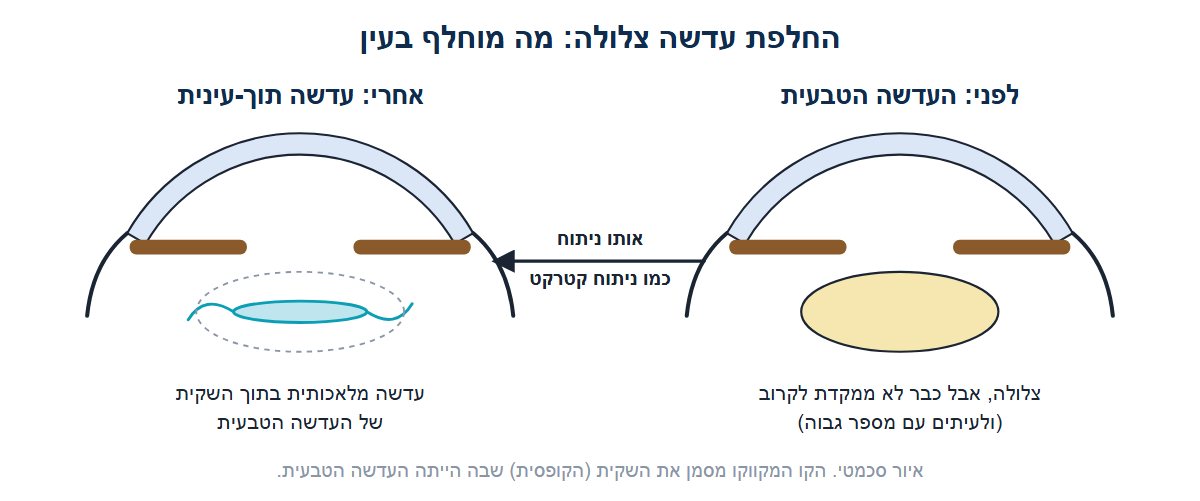
Technically this is cataract surgery in every respect: the same small incision, the same machine and the same lenses. The difference is in the goal. In cataract surgery the main goal is to restore vision that has been impaired, and in lens exchange the goal is to reduce dependence on glasses in an eye that sees well with glasses. Expectations of the result are therefore higher too, and the tests and the conversation before the decision are especially important. The course of the surgery itself is explained in the Guide to Cataract Surgery.
Who is lens exchange suitable for?
- Farsightedness with presbyopia: this is the classic group. Over age 45 to 50, people with farsightedness usually need glasses for both distance and near, and laser corrects farsightedness less well than nearsightedness.
- High farsightedness: beyond the range that laser corrects well, lens exchange is sometimes the only surgical option. In a small eye with a shallow anterior chamber it also widens the space inside the eye and reduces the risk of angle-closure glaucoma.
- Early changes in the lens: when the lens is already starting to become cloudy and the cataract is expected to progress, it is better to treat the lens than the cornea.
- Presbyopia without a significant distance prescription: in selected cases, with a lens that also corrects near vision. Here the decision is especially delicate, because you are giving up a natural lens that sees well at distance.
- High myopia after age 45 to 50: possible, but because of the risk to the retina the decision is more cautious (see below).
In people who still focus well up close, usually before age 40 to 45, lens exchange removes an ability that still exists, so at that age laser or an ICL lens is usually preferred.
Which lenses can you choose?
The choice of lens is no less important than the surgery itself. In the review by Dr. Stern and Prof. Damien Gatinel (2025) the lenses are classified according to the depth of focus they provide:
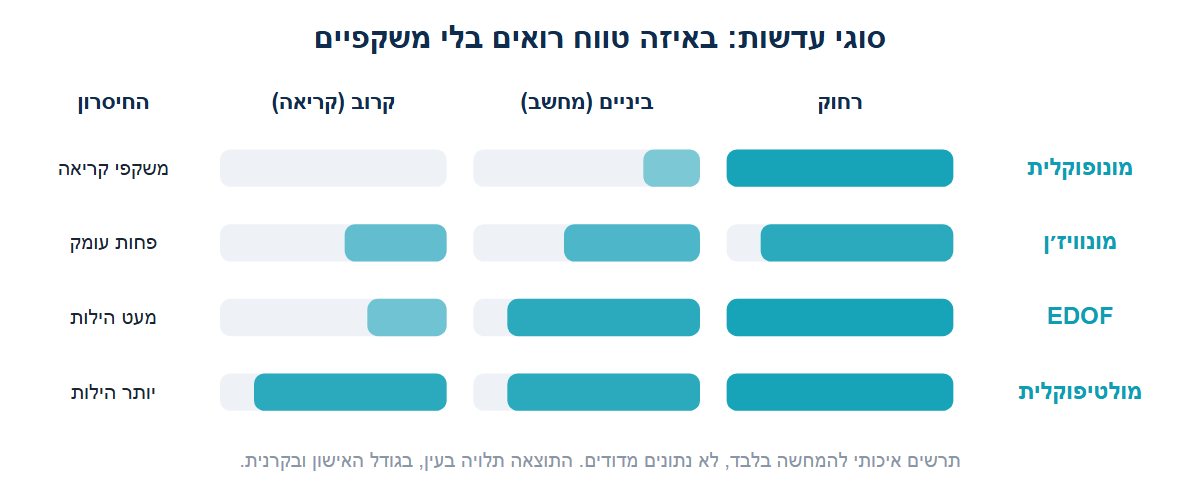
- Monofocal lens: sharp distance vision and glasses for reading. The simplest, with the fewest light phenomena.
- Monovision: one eye is set for distance and the other for mild nearsightedness, in Dr. Stern's practice −1.50 D. The range is similar to that of an EDOF lens: distance and intermediate without glasses, and reading glasses for small print. Its main drawback is a reduction in three-dimensional vision (depth perception). It is worth trying it first with contact lenses (Monovision).
- EDOF lens (extended depth of focus): a continuous range from distance to the computer, with few halos. Glasses are sometimes still needed for reading small print (EDOF Lenses).
- Multifocal (trifocal) lens: according to the review, it is still the most effective option for full correction of presbyopia. In a pooled analysis of studies, about 80% of patients with such lenses managed without glasses. The price is halos around lights at night and some reduction in contrast, which most patients get used to (How to Choose a Multifocal Lens).
When there is astigmatism, each of these lenses is also available in a toric version. Multifocal lenses are especially sensitive to a residual prescription, to an irregular cornea and to dry eye, so they are not suitable for every eye. Disease of the macula, for example, is usually a reason to forgo them. An organized comparison of the lens types can be found on the Types of Lenses in Cataract Surgery page.
What are the risks of lens exchange?
The risks are the same as those of cataract surgery: infection inside the eye (very rare), swelling in the center of the retina, a rise in eye pressure, a residual prescription and secondary clouding of the capsule, which is treated with YAG laser (Secondary Cataract). When a bothersome prescription remains, it can be corrected with laser on the cornea or by exchanging the lens. A residual prescription is more noticeable with multifocal lenses.
Retinal detachment in high myopia
This is the most important consideration in nearsightedness. An eye with high myopia is longer than usual, and its risk of retinal detachment is high even without surgery. Removing the lens raises the risk further, mainly when the length of the eye is 26 mm or more, at a young age (under 50), in men, and after a complication during surgery or YAG laser treatment. In studies of lens exchange in high myopia, retinal detachment was reported in about 1% to 2% of eyes, and in some series in up to about 8% over years of follow-up. In farsightedness the risk is much lower.
For this reason, before lens exchange in nearsightedness the peripheral retina is examined carefully, holes or weak spots are treated if they are found, and the signs that require an urgent examination are explained.
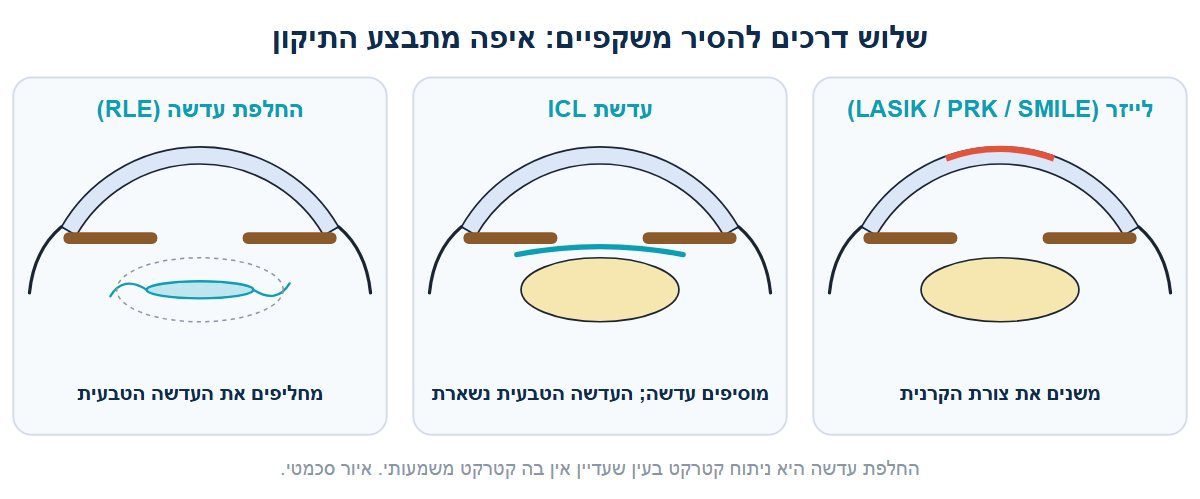
Lens exchange, laser or ICL: what is the difference?
| Laser (LASIK / PRK) | ICL lens | Lens exchange (RLE) | |
|---|---|---|---|
| Typical age | Young adults, as long as the lens is clear | Young adults, as long as the lens is clear | Usually over 45 to 50 |
| What is corrected | Nearsightedness, farsightedness and astigmatism within a limited range | Mainly nearsightedness, including high myopia | Almost any prescription, and also presbyopia depending on the type of lens |
| Natural near focus | Preserved (until presbyopia develops) | Preserved | Lost; the artificial lens compensates partly or fully |
| Cataract in the future | Can develop | Can develop, sometimes earlier | Will not develop |
| Type of surgery | On the cornea | Intraocular | Intraocular |
| Reversibility | No | The lens can be removed | The lens can be exchanged, but that is more complex surgery |
The options for getting rid of reading glasses after age 40 are brought together on the Surgery for Presbyopia page.
How is the surgery done, and how long is the recovery?
Before surgery the eye is measured optically (biometry) to calculate the lens power, the cornea is mapped, and the macula and the peripheral retina are examined. The surgery is usually done under local anesthesia. In most cases one eye is operated on and then the other, days or weeks apart, and some centers operate on both on the same day (Surgery on Both Eyes on the Same Day). Recovery is similar to recovery after cataract surgery (Instructions After Cataract Surgery), and you do not drive for at least a week after the surgery.
Dr. Stern is a cataract surgeon at Hadassah, and he researches the optics of intraocular lenses. You can read about cataract surgery with him on the Cataract Surgeon in Jerusalem page.
Frequently asked questions
What is the difference between lens exchange and cataract surgery?
The surgery itself is the same: the natural lens is removed and an intraocular lens is implanted. The difference is in the reason. In cataract surgery the lens is cloudy and impairs vision. In lens exchange it is still clear, and the goal is to reduce dependence on glasses.
From what age is lens exchange suitable?
Usually over age 45 to 50, when the natural lens has already lost most of its ability to focus up close. At a younger age the surgery removes natural focusing that still exists, so laser or an ICL lens is usually preferred.
Can you get a cataract after lens exchange?
No. The natural lens has been removed, and the artificial lens does not become cloudy. In some patients the capsule behind the lens later becomes cloudy (secondary cataract), and this is treated with a brief YAG laser procedure in the clinic.
Is lens exchange dangerous for people with nearsightedness?
In high myopia the risk of retinal detachment after the lens is removed is higher, mainly in a long eye, at a young age and in men. For this reason the retina is examined carefully before surgery, and sometimes an alternative such as an ICL lens is preferred. In farsightedness the risk is much lower.
Can you get rid of reading glasses as well?
Yes, to a degree that depends on the type of lens. A multifocal lens gives the greatest independence up close, with halos at night. An EDOF lens gives good vision down to computer range. Monovision gives partial independence at the expense of depth perception. The choice is made according to the eye and your lifestyle.
References
- Stern B, Gatinel D. Presbyopia correction in lens replacement surgery: a review. Clin Exp Ophthalmol. 2025;53(6):668-681. Link
- Taravella MJ, Lee BS, Garg S, et al. 2025–2026 Basic and Clinical Science Course, Section 13: Refractive Surgery. San Francisco: American Academy of Ophthalmology; 2025.
- Alió JL, Grzybowski A, El Aswad A, Romaniuk D. Refractive lens exchange. Surv Ophthalmol. 2014;59(6):579-598. Link
- Rosen E, Alió JL, Dick HB, Dell S, Slade S. Efficacy and safety of multifocal intraocular lenses following cataract and refractive lens exchange: metaanalysis of peer-reviewed publications. J Cataract Refract Surg. 2016;42(2):310-328. Link
- Alió JL. Lens surgery (cataract and refractive lens exchange) and retinal detachment risk in myopes: still an issue? Br J Ophthalmol. 2011;95(3):301-303. Link