

In brief
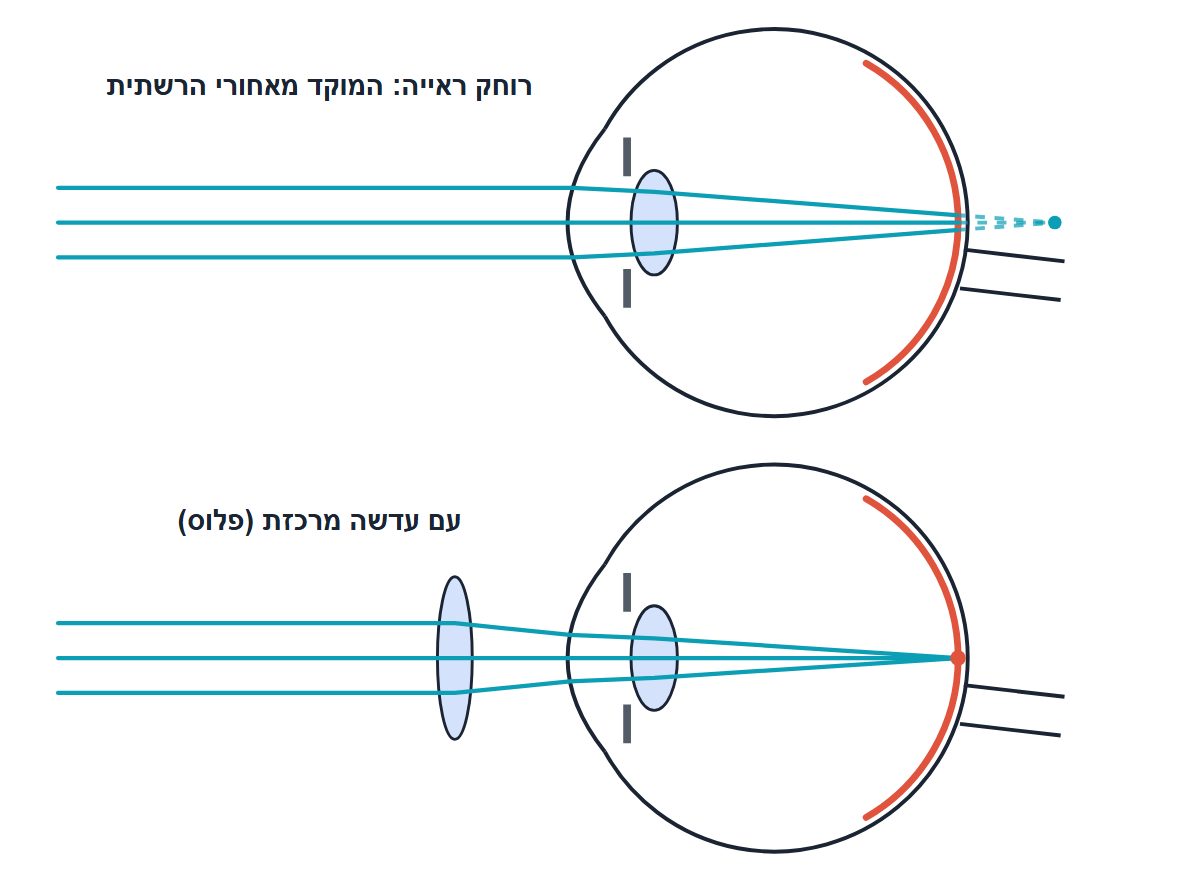
- In farsightedness the focal point falls behind the retina, because the eye is too short or the cornea and the lens are too weak.
- At a young age the lens compensates for the error with constant effort, so the main symptoms are eye fatigue and headaches, and not necessarily blur.
- Farsightedness is not presbyopia, but it brings forward the need for reading glasses, and later causes blur at a distance as well.
- A short eye is at increased risk of angle-closure glaucoma. Sudden pain in the eye with blurred vision requires immediate care.
What is farsightedness?
In farsightedness (hyperopia, or hypermetropia), the focusing power of the cornea and the lens is too low relative to the length of the eye. In most cases the eye is simply shorter than usual. Light from a distant object “reaches the retina too early,” before it has had time to come to a focus, and the focal point lies, in theory, behind the retina.
Unlike nearsightedness, here the eye can correct part of the error by itself. The natural lens can add power when the ciliary muscle contracts, the same mechanism that is used for reading (accommodation). Young people with mild to moderate farsightedness therefore see well at a distance, but their muscle almost never rests: it works in order to see far, and works even harder in order to see near.
Farsightedness or presbyopia?
The names are confusing, but these are two different things:
- Farsightedness is a feature of the structure of the eye: a short or “weak” eye. It remains throughout life.
- Presbyopia (age-related loss of near focus) is a gradual loss of the ability to focus up close, which happens to everyone with age, usually from the age of 40 to 45.
The two affect each other. A person with farsightedness already uses part of their focusing ability for distance vision, so when this ability declines with age, they need reading glasses earlier, sometimes as early as their late thirties. Later the lens can no longer compensate for distance either, and the person suddenly “discovers” that they need glasses for both distance and near.
Symptoms of farsightedness
- Eye fatigue, burning or headaches after reading or prolonged work at a screen.
- Blur when reading, which gets worse in the evening and when you are tired.
- Difficulty concentrating during long reading, and a need for more light.
- With higher farsightedness, and especially after age 40: blur at a distance as well.
Many people discover their farsightedness only in their forties, when the lens stops compensating. There is no danger in this, but suitable glasses greatly improve comfort.
How is it diagnosed?
The exam includes a computerized measurement and a test in front of a letter chart with lenses that are switched. Because the lens continues to compensate during the exam as well, part of the farsightedness may remain “hidden.” When this is suspected, mainly in young adults with symptoms, drops are given that temporarily relax the focusing muscle and reveal the full prescription. The drops dilate the pupil and blur vision, mainly up close, for a few hours, and sometimes until the next day.
In significant farsightedness, the depth of the anterior chamber and the drainage angle of the eye are also examined, in order to identify in advance a risk of angle-closure glaucoma (see below).
Ways to correct it
Glasses
A converging (plus) lens adds the missing power and brings the focal point forward onto the retina. With low prescriptions, glasses for reading and the computer alone are sometimes enough; with age, people usually move to wearing glasses all the time, and after age 40 to multifocal glasses as well.
Contact lenses
Soft contact lenses are also suitable for farsightedness, and there are also toric lenses and multifocal contact lenses for those who already need an addition for reading.
Laser eye surgery
In farsightedness the laser adds curvature to the center of the cornea, in order to increase its power. The treatment is suitable for a narrower range of prescriptions than in nearsightedness, and the tendency for the prescription to come back partially over the years is greater. A stable prescription and a healthy cornea are required. For details, see The Guide to Laser Vision Correction and the page Laser Eye Surgeon in Jerusalem. It is important to keep the records of the surgery: years later, at cataract surgery, calculating the lens in an eye that has had laser surgery requires special formulas (Cataract Surgery After Laser Eye Surgery).
Lens exchange
After about age 50, when farsightedness and presbyopia combine, and especially when a cataract is beginning, the natural lens can be replaced with an intraocular lens whose power is calculated so that the farsightedness is corrected. The choice of lens can also address reading, with a multifocal lens, an EDOF lens or monovision (Types of Lenses in Cataract Surgery, Choosing a Multifocal Lens). In a short eye with a narrow angle, exchanging the lens also frees up space in the front part of the eye and widens the angle.
Farsightedness and angle-closure glaucoma
In a short eye the front part is more crowded. The natural lens continues to grow throughout life and pushes the iris forward, and in some people the drainage angle, through which fluid leaves the eye, becomes narrower and narrower. If it closes all at once, the pressure in the eye rises quickly. This is an emergency.
An eye exam can identify a narrow angle in good time, and it can be treated preventively with laser (a small opening in the iris) or with lens surgery.
Frequently asked questions
Is farsightedness the same thing as presbyopia?
No. Farsightedness is a feature of the structure of the eye, an eye that is too short or too weak, and it remains throughout life. Presbyopia is a loss of the ability to focus up close that happens to everyone with age. People with farsightedness feel presbyopia earlier.
Why do I suddenly need glasses for distance too after age 40?
At a young age the flexible lens compensates for farsightedness without your noticing. When its flexibility declines over the years, it can no longer compensate, and the farsightedness that was always there comes to light, first for near and later for distance as well.
I see well, so why were glasses recommended for me?
With farsightedness you can see sharply and still be straining all the time. When there is eye fatigue or headaches with reading and screens, glasses take the effort off the eye. Wearing them does no harm.
Is laser eye surgery suitable for farsightedness?
Sometimes yes, for a narrower range of prescriptions than in nearsightedness, and provided that the prescription is stable and the cornea is healthy. After about age 50, lens exchange is often considered instead of laser. Suitability is determined at an examination.
What is the link between farsightedness and glaucoma?
In a short eye the front part is crowded, and the drainage angle of the eye may be narrow and may close. An eye exam identifies a narrow angle in advance, and it can be treated preventively. Sudden pain in the eye with blur, halos and headache requires immediate care at an eye emergency room.
References
- American Academy of Ophthalmology. Basic and Clinical Science Course (BCSC), Section 3: Clinical Optics. San Francisco: American Academy of Ophthalmology; 2018–2019.
- Chuck RS, Jacobs DS, Lee JK, et al. Refractive Errors & Refractive Surgery Preferred Practice Pattern. Ophthalmology. 2018;125(1):P1-P104. Link
- American Academy of Ophthalmology. Basic and Clinical Science Course (BCSC), Section 10: Glaucoma. San Francisco: American Academy of Ophthalmology; 2018–2019.
- Azuara-Blanco A, Burr J, Ramsay C, et al. Effectiveness of early lens extraction for the treatment of primary angle-closure glaucoma (EAGLE): a randomised controlled trial. Lancet. 2016;388(10052):1389-1397. Link
- American Academy of Ophthalmology. Basic and Clinical Science Course (BCSC), Section 11: Lens and Cataract. San Francisco: American Academy of Ophthalmology; 2018–2019.