

In brief
- Presbyopia (age-related loss of near focus) is caused by stiffening of the natural lens. Laser treatment of the cornea does not restore its flexibility, so all the surgical solutions are “workarounds.”
- The main options: laser monovision (one eye for distance, and mild nearsightedness in the other eye), and lens exchange with a multifocal lens, an EDOF lens or monovision.
- Every solution has a drawback: less three-dimensional vision with monovision, halos at night with multifocal lenses, and with all of them glasses are sometimes still needed for certain tasks.
- Drops that make the pupil smaller improve near vision for a few hours, but they do not cure presbyopia.
- It is worth trying monovision with contact lenses before any decision about surgery.
Why do you need reading glasses after age 40?
To see clearly up close, the natural lens becomes rounder and adds focusing power. Over the years it stiffens, and around age 40 to 45 the power that remains is no longer enough for comfortable reading. This happens to everyone, including people who have seen perfectly all their lives. The process is explained on the Presbyopia page.
Because the problem is in the lens and not in the cornea, there is still no surgery that restores the natural focusing ability. Operations that tried to do so, for example on the white of the eye (the sclera), have not proven themselves, and “accommodating” lenses have not reached the level of a practical solution either. What works today are solutions that divide the work between the two eyes, or between different zones of the lens.
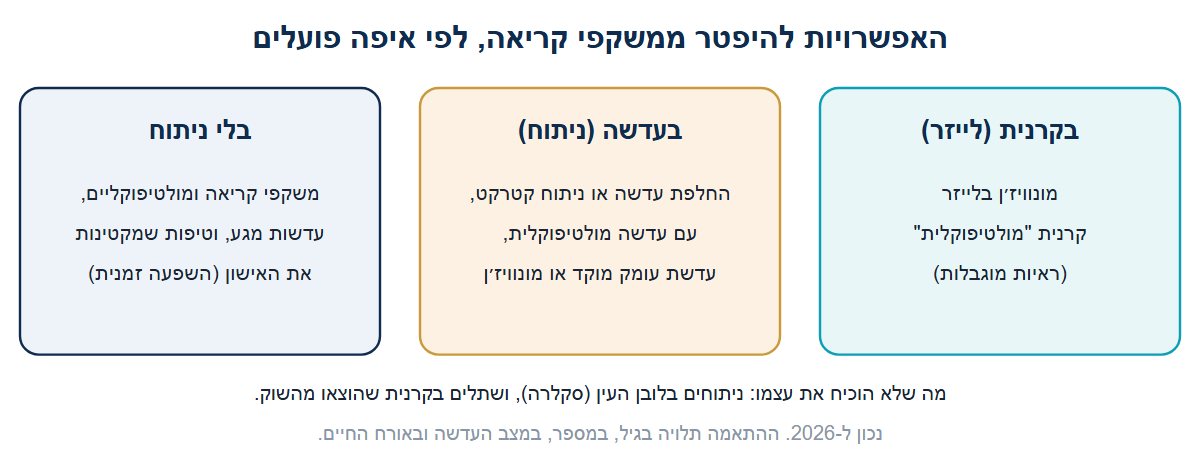
Laser monovision: one eye for distance and one eye for intermediate vision
In monovision, the dominant eye is set for sharp distance vision and the other eye for mild nearsightedness, so that it is sharp in the intermediate range. The brain learns to use each eye for its own range. In laser eye surgery (LASIK or PRK) this is done by a deliberate partial correction of the other eye. The Guide to Laser Vision Correction explains that in most cases Dr. Stern focuses both eyes for distance, and monovision is planned only for those it suits.
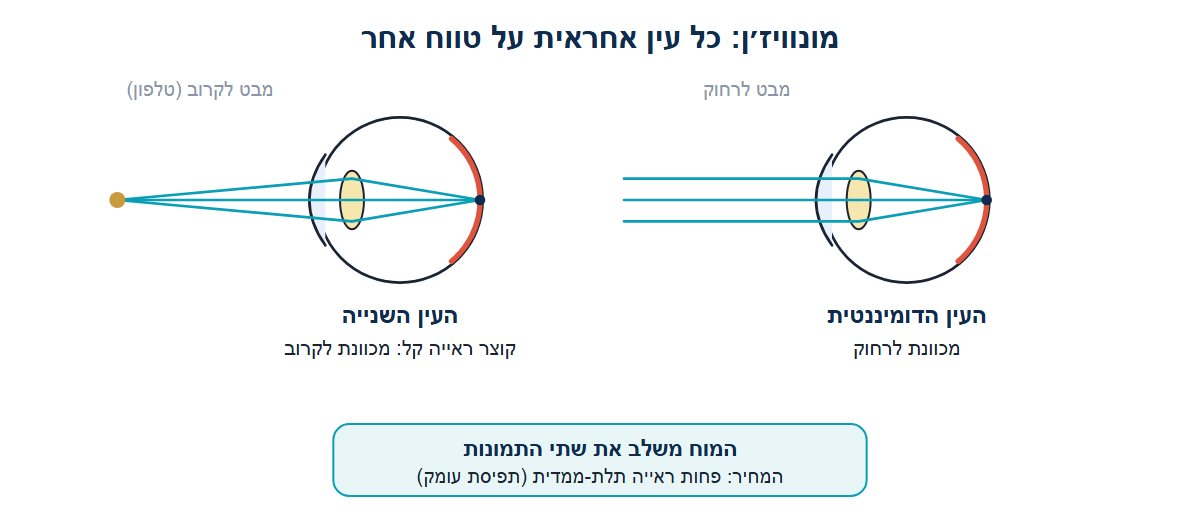
- The size of the difference: in Dr. Stern's practice the other eye is set for nearsightedness of −1.50 D, and no more. This gives good vision in the intermediate range, for example at a computer, and makes reading on a phone easier; small print and prolonged reading of a book still require glasses. A smaller difference (mini-monovision) better preserves distance vision and depth perception, and suits some cases.
- The drawbacks: the main drawback is a reduction in three-dimensional vision (depth perception), as the review by Dr. Stern and Prof. Gatinel (2025) also emphasizes. In addition, at night the eye that is set for near sees less sharply and with more glare, and glasses may be needed for night driving or prolonged reading.
- Who it suits: the best candidates are people over age 40 with nearsightedness who are used to reading without glasses. People with strabismus or a history of a “lazy” eye need special caution. Dr. Stern does not offer monovision to anyone with a latent strabismus, which the difference between the eyes could make worse. Monovision is also not suitable for people who read small print for hours, for example those who study Talmud with Rashi script.
- A trial before deciding: monovision is tried with contact lenses for a few days. That way you know in advance whether adaptation is easy.
It is important to know that presbyopia keeps progressing until about age 60. Monovision that works at age 45 may no longer be enough for reading a few years later. In a large case series of LASIK monovision, a large majority of patients were satisfied, and a small minority asked to have the near eye corrected for distance. More on this on the Monovision page.
PresbyLASIK: a “multifocal” cornea
In these techniques the laser creates zones of different power on the cornea, or deliberately increases a particular optical aberration to extend the depth of focus, sometimes combined with mild monovision. Some centers use them, but the evidence is still limited: a systematic review from 2023 found that most of the studies are case series with no comparison group, and the only proven advantage was in combining such a profile with a small amount of monovision. The possible price is some loss of sharpness and contrast at distance. It is worth asking how much experience the center has with the technique, and what is done if the result is not good.
Lens exchange: the most complete solution, and also the biggest surgery
After age 45 to 50, and especially when there is farsightedness or early changes in the lens, the natural lens can be replaced with an intraocular lens that also corrects near vision (Refractive Lens Exchange). In cataract surgery the patient has the same options. According to Dr. Stern's review, these lenses are divided according to the depth of focus they provide:
- Multifocal (trifocal) lens: the most effective option for full correction of presbyopia. The price is halos around lights at night and some reduction in contrast (How to Choose a Multifocal Lens).
- EDOF lens (extended depth of focus): a partial correction, good for distance and for the computer, with fewer halos (EDOF Lenses).
- Monovision with monofocal lenses: the same principle as with laser, with the same price in depth perception. In Dr. Stern's practice the other eye is set for nearsightedness of −1.50 D, and the resulting range is similar to that of an EDOF lens.
- Combinations (“mix and match”): different lenses in the two eyes, for example a distance lens in one eye and a multifocal lens in the other.
This is intraocular surgery, with the risks of cataract surgery, so it is less suitable for someone whose lens is clear and who sees perfectly at distance without glasses.
Drops for presbyopia: what do they do?
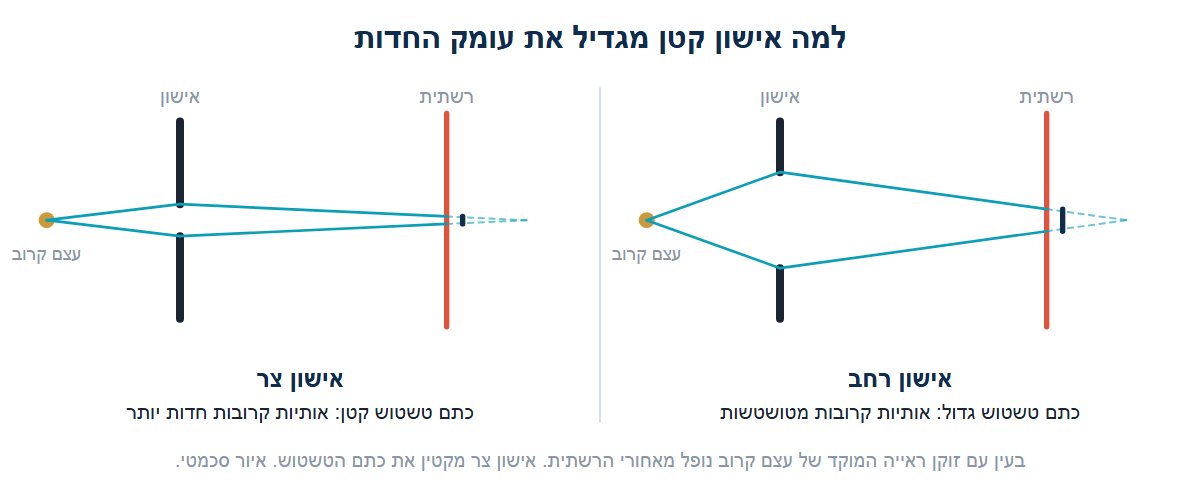
The first drop approved for presbyopia in the United States (in 2021) is based on low-dose pilocarpine, and other preparations are in development (as of 2026). These drops constrict the pupil, and a narrow pupil increases the depth of focus, like the small hole of a pinhole camera. In the large study that led to the approval, about a third of users read at least three additional lines on the reading chart after three hours, compared with about 8% of the control group. The effect begins within about a quarter of an hour and lasts a few hours. The most common side effect was headache, and vision in the dark may be dimmer. Because of a rare concern about retinal problems, they are used only after an eye exam, including a retinal exam. They do not cure presbyopia, and their effect disappears when they are stopped.
What really works, and for whom?
| Solution | Best suited to... | What you get | Drawback |
|---|---|---|---|
| Glasses or contact lenses | Everyone | Sharp vision, with no risk | Dependence on glasses |
| Laser monovision | Over age 40, a clear lens, people who have adapted to monovision with contact lenses | Distance, computer and phone without glasses; small print still requires glasses | Less depth perception; may no longer be enough over the years |
| PresbyLASIK | At centers that specialize in it | A wider range from a single cornea | Limited evidence; possible loss of sharpness at distance |
| Lens exchange with a multifocal or EDOF lens | Over age 45 to 50, especially with farsightedness or changes in the lens | The most complete correction; a cataract will not develop | Intraocular surgery; halos at night |
| Drops | Used as needed, for those who do not want surgery | Better near vision for a few hours | Temporary effect; headache; dim vision in the dark |
If you are considering laser eye surgery in your 40s, it is also worth learning about suitability for laser eye surgery and the differences between the techniques. Dr. Stern performs LASIK and PRK surgery, including monovision when it is suitable, at the Ein Tal Hadassah center in Jerusalem (Laser Eye Surgeon in Jerusalem).
Frequently asked questions
Can laser eye surgery eliminate the need for reading glasses?
Not in the sense of restoring the ability to focus. The laser changes the cornea, and presbyopia comes from the lens. It can be partly worked around with monovision, in which one eye is set for distance and mild nearsightedness is left in the other, at the cost of less depth perception.
What is monovision, and how do I know if it is right for me?
In monovision the dominant eye is set for distance, and mild nearsightedness is left in the other eye: in Dr. Stern's practice, minus 1.5 diopters. This gives good vision in the intermediate range and makes reading on a phone easier, and the brain learns to combine the two eyes. The best way to know whether it suits you is to try it for a few days with contact lenses before surgery.
Can presbyopia drops replace reading glasses?
Partly and temporarily. They constrict the pupil and improve reading for a few hours, but the effect disappears when they are stopped. Headache and dim vision in the dark are possible side effects, and they should be used only after an eye exam.
When is it better to exchange the lens rather than have laser surgery?
Usually after age 45 to 50, and especially with farsightedness or when changes in the lens are beginning. Lens exchange corrects both distance and near vision, and a cataract will not develop afterward, but it is intraocular surgery with the risks of cataract surgery.
Does a multifocal lens give you the vision you had at age 20?
Not exactly. It gives good vision for distance, intermediate and near, and most patients manage without glasses, but at the cost of halos around lights at night and some reduction in contrast. In most patients the halos gradually fade in the months after surgery.
References
- Stern B, Gatinel D. Presbyopia correction in lens replacement surgery: a review. Clin Exp Ophthalmol. 2025;53(6):668-681. Link
- Taravella MJ, Lee BS, Garg S, et al. 2025–2026 Basic and Clinical Science Course, Section 13: Refractive Surgery. San Francisco: American Academy of Ophthalmology; 2025.
- Fernández J, Molina-Martín A, Rocha-de-Lossada C, Rodríguez-Vallejo M, Piñero DP. Clinical outcomes of presbyopia correction with the latest techniques of presbyLASIK: a systematic review. Eye (Lond). 2023;37(4):587-596. Link
- Waring GO 4th, Price FW Jr, Wirta D, et al. Safety and efficacy of AGN-190584 in individuals with presbyopia: the GEMINI 1 phase 3 randomized clinical trial. JAMA Ophthalmol. 2022;140(4):363-371. Link
- Goldberg DB. Laser in situ keratomileusis monovision. J Cataract Refract Surg. 2001;27(9):1449-1455. Link