

In brief
- Suitability for laser eye surgery is determined by an examination, not by the prescription alone. The main conditions: age 18 or older, a stable prescription, a cornea that is thick and regular enough, and a healthy eye.
- The most important test is corneal mapping. It detects keratoconus even at an early stage. Laser vision correction is completely contraindicated in keratoconus.
- Dry eye, pregnancy and breastfeeding, and general medical conditions that are not well controlled are reasons to postpone surgery or to choose a different method.
- Laser surgery does not prevent the need for reading glasses after age 40. It is important to come with realistic expectations.
- People who are not suitable for laser surgery are not left without a solution. There are alternatives, such as the ICL lens.
Who is a candidate for laser eye surgery?
Laser vision correction (LASIK or PRK) changes the shape of the cornea so that light focuses on the retina. How this is done is explained in the Complete Guide to Laser Vision Correction. This page deals with one question: is your eye suitable?
The purpose of the evaluation before surgery is mainly to identify the people who should not have surgery. A good candidate usually meets these conditions:
- Age 18 or older, and a prescription that has not changed in the past year.
- A prescription within the range that the laser corrects well.
- A cornea that is thick enough and regular in shape, with no signs of keratoconus.
- A healthy eye: no active inflammation, no severe untreated dry eye and no cataract.
- Well-controlled general health, not pregnant or breastfeeding, and realistic expectations.
From what age is it possible, and what counts as a stable prescription?
The accepted minimum age is 18, and some lasers and techniques are approved only from age 21 or 22. Age itself matters less than the stability of the prescription: in some young people the prescription keeps changing even after age 18, and surgery on an eye that is still changing may end with part of the prescription coming back.
A prescription is considered stable when it has not changed by more than half a diopter in the past year. That is why it is worth bringing old glasses or previous prescriptions to the evaluation.
There is no fixed upper age limit. However, after age 40 presbyopia has to be taken into account, and from about age 50 the natural lens is examined carefully. When a cataract is starting to develop, the right solution is usually surgery on the lens rather than on the cornea (Refractive Lens Exchange).
What prescription can be corrected with laser?
The laser corrects nearsightedness, farsightedness and astigmatism (cylinder). These are the typical ranges in practice:
| Refractive error | Usual range | What you need to know |
|---|---|---|
| Nearsightedness (minus) | Up to about −10 D, with PRK and with LASIK | From 6 diopters upward (high myopia) a sufficiently thick cornea is required, and sometimes an ICL lens is the better choice |
| Farsightedness (plus) | Up to about +4 D with PRK, up to about +8 D with LASIK | The result is less accurate and less stable than in nearsightedness, and the prescription tends to come back more over the years |
| Astigmatism (cylinder) | Up to about 4 D with PRK, up to about 6 D with LASIK | Regular astigmatism only |
The decision depends on the thickness and shape of the cornea, so the same prescription may suit one eye and not another.
Corneal thickness and shape: does a thin cornea rule you out?
The laser corrects vision by removing a thin layer from the cornea. In nearsightedness, each diopter requires the removal of about 12 to 15 microns at the center of the cornea (a micron is one thousandth of a millimeter). An average cornea is about 550 microns thick, and the tissue that remains after treatment has to be thick enough to keep its shape over the years.
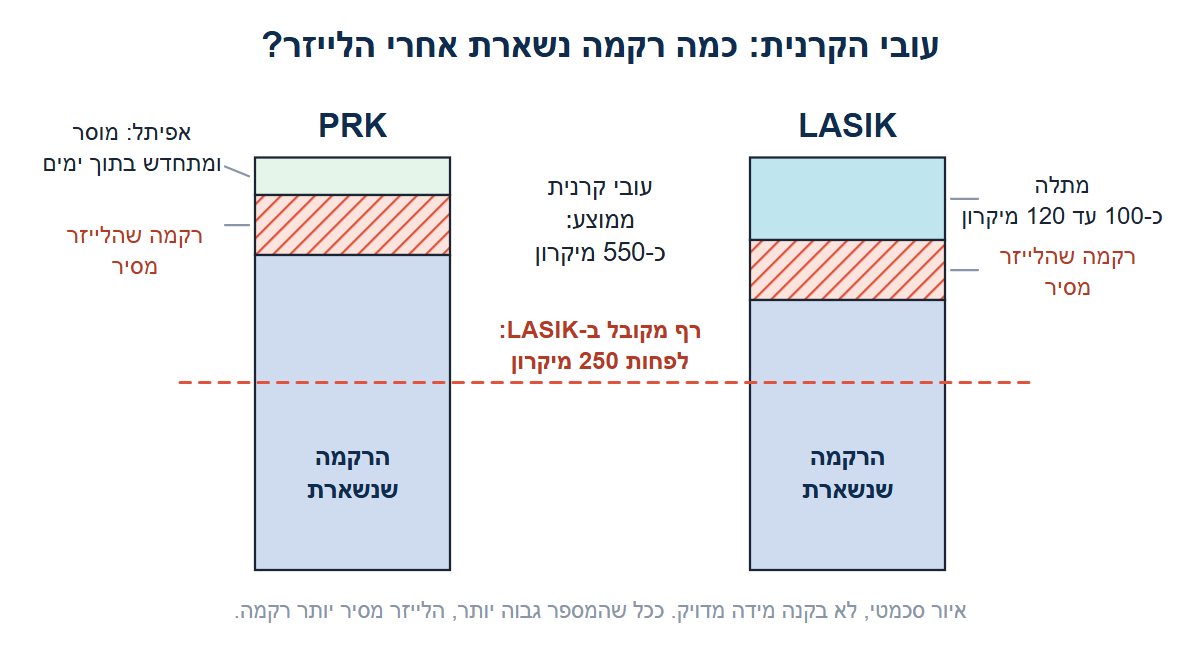
In LASIK a thin flap is created first, so less tissue remains beneath it. The accepted rule is to leave at least 250 microns beneath the flap, and not to alter more than about 40% of the corneal thickness. When the cornea is relatively thin (less than about 500 microns) or the prescription is high, PRK may be more suitable, because it involves no flap and more tissue remains. A thin cornea does not automatically rule you out, but it changes the calculation.
Corneal mapping and ruling out keratoconus
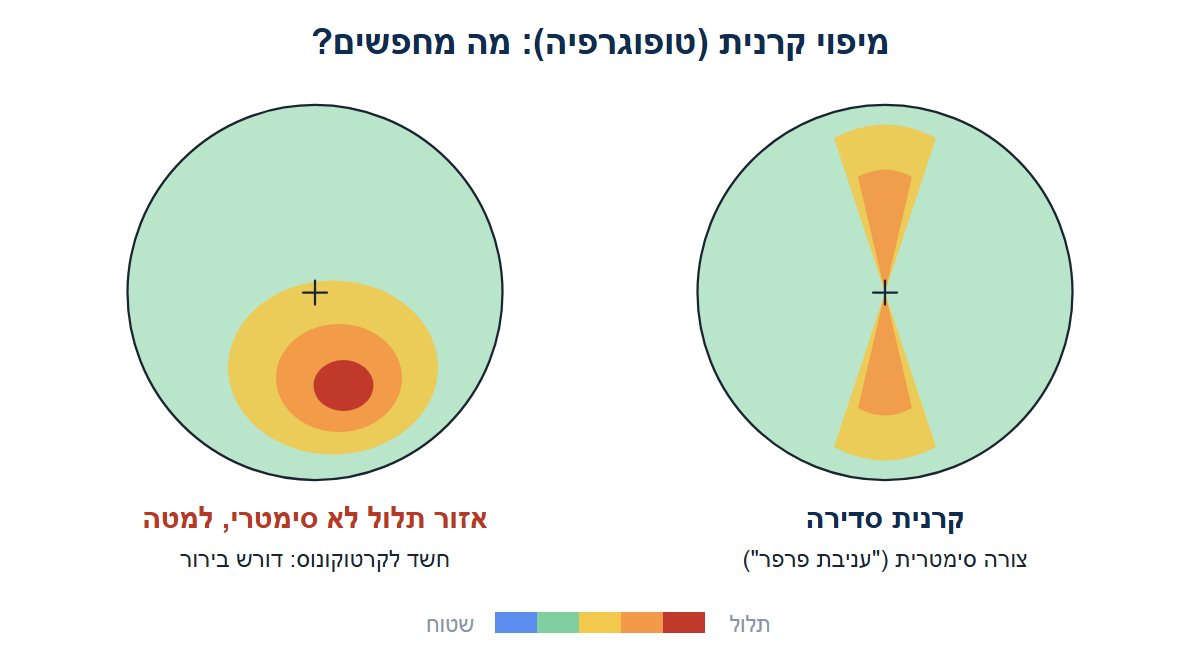
Keratoconus is a disease in which the cornea weakens, becomes thin and bulges forward. Laser vision correction is completely contraindicated in keratoconus, because removing tissue from a weak cornea may make the condition worse. Such worsening after surgery is called ectasia. It is rare, and it is the main reason the evaluation is so thorough.
At an early stage keratoconus cannot be felt, and vision with glasses can be excellent. That is why every candidate has corneal mapping (topography and tomography): a color map of the curvature of the cornea, of its thickness at every point and of its back surface. Warning signs are an asymmetric steep area, usually in the lower part, a thin point that is not at the center, and irregular astigmatism. It is also important to tell your doctor about keratoconus in the family and about a habit of rubbing your eyes.
Dry eye: does it rule out laser surgery?
Laser surgery on the cornea temporarily affects the corneal nerves, and dry eye in the first months is the most common side effect. People who come in with significant dry eye may suffer from it more after surgery. Dry eye does not automatically rule you out: the dry eye is treated first, along with eyelid inflammation if present, and the process continues only when the surface of the eye is calm, also because dry eye impairs the accuracy of the measurements. Difficulty wearing contact lenses is sometimes the first hint of dry eye.
When the dry eye is significant, it is possible to consider PRK, in which no flap is cut, or a solution that does not change the cornea at all, such as the ICL lens. Severe dry eye that does not respond to treatment is a reason to forgo laser surgery. More on this topic is on the page Dry Eye.
Pregnancy, breastfeeding and general medical conditions
Laser surgery is not performed during pregnancy or breastfeeding, because of possible changes in the prescription and in the condition of the cornea. Many surgeons recommend waiting at least three months after giving birth and after breastfeeding has ended, and only then having the suitability evaluation.
Diseases and medications that affect wound healing or the immune system call for careful judgment:
- Diabetes: only when it is well controlled, and with no diabetic damage to the retina or the cornea.
- Autoimmune diseases and connective tissue diseases (such as rheumatoid arthritis or lupus): surgery is not performed when the disease is active. When it has been quiet and well controlled over time, surgery can be considered, cautiously and in coordination with the treating physician.
- Immunosuppression and long-term steroid treatment: these raise the risk of infection and of slow healing.
- Past herpes of the cornea: surgery may reactivate the virus, so many surgeons avoid it.
- Glaucoma: surgery is not performed when the pressure is not controlled. After laser surgery the cornea is thinner, and the eye pressure measurement gives a value lower than the true one, so it is important to tell every ophthalmologist you see in the future about the surgery.
It is worth bringing a list of all your regular medications to the evaluation.
Does a large pupil rule out laser surgery?
In the past it was thought that a pupil that is wide in the dark predicts halos and glare at night after surgery. Studies from recent years have found no such link in modern treatments, in which the treatment zone is wide (6 mm or more). Pupil size is still measured, in light and in the dark, but on its own it does not rule you out. What affects the quality of night vision more is the size of the treatment zone and the size of the prescription being corrected.
People who already see halos around lights at night before surgery tend to notice them afterward as well. Details are on the page Risks and Side Effects of Laser Eye Surgery.
Realistic expectations: what surgery gives you and what it does not
Unrealistic expectations are probably the most common reason for disappointment after surgery that was a medical success. It is worth knowing in advance:
- The goal is to greatly reduce dependence on glasses, not to guarantee perfect vision. In studies of modern lasers, a large majority of eyes with nearsightedness reach 20/20 without glasses, but not all of them. With high prescriptions and in farsightedness the rate is lower.
- Surgery does not necessarily improve vision beyond what you see today with accurate glasses.
- It does not prevent presbyopia. After age 40 reading glasses will be needed, and people who are nearsighted and used to reading without glasses will lose that ability. Monovision can be planned in advance, and it is best to try it first with contact lenses.
- It does not prevent eye diseases in the future, such as cataract or glaucoma, and it does not reduce the risk to the retina in an eye with high myopia.
- Sometimes a small prescription remains, and some patients will need an enhancement in the future.
What does the suitability evaluation for laser surgery include?
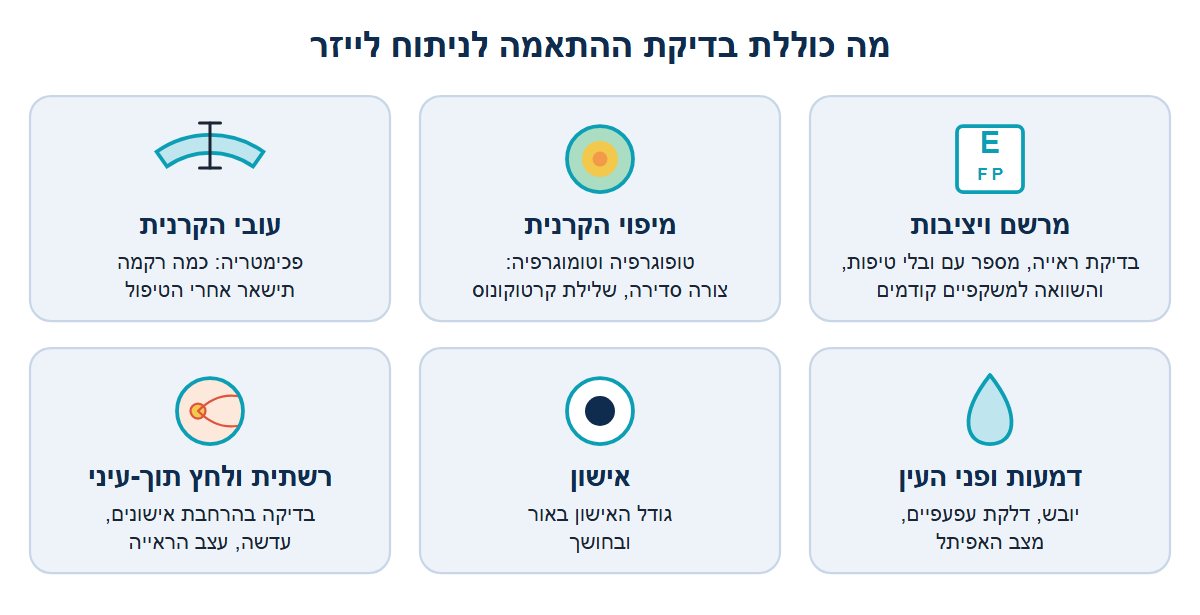
- A conversation: work and hobbies (contact sports, night driving, hours in front of a screen), illnesses and medications.
- Vision and prescription testing, including determining the dominant eye, and a repeat test after drops that relax the focusing muscle. This is how “hidden” farsightedness is also revealed.
- Corneal mapping and thickness measurement (topography, tomography and pachymetry).
- Pupil measurement, and sometimes a measurement of the optical distortions of the eye (Wavefront).
- Slit lamp exam: eyelids, tears, cornea and lens, and measurement of the eye pressure.
- Retinal exam with pupil dilation, which is especially important in high myopia.
The drops used to dilate the pupils blur vision, mainly up close, for a few hours.
How long without contact lenses before the evaluation?
Contact lenses sit on the cornea and temporarily change its shape. For the measurements to be accurate, you stop wearing them before the evaluation and before surgery: soft lenses for at least one to two weeks, and rigid lenses for at least three to four weeks. With soft lenses for astigmatism, and after many years of rigid lenses, more time is sometimes needed, until the mapping stays the same from one exam to the next.
Not suitable for laser surgery? These are the alternatives
A “no” is a good result of a good evaluation, and in most cases it is not the end of the road:
- A different laser method: a relatively thin cornea or taking part in contact sports tips the choice toward PRK.
- ICL lens: for high myopia, a cornea that is too thin or significant dry eye. The lens is implanted inside the eye, without removing tissue from the cornea (The ICL Lens Guide).
- Lens exchange: at an age when presbyopia or an early cataract is already present.
- Waiting, when the prescription is still changing, or staying with glasses or contact lenses. Surgery is a choice, not a necessity.
Dr. Stern performs LASIK and PRK surgery at the Ein Tal Hadassah center in Jerusalem, and ICL lens implantation at Hadassah Ein Kerem. Details about the consultation and the suitability evaluation are on the page Laser Eye Surgeon in Jerusalem.
Frequently asked questions
From what age can you have laser eye surgery?
The accepted minimum age is 18, and some techniques are approved only from age 21 or 22. More important than age is that the prescription is stable: that it has not changed by more than half a diopter in the past year.
How long do I need to be without contact lenses before the suitability evaluation?
Soft lenses are stopped at least one to two weeks before the evaluation, and rigid lenses at least three to four weeks before. With lenses for astigmatism and after years of rigid lenses, more time is sometimes needed, until the corneal mapping stabilizes.
Can you have laser surgery with a thin cornea?
Sometimes. A thin cornea does not automatically rule you out, but it limits the amount of tissue that can be removed. When the cornea is relatively thin and the mapping is normal, PRK, which involves no flap, is usually preferred. When the cornea is too thin or the prescription is high, an ICL lens is an alternative that does not remove tissue from the cornea.
Can you have laser surgery during pregnancy or while breastfeeding?
No. During pregnancy and breastfeeding the prescription and the cornea may change temporarily. Many surgeons recommend waiting at least three months after giving birth and after breastfeeding has ended, and only then having the suitability evaluation.
I have dry eye. Does that rule me out?
Not necessarily. The dry eye is treated first, and the decision is made only when the surface of the eye is calm. With significant dry eye, PRK or an ICL lens can be considered instead of LASIK. Severe dry eye that does not respond to treatment is a reason to forgo laser surgery.
Is laser surgery worthwhile after age 40?
It is possible, but you need to understand what it means. The laser corrects distance vision and does not prevent presbyopia, so glasses will be needed for reading, unless monovision is planned. From about age 50 the lens is also examined carefully, because when a cataract is beginning, surgery on the lens is usually preferable.
References
- Taravella MJ, Lee BS, Garg S, et al. 2025–2026 Basic and Clinical Science Course, Section 13: Refractive Surgery. San Francisco: American Academy of Ophthalmology; 2025.
- Randleman JB, Woodward M, Lynn MJ, Stulting RD. Risk assessment for ectasia after corneal refractive surgery. Ophthalmology. 2008;115(1):37-50. Link
- Santhiago MR, Smadja D, Gomes BF, et al. Association between the percent tissue altered and post-laser in situ keratomileusis ectasia in eyes with normal preoperative topography. Am J Ophthalmol. 2014;158(1):87-95. Link
- Myung D, Schallhorn S, Manche EE. Pupil size and LASIK: a review. J Refract Surg. 2013;29(11):734-741. Link
- Schallhorn JM, Schallhorn SC, Hettinger KA, et al. Outcomes and complications of excimer laser surgery in patients with collagen vascular and other immune-mediated inflammatory diseases. J Cataract Refract Surg. 2016;42(12):1742-1752. Link