

In brief
- The change the laser makes in the cornea is permanent, but the eye goes on living. A prescription can “come back” because of corneal healing, a change in the eye itself, presbyopia or an early cataract.
- Partial regression is more common after correction of a high prescription and in farsightedness. In low nearsightedness the result usually stays stable for years.
- Before an enhancement, the prescription is given time to stabilize, and the cornea is checked to be stable and the lens to be clear.
- An enhancement is done by lifting the existing flap or by treating the surface of the cornea (PRK), provided enough tissue remains.
- Over age 50, new nearsightedness often comes from the lens, and then the solution is usually cataract surgery rather than more laser.
Is laser correction permanent?
The structural change in the cornea is permanent: the tissue that was removed does not grow back. But the cornea is living tissue, and the eye as a whole keeps changing with age. That is why in some patients the prescription shifts a little over the years, and it is not always because of the laser. The Guide to Laser Vision Correction explains that laser surgery also does not prevent the presbyopia that develops in the 40s.
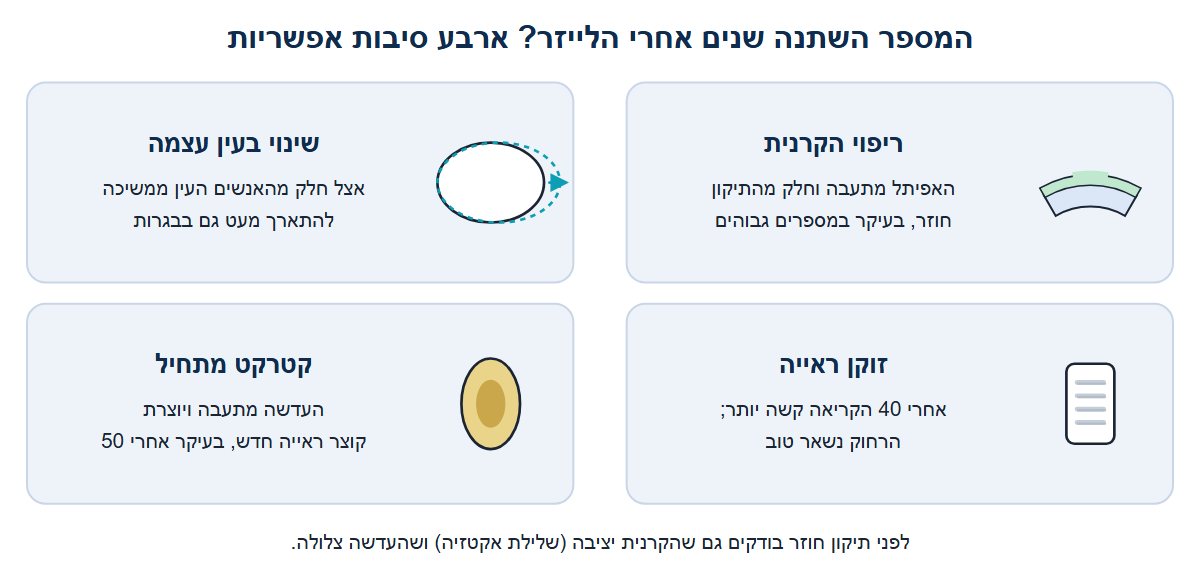
Why does the prescription come back after laser eye surgery?
1. Corneal healing (regression)
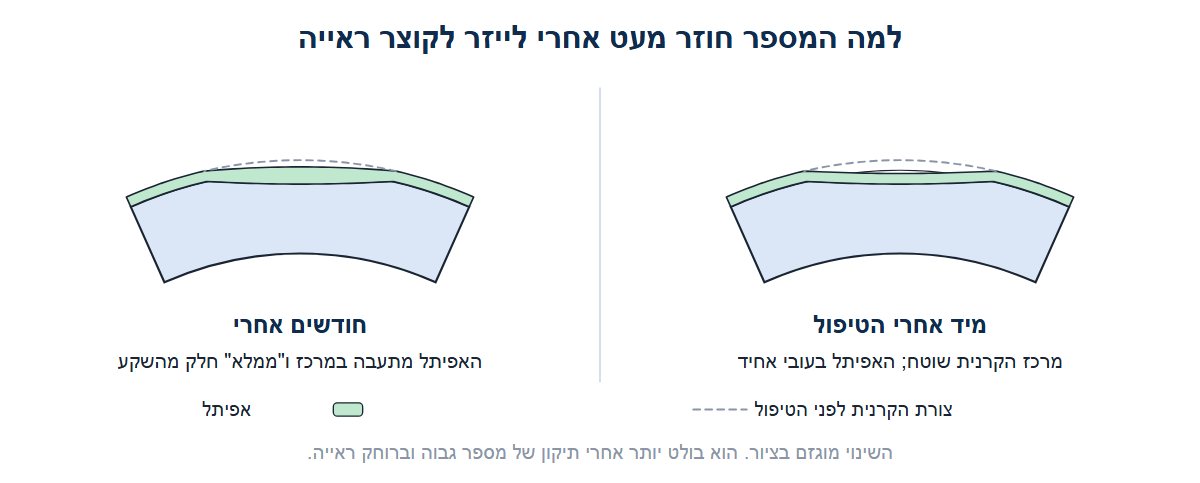
After laser surgery for nearsightedness, the center of the cornea is flatter. In the months after treatment, the epithelium, the outer layer that is constantly renewed, thickens slightly in the center and “fills in” part of the depression, and sometimes slight changes in the tissue beneath it add to this. In this way a small part of the correction is lost. The effect is more pronounced after correction of a high prescription, and in farsightedness the tendency to regress is greater than in nearsightedness.
Long-term studies show the difference. In a ten-year follow-up after PRK for nearsightedness of up to 6 diopters, the average prescription hardly changed. In a ten-year follow-up after LASIK for nearsightedness of more than 10 diopters, the prescription came back gradually, by about a quarter of a diopter per year on average, and the rate slowed with time. Both studies used earlier-generation lasers, and yet the trend is clear: the larger the correction, the greater the chance of regression.
2. A change in the eye itself
In some people the eye continues to lengthen slightly even in their 20s and 30s, and a little nearsightedness is added. This is one of the reasons surgery is performed only after the prescription has been stable for at least a year (Who Is a Candidate for Laser Eye Surgery).
3. Presbyopia: this is not “the prescription coming back”
Around age 40 to 45, reading up close starts to become difficult. Distance vision remains good, so there is no need for an enhancement, and it would not help either. What is needed is reading glasses, or a solution for presbyopia (Getting Rid of Reading Glasses After Age 40).
4. Early cataract
Over the years the natural lens thickens, and in the common type of cataract (nuclear cataract) it creates new nearsightedness. In a large population study, in people aged about 50 and older with this kind of cataract the prescription shifted toward nearsightedness over ten years, while in people without cataract it did not. So when someone over 50 “loses” the result of their laser surgery, the cause is often the lens, and the solution is usually cataract surgery rather than more laser.
When is an enhancement possible?
An enhancement is considered when a prescription that interferes with daily life has remained or come back, and light glasses are not a good solution for you. In studies, between about 1% and about 11% of patients have an enhancement. The rate is higher after correction of a high prescription, with high astigmatism, in farsightedness and over age 40. Before the decision:
- Waiting for stability: usually about three months after LASIK, and three to six months after PRK, because after PRK the cornea goes on healing for longer.
- Confirming that the prescription is stable on two or more exams.
- Mapping the cornea and measuring its thickness, to rule out ectasia and make sure enough tissue remains. In LASIK, at least 250 microns are required beneath the flap even after the enhancement.
- Checking the lens, especially over age 50.
- Treating dry eye, which can itself cause fluctuating vision and inaccurate measurements.
How is an enhancement done?
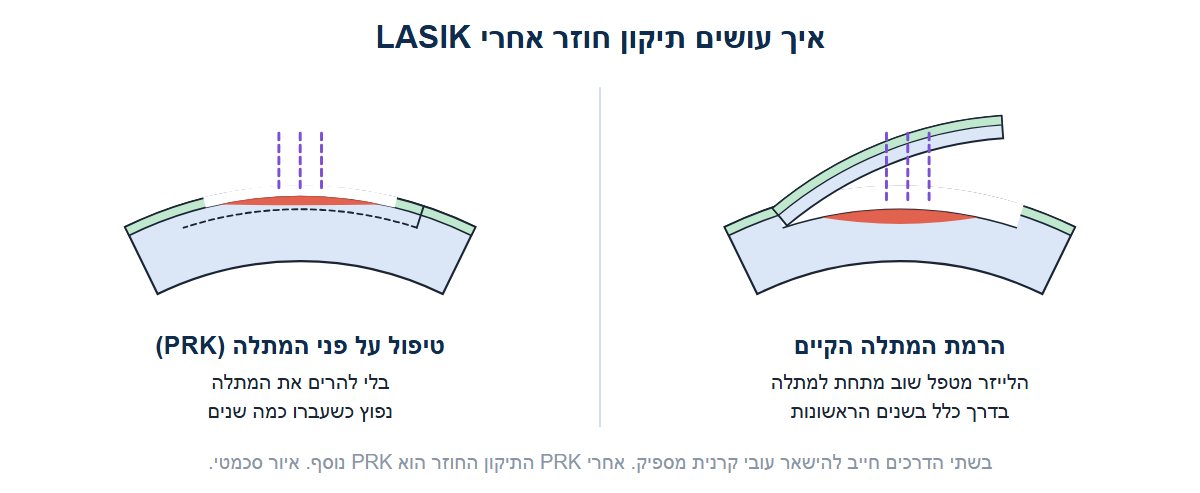
- After LASIK: the existing flap can be lifted, even years after surgery, and the tissue beneath it treated again. After several years, many surgeons prefer to treat on the surface of the flap (PRK), because with a late lift the risk of the epithelium growing under the flap is higher. When the flap was made at another center and its thickness is not known, or when little tissue remains, PRK on the surface of the flap is also usually the choice.
- After PRK: another PRK is performed, sometimes with a medication that reduces haze.
- After SMILE: SMILE cannot be repeated. The enhancement is done with PRK, or by converting the “cap” into a flap, as in LASIK.
Recovery from an enhancement is similar to recovery from the original surgery with the same technique (Recovery After Laser Eye Surgery), and the rules are the same too. When a laser enhancement is not possible, the options of glasses and contact lenses remain, and at the appropriate age lens surgery as well.
Cataract surgery after laser eye surgery
Over the years most people develop a cataract, including those who had laser surgery when they were young. The surgery itself is the same, but calculating the intraocular lens is more complex, because the laser changed the shape of the cornea and the standard formulas may err. After laser surgery for nearsightedness the error tends toward farsightedness. That is why a measurement of both surfaces of the cornea and dedicated formulas are used, and it is important to tell your doctor about the earlier surgery. If you kept documents from your laser surgery, bring them. They help, but they are not essential. The details are on the page Cataract Surgery After Laser Eye Surgery.
Dr. Stern performs LASIK and PRK surgery at the Ein Tal Hadassah center in Jerusalem, and intraocular lens calculation is his main field of research. More information is on the page Laser Eye Surgeon in Jerusalem.
Frequently asked questions
Is laser eye surgery permanent?
The change in the cornea is permanent, but the eye keeps changing. In some patients a little of the prescription comes back, mainly after correction of a high prescription and in farsightedness, and with age presbyopia and later cataract appear, which are unrelated to the laser.
Can laser surgery be done a second time?
Often yes, if the prescription is stable, the cornea is stable and enough tissue remains. After LASIK the flap is lifted or the surface of the cornea is treated, and after PRK another PRK is performed. Before the decision, the cornea is mapped and the lens is checked.
I had laser surgery 15 years ago and now I need glasses for reading. Has my prescription come back?
Probably not. If your distance vision is good and the difficulty is with reading up close, this is presbyopia, which begins in the 40s in everyone. An enhancement for distance will not help. The solution is reading glasses or one of the options for presbyopia.
I am over 50 and have become nearsighted again. What is the reason?
At this age the common cause is a change in the lens, an early cataract, which creates new nearsightedness. In that situation more laser is not the right solution, and cataract surgery is usually planned later on, with a lens calculation that takes the earlier surgery into account.
Can I have cataract surgery after LASIK or PRK?
Yes. The surgery itself is the same, but the lens calculation requires a measurement of both surfaces of the cornea and special formulas. It is important to tell your doctor about the laser surgery, and to bring old documents if you kept them.
References
- Taravella MJ, Lee BS, Garg S, et al. 2025–2026 Basic and Clinical Science Course, Section 13: Refractive Surgery. San Francisco: American Academy of Ophthalmology; 2025.
- Alió JL, Muftuoglu O, Ortiz D, et al. Ten-year follow-up of photorefractive keratectomy for myopia of less than -6 diopters. Am J Ophthalmol. 2008;145(1):29-36. Link
- Alió JL, Muftuoglu O, Ortiz D, et al. Ten-year follow-up of laser in situ keratomileusis for high myopia. Am J Ophthalmol. 2008;145(1):55-64. Link
- Hersh PS, Fry KL, Bishop DS. Incidence and associations of retreatment after LASIK. Ophthalmology. 2003;110(4):748-754. Link
- Fotedar R, Mitchell P, Burlutsky G, Wang JJ. Relationship of 10-year change in refraction to nuclear cataract and axial length: findings from an older population. Ophthalmology. 2008;115(8):1273-1278. Link
- Sasaki M, Hieda O, Wakimasu K, et al. Myopia progression over a 4-year period after laser-assisted refractive surgery in patients in their 20s and 30s. Jpn J Ophthalmol. 2020;64(4):450-454. Link
- Spadea L, Fasciani R, Necozione S, Balestrazzi E. Role of the corneal epithelium in refractive changes following laser in situ keratomileusis for high myopia. J Refract Surg. 2000;16(2):133-139. Link