

In brief
- Dry eye is a disease of the surface of the eye: the tear film is unstable, and the surface of the eye dries out and becomes irritated. It is one of the most common conditions in an eye clinic, especially with age and in women.
- The signs: burning, a sandy feeling, redness, vision that fluctuates and clears when you blink, and sometimes, surprisingly, excess tearing.
- The most common cause is poor function of the oil glands at the eyelid margins, which makes the tears evaporate quickly. Less commonly, the tear gland produces too few tears.
- Treatment is built in steps: adjustments to your environment and habits, artificial tears and eyelid hygiene, and then anti-inflammatory drops and in-office treatments, depending on severity.
- Pain, a drop in vision or light sensitivity are not “just dry eye,” and need an exam.
What is dry eye?
The surface of the eye is covered by a very thin tear film, only a few microns thick. It protects the cornea, nourishes it and creates a smooth surface through which light enters the eye. With every blink, the eyelids spread it anew. This film has two main parts: a thin oil layer on the outside, which comes from the Meibomian glands at the eyelid margins and slows evaporation, and beneath it a watery-mucous layer, which comes from the tear gland and from cells in the conjunctiva.
In dry eye (formally, Dry Eye Disease) this balance is disrupted. The tears evaporate too quickly or there are not enough of them, they become too concentrated, and the surface of the eye becomes irritated and inflamed. The inflammation damages the surface cells of the eye and the nerves within them, and this worsens the instability of the tears: a self-perpetuating cycle.
Dry eye is very common, with estimates ranging from 5% to 50% of the population, depending on the definition. It increases with age and is more common in women. It is usually a chronic condition that is improved and kept under control, not one that goes away completely.
Symptoms of dry eye
- Burning, stinging, a sandy feeling or “something in the eye.”
- Redness and tired eyes, which get worse at the end of the day, in front of a screen, while driving or in air conditioning.
- Fluctuating vision: blur that clears after a few blinks and then comes back. It happens especially when reading and in front of a screen.
- Excess tearing: it sounds surprising, but a dry, irritated eye sends a signal to the tear gland, which responds with a flood of “emergency” tears. These tears are watery and do not fix the problem.
- Light sensitivity, a sticky mucous discharge, and discomfort with contact lenses.
When the main problem is in the eyelid glands, the symptoms are sometimes actually worse in the morning. When tears are lacking, they usually get worse as the day goes on.
What causes dry eye?
Evaporative dry eye: meibomian glands and eyelid inflammation
This is the most common cause. The meibomian glands at the eyelid margins become blocked or secrete thick, poor-quality oil, and the oil layer does not protect the tears from evaporation. This is often linked to eyelid inflammation (blepharitis) and to rosacea, a skin disease of the face.
Tear deficiency
The tear gland produces too little fluid, because of age, medications, or an autoimmune disease such as Sjögren syndrome, in which there is also dry mouth. Often both types exist together.
Aggravating factors
- Screens: in front of a screen we blink much less, and many of the blinks are partial. In one study, the blink rate dropped from about 18 blinks per minute at rest to fewer than 4 while reading on a computer.
- Environment: dry air, air conditioning or heating, wind and a fan aimed at the face.
- Contact lenses: prolonged wear increases dryness. See safe contact lens wear.
- Medications: antihistamines, some medications for depression and anxiety, diuretics, beta-blockers, isotretinoin-type acne medications and more. Also long-term use of eye drops that contain a preservative. Do not stop a medication without consulting the doctor who prescribed it.
- Hormonal changes: menopause.
- After eye surgery: laser vision correction cuts nerves in the cornea, and dry eye afterward is common and usually temporary. See the risks of laser eye surgery. After cataract surgery, too, dry eye is common in the first weeks and months, especially in people who had it before: Dry Eye and Cataract Surgery.
How is dry eye diagnosed? What the tests measure
The ophthalmologist asks about your symptoms, sometimes with a short questionnaire, and examines the eye at the slit lamp. The common tests:
- Tear break-up time (TBUT): how many seconds after a blink the tear film starts to break up. Less than about 10 seconds is considered short, meaning unstable tears. Some devices measure this even without dye drops.
- Staining of the surface of the eye: fluorescein (yellow) or lissamine green drops highlight damaged cells in the cornea and conjunctiva.
- The Schirmer test: a small paper strip at the edge of the lower eyelid for 5 minutes, which measures the amount of tears.
- Examination of the eyelid margins and meibomian glands: gentle pressure on the eyelid shows whether the oil comes out clear or thick like an ointment. Infrared imaging (meibography) shows how many of the glands are still present.
- Additional tests as needed: the salt concentration of the tears (osmolarity), and blood tests when Sjögren syndrome is suspected.
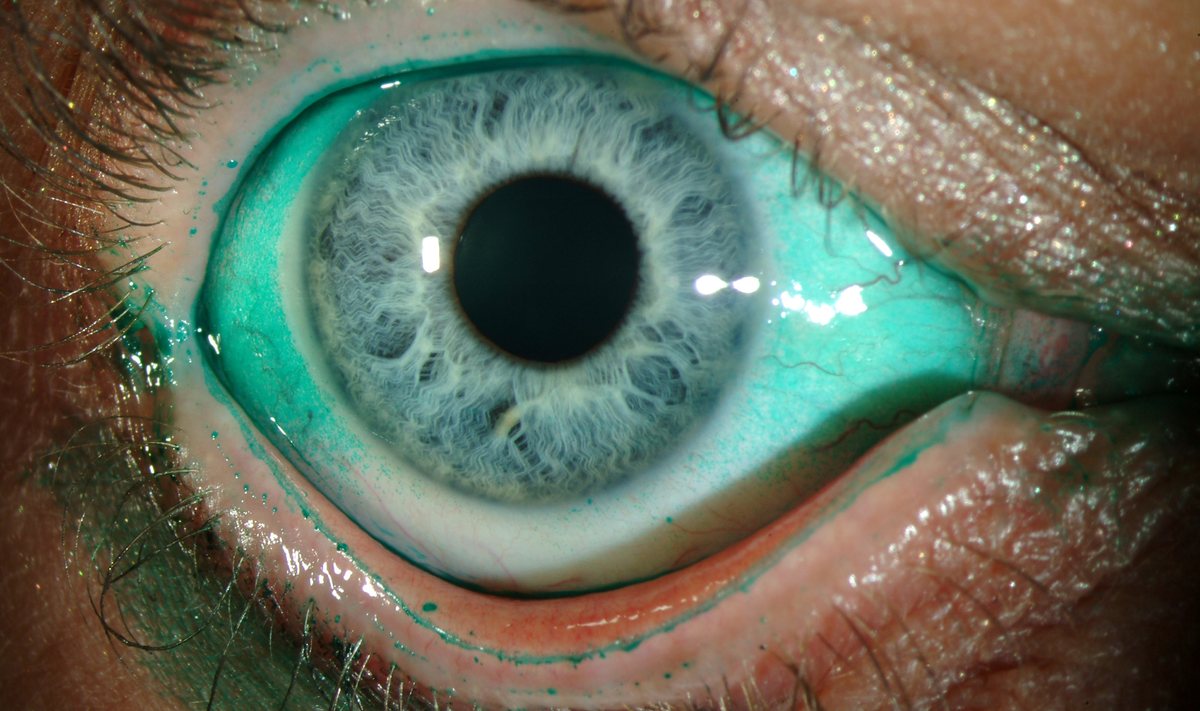
It is also important to rule out conditions that look like dry eye: allergy, conjunctivitis, an eyelid that does not close completely during sleep, or a lax eyelid. And before cataract or laser surgery, dry eye can skew the measurements, so it is sometimes treated first and the measurement is repeated.
Treating dry eye, step by step
The international TFOS DEWS II guidelines (2017) recommend building the treatment in steps: you start with the simple measures, and add treatment only if there is not enough improvement. The treatment is also matched to the type of dry eye: evaporative dry eye is treated mainly through the eyelids. The committee also noted that some of the common treatments do not yet have strong evidence behind them.
| Step | What it includes |
|---|---|
| 1. The basics | An explanation of the disease. Changes to the environment: a humidifier, keeping the airflow of an air conditioner or fan away from your face, short breaks from screens with complete blinks, and a screen slightly below eye level. A review of your regular medications. Artificial tears, preferably preservative-free when they are used often. Warm compresses and eyelid hygiene when there is a problem with the meibomian glands. |
| 2. Targeted treatment | Preservative-free lubricating drops and a gel or ointment for the night. Prescription anti-inflammatory drops (such as cyclosporine), and sometimes steroid drops for a short period, only under a doctor's supervision. Topical or oral antibiotics for eyelid inflammation. In-office treatments for the meibomian glands, such as heating and expressing the eyelids or intense pulsed light (IPL). Tiny plugs in the tear drainage openings. Sealed glasses that retain moisture. |
| 3. Severe dry eye | Drops prepared from the patient's own blood (autologous serum). Therapeutic contact lenses, such as scleral lenses that hold a reservoir of fluid over the cornea. Medications that stimulate tear secretion. |
| 4. Rare and severe cases | Longer steroid treatment under close follow-up, surgical closure of the drainage openings, surgical partial narrowing of the eyelid opening, and biological grafts. |
Omega-3? In the large U.S. DREAM study (2018), people with moderate to severe dry eye who took omega-3 for a year did not improve more than those who received olive oil as a “placebo.” You can include fish in your diet, but do not expect a supplement to solve the problem.
Most patients need regular treatment over the long term. The improvement from anti-inflammatory drops usually comes after a few weeks, so it is important to persist and not stop after just a few days.
When should you see a doctor?
- When the symptoms persist or come back despite artificial tears and adjustments to your environment.
- When there is also dry mouth, joint pain or a known autoimmune disease.
- Before cataract surgery or laser eye surgery, if you have dry eye: mention it at the very first exam.
Frequently asked questions
How can I have dry eye if my eyes are watering?
When the surface of the eye is dry and irritated, the nerves in the cornea send a signal to the tear gland, which responds with a flood of watery tears. These tears rinse the eye for a moment but do not stabilize the tear film, so the feeling returns. Watery eyes are a common symptom of dry eye, especially in wind, in the cold or when reading.
Which artificial tears should I buy?
No single type suits everyone. If you use drops more than a few times a day, preservative-free drops are preferable, because frequent use of a preservative can irritate the surface of the eye. A thick gel or ointment is suitable mainly for the night, because it blurs vision for a short time. Your ophthalmologist can make a recommendation based on the type of dry eye.
Can dry eye damage vision permanently?
In most cases, no. Dry eye causes discomfort and fluctuating vision, but it does not permanently damage the eye. In very severe dry eye, for example in Sjögren syndrome, corneal damage and infections can develop, which is why severe dry eye needs treatment and follow-up with an ophthalmologist.
Does an omega-3 supplement help dry eye?
The evidence does not support it. In the large U.S. DREAM study, people with moderate to severe dry eye who took omega-3 for a year did not improve more than those who received olive oil as a placebo. A balanced diet with fish is a good idea, but it is not a substitute for treatment.
Does working at a computer cause dry eye?
It makes it worse. In front of a screen we blink much less, and many of the blinks are partial, so the tears evaporate. It helps to take short breaks, to blink deliberately and completely, to lower the screen slightly below eye level and to keep the airflow of an air conditioner away from your face.
I have dry eye. Can I have cataract surgery or laser eye surgery?
Usually yes, but it is important to treat the dry eye before surgery: dry eye can skew the measurements on which the lens calculation or the laser treatment is based, and after surgery it may temporarily get worse. Tell your doctor about the dry eye at the very first exam.
References
- Jones L, Downie LE, Korb D, et al. TFOS DEWS II Management and Therapy Report. Ocul Surf. 2017;15(3):575-628. Link
- American Academy of Ophthalmology. Basic and Clinical Science Course (BCSC) 2025–2026, Section 8: External Disease and Cornea. Chapter 3: Clinical approach to ocular surface disease. San Francisco: AAO; 2025.
- Wolffsohn JS, Arita R, Chalmers R, et al. TFOS DEWS II Diagnostic Methodology report. Ocul Surf. 2017;15(3):539-574. Link
- Stapleton F, Alves M, Bunya VY, et al. TFOS DEWS II Epidemiology Report. Ocul Surf. 2017;15(3):334-365. Link
- Gomes JAP, Azar DT, Baudouin C, et al. TFOS DEWS II iatrogenic report. Ocul Surf. 2017;15(3):511-538. Link
- Wolffsohn JS, Lingham G, Downie LE, et al. TFOS Lifestyle: Impact of the digital environment on the ocular surface. Ocul Surf. 2023;28:213-252. Link
- Dry Eye Assessment and Management Study Research Group; Asbell PA, Maguire MG, et al. n-3 fatty acid supplementation for the treatment of dry eye disease. N Engl J Med. 2018;378(18):1681-1690. Link
- Miura M, Inomata T, Nakamura M, et al. Prevalence and characteristics of dry eye disease after cataract surgery: a systematic review and meta-analysis. Ophthalmol Ther. 2022;11(4):1309-1332. Link