

In brief
- Modern laser eye surgery is very safe, but it is not risk-free. Most side effects are temporary, and the serious complications are rare.
- The most common: dry eye and light phenomena at night (halos and glare) in the first months. In most patients they gradually fade.
- In some patients a small prescription remains, or the prescription comes back. Then light glasses can be worn, or an enhancement can be considered.
- Rare complications: flap problems in LASIK, haze after PRK, infection and corneal ectasia. A meticulous suitability evaluation and following the instructions reduce them.
- Pain that gets worse, a drop in vision or increasing redness in the days after surgery mean you should seek care immediately.
Is laser eye surgery safe?
Laser vision correction is among the most thoroughly studied elective surgeries in medicine. In a review of the world literature, about 95% of patients were satisfied with the result of LASIK. In the PROWL studies of the U.S. Food and Drug Administration (FDA), which assessed symptoms with questionnaires before and after surgery, only 1% to 2% of participants were dissatisfied with the surgery.
Still, “very safe” does not mean “risk-free.” It is important to know the common side effects, which usually pass, and the rare complications, and to know what is done to prevent them. The general explanation of the risks is in the Guide to Laser Vision Correction. Here they are set out in detail, with numbers.
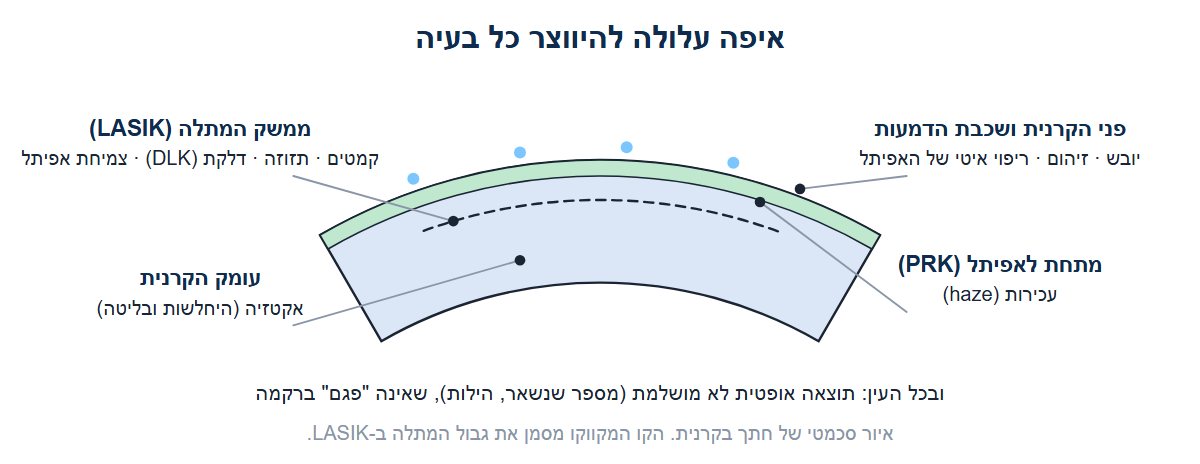
The risks in numbers
| Side effect or complication | How common (approximately) | What usually happens |
|---|---|---|
| Dry eye | Almost everyone in the first months. About a quarter of those who had no dry eye before surgery reported symptoms three months later, most of them mild | Improves gradually, and in most patients returns to the previous state within about six months |
| New light phenomena at night (halos, glare) | About 45% reported some new symptom three months after LASIK | Very few reported significant difficulty, and overall the phenomena decreased compared with before surgery |
| Enhancement because of a residual prescription | About 1% to 11%, depending on the size of the prescription, age and the equipment | Laser enhancement, or light glasses for certain tasks |
| Corneal clouding (haze) after PRK | About 1% in low to moderate nearsightedness and about 2% in high nearsightedness, in a large Israeli series with mitomycin | Usually fades within months, sometimes with the help of drops |
| Flap wrinkles that require lifting the flap (LASIK) | About 1% | Corrected by lifting and smoothing the flap, preferably in the first days |
| Corneal infection | Between about 1 in 3,000 and about 1 in 20,000 surgeries; slightly more after PRK | Intensive treatment with drops; most eyes keep good vision when treatment is early |
| Corneal ectasia | About 1 in 1,000 to 1 in 3,000 after LASIK; rarer after PRK | Halting the condition with collagen cross-linking, and correcting vision with special contact lenses |
| A significant drop in best visual acuity (even with glasses) | Less than 0.6% in modern surgery | Usually as a result of one of the complications above |
The numbers summarize large studies, and some of them depend on the equipment and methods of a particular center. They are meant to give an order of magnitude, not to predict what will happen to a particular eye.
Dry eye after laser eye surgery
The sensory nerves of the cornea regulate tear secretion and blinking. The laser, and in LASIK the cutting of the flap as well, damages them temporarily, which is why almost all patients feel dryness, burning or vision that fluctuates during the day in the first months. The nerves regenerate gradually, and in most patients sensation returns to its pre-surgery state within about six months. The basic treatment is preservative-free artificial tears, used frequently.
In a small minority the dry eye lasts longer, and in rare cases pain appears that does not match the appearance of the eye: nerve pain. The risk is higher in people who had dry eye before surgery, which is why it is treated in advance. Anyone with significant dry eye should consider a different method.
Halos, glare and night vision after laser surgery
After surgery many people notice a halo around lights, rays of light radiating from them or glare from car headlights, mainly in the dark, when the pupil is wide. In the first months this is very common, and as noted, almost half of the participants in the PROWL studies reported a new symptom. But overall, the number of patients with light phenomena went down after surgery, because glasses and contact lenses cause them too.
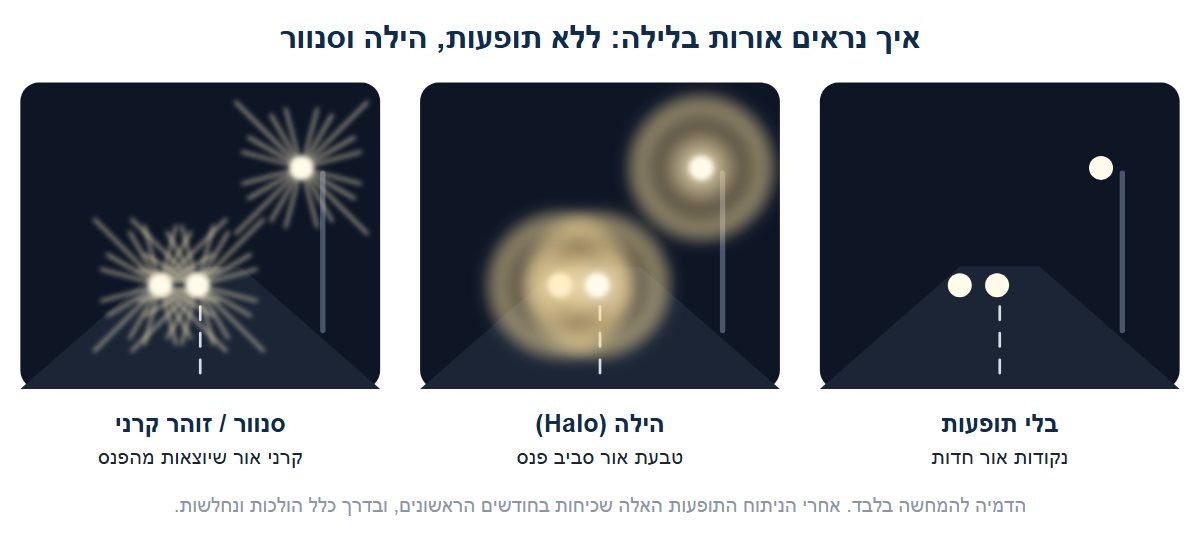
The light phenomena are stronger when the corrected prescription is high, when the treatment zone is small and when there is dry eye. Modern lasers treat a wide zone (6 mm or more) and are designed to reduce optical distortions. If the phenomena persist, it is worth checking for dry eye and a residual prescription, both of which can be treated.
Undercorrection, overcorrection and regression of the prescription
The cornea is living tissue that heals a little differently in each person, so sometimes a small prescription remains. This is more common with high prescriptions, high astigmatism, farsightedness and over age 40. In the first months the prescription can still shift, so it is given time to stabilize: about three months after LASIK, and three to six months after PRK. Only then is it decided whether an enhancement is needed.
Over the years the prescription may partly come back, especially after correction of a high prescription and in farsightedness, where the tendency to regress is greater than in nearsightedness. Not every late change is “the laser wearing off”: sometimes it is a natural change in the eye, presbyopia or an early cataract. The topic is explained on the page Regression of the Prescription and Enhancement.
Flap complications in LASIK
- Flap wrinkles: usually discovered on the first day or in the first week. Wrinkles that affect vision are corrected by lifting and smoothing the flap, and it is best to do this early.
- Flap displacement: rare. The risk is highest on the first day, which is why you do not rub the eye and you protect it with a shield. The flap never heals completely, so a hard blow to the eye can displace it even years after surgery. This is why PRK is sometimes preferred for people who play contact sports.
- Inflammation under the flap (DLK): a non-infectious inflammatory reaction in the first days. It usually responds well to steroid drops when it is detected early.
- Epithelial growth under the flap: occurs in fewer than 3% of eyes, usually at the edge and with no effect on vision. It is cleaned out only when it advances toward the center.
Corneal clouding (haze) after PRK
After PRK, the healing process of the corneal surface may leave a faint haze. If it appears, it is usually a few weeks after surgery. It peaks after one to two months, and over six months to a year it fades or disappears. Haze is more common after correction of a high prescription, with high astigmatism and in farsightedness. During surgery, a medication that reduces haze (mitomycin C) is sometimes placed on the cornea for a short time. UV radiation increases haze, so it is recommended to wear sunglasses in the first months, and to use the steroid drops exactly as prescribed. Patients who receive steroids for a prolonged period also have their eye pressure measured.
Infection after laser eye surgery
Corneal infection is rare, but it is the complication that is most important to recognize quickly. In large series its rate ranges from about 1 in 3,000 to about 1 in 20,000 surgeries, and it is slightly more common after PRK, because the surface of the cornea is open until the epithelium heals. Many of the infections appear in the first week. That is why you keep the eye clean, do not swim or go into a hot tub for at least the first two weeks, use the antibiotic drops as prescribed and come to the follow-up visits.
Ectasia: weakening of the cornea
Ectasia is the most significant complication, and also one of the rarest. After surgery the cornea weakens, gradually becomes thin and bulges forward, much as in keratoconus. Vision becomes distorted, and sometimes this is discovered only months or years after surgery.
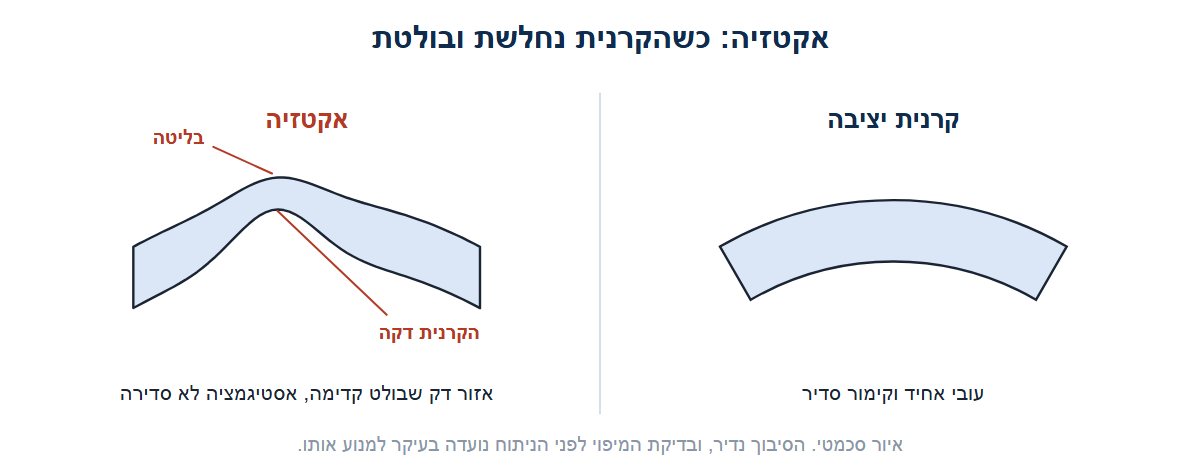
In a series of more than 30,000 LASIK surgeries the rate was about 0.03%, and in other estimates up to about 0.1%. After PRK the rate is lower. The main causes are hidden keratoconus that was not identified before surgery, a thin cornea, correction of a high prescription, young age and removal of too large a share of the corneal thickness. That is why the suitability evaluation is designed first and foremost to identify this risk (Who Is a Candidate for Laser Eye Surgery). Repeated eye rubbing has also been linked to ectasia, so it is best avoided. When ectasia is discovered, collagen cross-linking can halt the progression, and rigid or special contact lenses improve vision.
How is the risk reduced?
- A full suitability evaluation: corneal mapping, thickness measurement and a tear exam, and forgoing laser when the findings are borderline.
- Treating dry eye and eyelid inflammation before surgery.
- Telling your doctor everything: illnesses, medications, past herpes in the eye, keratoconus in the family.
- Following the instructions after surgery: no rubbing, a shield at night, no pool for at least the first two weeks and no eye makeup in the first days, and drops exactly as prescribed (Recovery After Laser Eye Surgery).
- Coming to all the follow-up visits, even when everything feels fine, because some problems are discovered only on examination.
What should you remember years after surgery?
Tell every ophthalmologist that you have had laser eye surgery. After laser surgery for nearsightedness, the eye pressure measurement gives a value lower than the true one, and in the future, at cataract surgery, the lens has to be calculated with special methods (Cataract Surgery After Laser Eye Surgery). It is worth keeping the summary of the surgery and your prescription from before it.
Dr. Stern performs LASIK and PRK surgery at the Ein Tal Hadassah center in Jerusalem. Information about the consultation and the suitability evaluation is on the page Laser Eye Surgeon in Jerusalem.
Frequently asked questions
Can laser eye surgery cause blindness?
Severe vision loss after laser eye surgery is very rare. In modern surgery, fewer than 0.6% of eyes lose a significant part of their best visual acuity, usually because of a complication such as infection or ectasia. Most of these complications can be treated, especially when they are detected early.
How long does dry eye last after laser eye surgery?
Almost all patients feel dryness in the first months. In most of them it improves gradually and returns to its pre-surgery state within about six months. During this period preservative-free artificial tears are used. In a small minority the dry eye lasts longer and requires additional treatment.
Do the halos at night go away?
In most cases they gradually fade in the first months. Almost half of patients notice some new phenomenon in the first months, but very few describe significant difficulty. When they persist, dry eye and a residual prescription are looked for, both of which can be treated.
What is the chance that I will need an enhancement?
In studies the rate of enhancements ranges from about 1% to about 11%. It is higher with high prescriptions, high astigmatism, farsightedness and over age 40. The prescription is given time to stabilize, about three months after LASIK and three to six months after PRK, before a decision is made.
What should I do if I get hit in the eye after LASIK?
In the first weeks, and after any hard blow even years after surgery, get examined as soon as possible. The LASIK flap never heals completely, and a blow may displace it. Such a displacement is corrected by putting the flap back in place, and the earlier this is done, the better the result.
References
- Taravella MJ, Lee BS, Garg S, et al. 2025–2026 Basic and Clinical Science Course, Section 13: Refractive Surgery. San Francisco: American Academy of Ophthalmology; 2025.
- Eydelman M, Hilmantel G, Tarver ME, et al. Symptoms and satisfaction of patients in the Patient-Reported Outcomes With Laser In Situ Keratomileusis (PROWL) studies. JAMA Ophthalmol. 2017;135(1):13-22. Link
- Solomon KD, Fernández de Castro LE, Sandoval HP, et al. LASIK world literature review: quality of life and patient satisfaction. Ophthalmology. 2009;116(4):691-701. Link
- Schallhorn JM, Schallhorn SC, Hettinger K, Hannan S. Infectious keratitis after laser vision correction: incidence and risk factors. J Cataract Refract Surg. 2017;43(4):473-479. Link
- Bohac M, Koncarevic M, Pasalic A, et al. Incidence and clinical characteristics of post LASIK ectasia: a review of over 30,000 LASIK cases. Semin Ophthalmol. 2018;33(7-8):869-877. Link
- Kaiserman I, Sadi N, Mimouni M, Sela T, Munzer G, Levartovsky S. Corneal breakthrough haze after photorefractive keratectomy with mitomycin C: incidence and risk factors. Cornea. 2017;36(8):961-966. Link
- Llovet F, de Rojas V, Interlandi E, et al. Infectious keratitis in 204 586 LASIK procedures. Ophthalmology. 2010;117(2):232-238. Link