

In brief
- Blepharitis is a chronic inflammation of the eyelid margins: redness, itching, burning, flakes at the base of the eyelashes and a sandy feeling in the eye.
- In the common form, the meibomian glands in the eyelid margins become blocked. This is also the most common cause of dry eye.
- The foundation of treatment is daily eyelid hygiene: heat, massage and cleaning. This is a condition that is kept under control over time, not cured once and for all.
- A tiny mite called Demodex is another cause, and one that can be identified and treated.
- Before cataract surgery or laser eye surgery, significant eyelid inflammation is treated, to reduce the risk of infection and to improve the accuracy of the measurements.
What is blepharitis (eyelid inflammation)?
Blepharitis is an inflammation of the eyelid margins, the thin strip from which the eyelashes grow. It is very common, usually affects both eyes, and tends to come back in waves. It is not contagious and in most cases does not threaten vision, but it can be a real nuisance.
The eyelid margin has two important zones: the eyelashes grow from the front part, and in the back part, right next to the eye, the meibomian glands open in a row. These glands secrete the thin oily layer of the tears, the layer that keeps them from evaporating.
Types of blepharitis and what causes them
- Posterior blepharitis, blockage of the meibomian glands (MGD): the common form. The oil in the glands becomes thick and cloudy, and the gland openings become blocked. The tears evaporate quickly, and dryness sets in. It is often associated with rosacea, a skin disease that causes redness of the face.
- “Greasy” (seborrheic) anterior blepharitis: greasy flakes at the base of the eyelashes, sometimes together with flakes on the scalp and eyebrows.
- Blepharitis caused by staphylococcus bacteria: hard crusts around the eyelashes, and sometimes loss of eyelashes. More common at a young age.
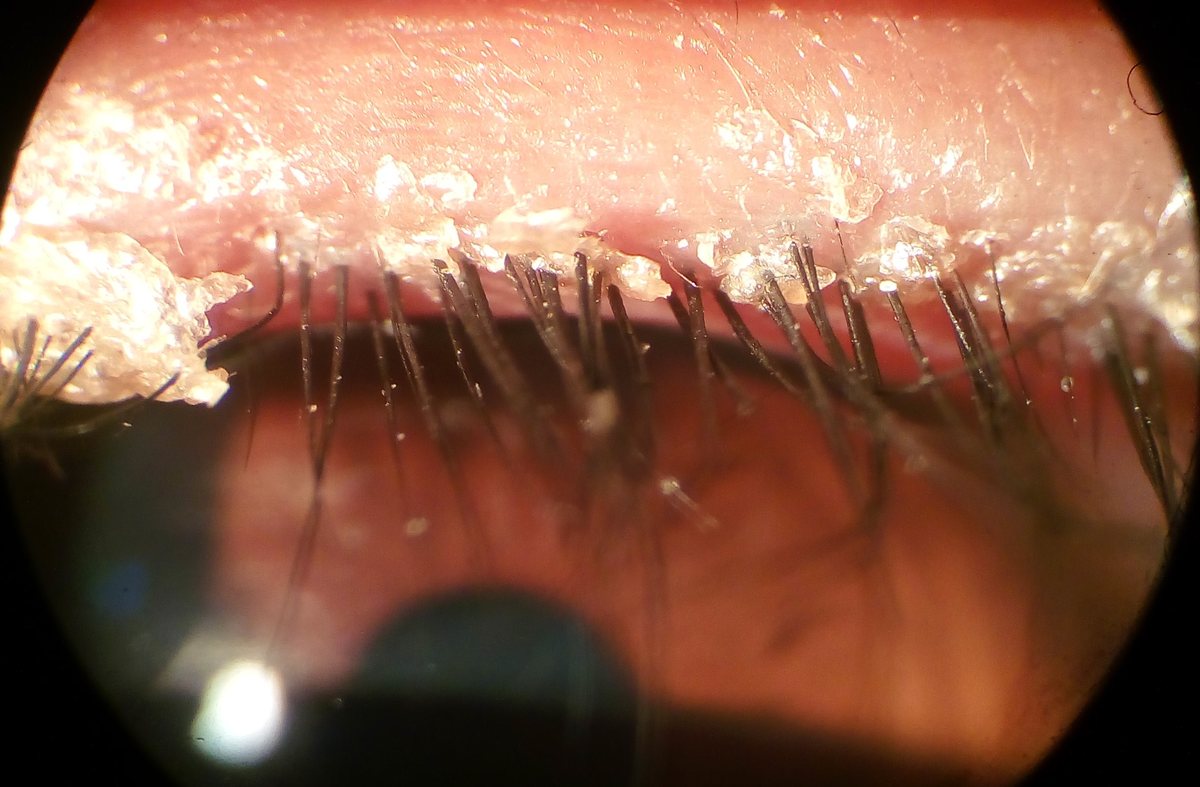
- Demodex: a tiny mite that lives in the eyelash follicles. It becomes more common with age, and is found in most adults. The assumption is that when it multiplies, it increases the inflammation. The typical sign is flaky “sleeves” that wrap around the base of the eyelashes.
Often there is a combination of several types.
Symptoms of eyelid inflammation
- Red, slightly swollen eyelid margins.
- Itching, burning and a sandy feeling in the eye.
- Flakes or crusts at the base of the eyelashes, and sticky eyelids in the morning.
- Dry eyes or, on the contrary, watery eyes.
- Blurred vision that improves with blinking.
- Styes and chalazia (lumps in the eyelid) that keep coming back.
The symptoms are often worst in the morning, and vary from day to day.
Eyelid hygiene, step by step
Eyelid hygiene is the foundation of treatment for all types of blepharitis. It is done once or twice a day, every day, even when your eyes feel fine.
- Heat: place a warm compress, not scalding hot, on your closed eyelids for about 3 to 5 minutes. The heat softens the thick oil in the glands and the crusts. If you heat the compress in the microwave, test it on your wrist first so that you do not burn yourself.
- Massage and pressure: right after the heat, press gently but firmly on the eyelid, for a few seconds, moving toward the eyelid margin: on the upper eyelid from top to bottom, on the lower eyelid from bottom to top. This is how the oil comes out of the glands.
- Cleaning: clean the eyelid margins and the base of the eyelashes with your eyes closed, using a pad or a soft, clean cloth. You can use wipes or a spray made for the eyelids, or a gentle baby shampoo well diluted in water.
- Gently: do not rub hard, and do not let the cleanser get into the eye.
Improvement usually comes after a few weeks of persistence. When you stop, the symptoms tend to return.
Other treatments for blepharitis
When eyelid hygiene alone is not enough, your ophthalmologist may add:
- Artificial tears to relieve the dryness.
- Antibiotic ointment or drops for the eyelid margins, for short periods.
- Steroid drops for a short period, when the inflammation is severe. Only under a doctor's supervision, because of the risk of increased eye pressure and of cataract with prolonged use.
- A tetracycline-class antibiotic in tablet form, at a low dose, for several weeks or months. It works mainly against the inflammation in the glands, and is especially suitable for posterior blepharitis and rosacea. It is not suitable during pregnancy or breastfeeding.
- In-office treatments for the meibomian glands: devices that heat the eyelids and apply pressure to them, or intense pulsed light treatment (IPL).
Demodex: a mite in the eyelashes
The typical sign of Demodex is “sleeves”: cylindrical flakes that wrap around the base of the eyelashes. On slit-lamp examination, and sometimes by looking under a microscope at an eyelash that has been plucked, the mite itself can be identified. When this sign is present, the likelihood of Demodex is very high.
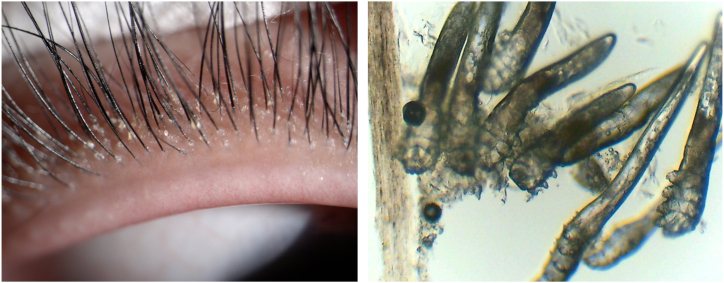
The treatment: daily eyelid hygiene and, as needed, dedicated treatments against the mite, such as tea tree oil-based products or ivermectin cream. Tea tree oil can irritate the eye, so it is used only in products intended for the eyelids and as directed. In the United States, dedicated drops against Demodex were approved in 2023; in studies they cleared the “sleeves” in about half of patients after six weeks.
Chalazion and stye
A stye is an acute infection of a gland in the eyelid margin: a red, swollen, painful lump. It usually goes away on its own within a week or two. A chalazion is a painless lump that forms when a meibomian gland becomes blocked and the oil builds up in the tissue. It usually disappears within weeks to months, and is more common in people who have posterior blepharitis or rosacea.
The first treatment for both is warm compresses and eyelid hygiene. Antibiotic drops usually do not help. A chalazion that does not go away is treated with a steroid injection into it or with a small drainage procedure in the clinic, under local anesthesia. A chalazion that keeps coming back in the same place, or that looks atypical, is sent for pathology, because in rare cases a tumor of the eyelid can look like a chalazion.
Why is blepharitis treated before cataract and laser surgery?
- Preventing infection: most of the bacteria that can cause an infection after surgery come from the eyelid margins and the skin around the eye. Severe eyelid inflammation or rosacea may increase the risk of infection inside the eye (endophthalmitis), so the guidelines recommend treating them before cataract surgery. In laser surgery, too, blepharitis is one of the risk factors for infection.
- Accurate measurements: an unstable tear film distorts the measurement of the cornea, on which the calculation of the intraocular lens or of the laser treatment is based. After treatment, the measurement is repeated.
- A comfortable recovery: after surgery, and especially after laser, dryness and blepharitis are among the common causes of discomfort and of disappointment with the result, even when vision is good. See Dry Eye and Cataract Surgery.
If you have blepharitis and are planning surgery, start eyelid hygiene now, and mention it at your exam before surgery.
When should you see a doctor?
- When the symptoms do not improve after a few weeks of daily eyelid hygiene.
- A chalazion that does not go away after a few weeks or that comes back in the same place, or a lump in the eyelid with loss of the eyelashes over it.
- Inflammation in one eye only that does not go away.
Frequently asked questions
Is blepharitis contagious?
No. Blepharitis is an inflammation of the eyelid margins, not an infection that passes from person to person. Even so, it is best not to share towels or eye makeup.
Does blepharitis go away completely?
In most cases it is a chronic condition that tends to come back, so the goal is to keep it under control rather than to cure it once and for all. Daily eyelid hygiene greatly reduces the symptoms, and when it is stopped they tend to return.
Can I wear makeup if I have blepharitis?
Yes, with care: remove your makeup thoroughly every evening, do not apply eyeliner to the inner rim of the eyelid, where the openings of the meibomian glands are located, and replace your eye makeup products often. During a flare-up it is better to avoid eye makeup.
What is the difference between a chalazion and a stye?
A stye is an acute infection of a gland in the eyelid margin: a red, painful lump that usually goes away within a week or two. A chalazion is a painless lump that forms from a blocked meibomian gland, and usually disappears within weeks to months. For both, the first treatment is warm compresses and eyelid hygiene.
I have blepharitis. Does that delay my cataract surgery?
Not necessarily. When the inflammation is significant, it is treated before surgery to reduce the risk of infection and to improve the accuracy of the measurements, and sometimes this takes a few weeks. It is worth starting eyelid hygiene now and mentioning it at your exam before surgery.
References
- American Academy of Ophthalmology. Basic and Clinical Science Course (BCSC) 2025–2026, Section 8: External Disease and Cornea. Chapter 3: Clinical approach to ocular surface disease (dry eye, blepharitis, rosacea, Demodex, hordeola and chalazia). San Francisco: AAO; 2025.
- Rhee MK, Yeu E, Barnett M, et al. Demodex blepharitis: a comprehensive review of the disease, current management, and emerging therapies. Eye Contact Lens. 2023;49(8):311-318. Link
- American Academy of Ophthalmology. Basic and Clinical Science Course (BCSC), Section 11: Lens and Cataract. Preoperative evaluation of the patient with cataract. San Francisco: AAO.
- Olson RJ, Braga-Mele R, Chen SH, et al. Cataract in the Adult Eye Preferred Practice Pattern. Ophthalmology. 2017;124(2):P1-P119. Link
- Gaddie IB, Donnenfeld ED, Karpecki P, et al; Saturn-2 Study Group. Lotilaner ophthalmic solution 0.25% for Demodex blepharitis: randomized, vehicle-controlled, multicenter, phase 3 trial (Saturn-2). Ophthalmology. 2023;130(10):1015-1023. Link