

In brief
- In nearsightedness the eye is too long, or too powerful, and light from distant objects comes to a focus in front of the retina. Distance is blurry, near is sharp.
- The number on the prescription is a minus. The higher it is, the closer to the eye the point of sharp vision lies.
- In adults it can be corrected with glasses, contact lenses, laser eye surgery (LASIK or PRK) or implantation of an ICL lens. Suitability is determined at an exam.
- High myopia increases the risk of retinal problems, even after laser correction, so it is important to have the retina checked regularly.
What is nearsightedness?
In a normal eye, the cornea and the lens focus light exactly on the retina, the light-sensitive layer lining the back wall of the eye. In a nearsighted eye the focus falls in front of the retina. In most cases the reason is that the eye is longer than usual; sometimes the cornea or the lens is too powerful. The light has already passed the focal point by the time it reaches the retina, so every point in the world appears on it as a blurry circle. This is not a disease of the retina or of the eye, but a mismatch between the focusing power of the eye and its length.
Nearby objects send diverging rays into the eye, and those are precisely the rays that the nearsighted eye manages to focus. That is why people with nearsightedness see well up close, and many of them read without glasses even after age 40.
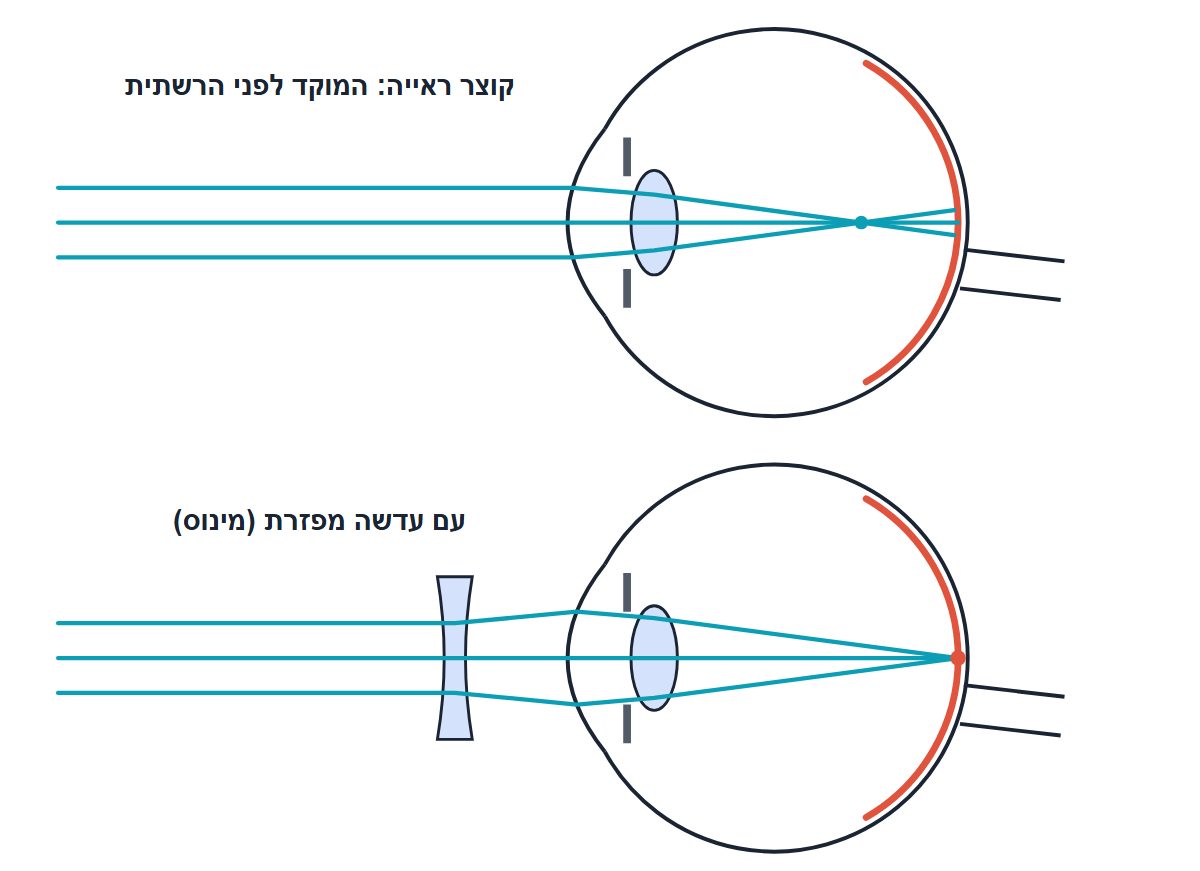
What does the minus number mean?
Nearsightedness is corrected with a diverging lens, which is why the number on the prescription is written as a minus, in units called diopters. The number has a simple meaning: 1 divided by the number is the distance, in meters, up to which you see sharply without glasses.
- -1.00: you see sharply up to about one meter.
- -2.00: you see sharply up to about 50 cm.
- -4.00: you see sharply up to about 25 cm.
Beyond that point everything is blurry. Nearsightedness of 6 diopters or more (and, by the World Health Organization definition, 5 or more) is considered high myopia, and in it the eye is usually considerably longer. If there is also a number in the CYL column, there is astigmatism as well.
Symptoms of nearsightedness
- Blurred distance vision: signs, TV subtitles, the faces of people across the room.
- Squinting to see far away. The narrow slit between the eyelids works like a pinhole in a camera and sharpens the image a little.
- Sometimes eye fatigue or headaches after a prolonged effort to see far away.
- Poorer vision in the evening and at night: the pupil is wider, and the blur is more noticeable.
An adult whose nearsightedness starts to increase after years of stability, or who suddenly finds they can read without the reading glasses they used to need, should be examined. A change like this is often caused by an early cataract in the center of the lens, which increases its focusing power.
How is it diagnosed?
A visual acuity test, a computerized measurement of the prescription, and a test in front of the letter chart with lenses that are switched back and forth. A full eye exam also checks the eye pressure and the retina, usually after drops to dilate the pupils. In high myopia the length of the eye is sometimes measured as well, and before any surgery is considered, the shape and thickness of the cornea are mapped.
Ways of correcting nearsightedness in adults
Glasses
The simple, safe option. The diverging lens moves the focus back onto the retina. With high prescriptions the lenses are thick at the edges and make what you see through them slightly smaller. High-index lenses (“thin lenses”) reduce the thickness.
With high prescriptions, the distance between the glasses and the eye matters too. In his optics course for residents, Dr. Stern gives an example: glasses of -10.00 diopters sitting 12 mm in front of the cornea are equivalent to a contact lens of only about -8.93 diopters. That is why a contact lens prescription is not identical to a glasses prescription and has to be fitted separately.
Contact lenses
Soft contact lenses suit most people with nearsightedness, and there are also toric lenses for astigmatism and rigid lenses (RGP). They give a full visual field and an image of almost natural size. The main risk is a corneal infection, so it is important to be strict about hygiene, not to sleep or swim in the lenses, and to replace them on time. A red, painful eye in a contact lens wearer means the lens must be taken out and the eye examined urgently (inflammation and a corneal ulcer).
Laser eye surgery: LASIK and PRK
The laser flattens the center of the cornea and reduces its power, so that the focus moves onto the retina. It is suitable for people whose prescription is stable, whose cornea is healthy and thick enough, and who have no medical condition that rules out the surgery. Before the decision, detailed corneal mapping is performed, among other things to rule out keratoconus. All the details are in The Guide to Laser Vision Correction, and the suitability evaluation and surgery with Dr. Stern are described on the page Laser Eye Surgeon in Jerusalem.
ICL lens
When the prescription is too high for laser, or the cornea is too thin, a thin lens (ICL) can be implanted inside the eye, behind the iris and in front of the natural lens, without removing any tissue from the cornea. The lens stays in the eye long term, and it can be removed if necessary. See The ICL Lens Guide and the page ICL Implantation in Jerusalem.
At an older age: replacing the lens
In cataract surgery the natural lens is replaced with an artificial lens, and its power is chosen so that the nearsightedness is corrected as well. This is worth thinking about in advance: full correction of nearsightedness means good distance vision and glasses for reading, and someone who has read without glasses all their life needs to decide what matters more to them. The options are explained on the page Types of Lenses in Cataract Surgery.
High myopia: why does the retina need to be checked?
In high myopia the eye is long and stretched, and the retina that lines it on the inside is thinner. This raises the risk of retinal tears and retinal detachment, of degenerative changes in the macula (myopic maculopathy), of glaucoma and of cataract at a relatively young age.
Important to know: laser eye surgery or an ICL lens corrects the prescription but does not change the length of the eye. The risk of retinal problems stays as it was, and even after a successful correction you need to continue with periodic retinal exams.
Frequently asked questions
Does nearsightedness keep increasing in adults too?
In most people the prescription stabilizes around age 20 to 25, although in some it keeps rising slightly in their twenties and thirties. A new increase in the prescription at an older age calls for an exam, because it is often caused by an early cataract.
Do glasses weaken the eyes?
No. Glasses and contact lenses correct the focus and do not change the eye itself. Wearing or not wearing glasses as an adult does not make nearsightedness worse.
From what prescription can laser eye surgery be done?
There is no single number that fits everyone. Suitability depends on the thickness and shape of the cornea, the stability of the prescription and the condition of the eye. With high prescriptions or a thin cornea, an ICL lens is considered. The decision is made after a full exam and corneal mapping.
After laser eye surgery, will I never need glasses again?
The laser corrects nearsightedness, but it does not prevent the presbyopia that begins around age 40 to 45. So over the years reading glasses will usually be needed. Monovision planned in advance can reduce dependence on them, but glasses are still needed for small print and prolonged reading.
Why does high myopia call for retinal exams?
In high myopia the eye is long and the retina is thinner and more stretched, so the risk of tears, retinal detachment and changes in the macula is higher. Correcting the prescription with laser or an ICL does not change this risk, so periodic exams continue.
References
- Flitcroft DI, He M, Jonas JB, et al. IMI – Defining and Classifying Myopia: A Proposed Set of Standards for Clinical and Epidemiologic Studies. Invest Ophthalmol Vis Sci. 2019;60(3):M20-M30. Link
- Haarman AEG, Enthoven CA, Tideman JWL, Tedja MS, Verhoeven VJM, Klaver CCW. The Complications of Myopia: A Review and Meta-Analysis. Invest Ophthalmol Vis Sci. 2020;61(4):49. Link
- Chuck RS, Jacobs DS, Lee JK, et al. Refractive Errors & Refractive Surgery Preferred Practice Pattern. Ophthalmology. 2018;125(1):P1-P104. Link
- American Academy of Ophthalmology. Basic and Clinical Science Course (BCSC), Section 3: Clinical Optics. San Francisco: American Academy of Ophthalmology; 2018–2019.
- Brennan NA, Cheng X, Bullimore MA. Adult Myopia Progression. Invest Ophthalmol Vis Sci. 2024;65(13):49. Link