

In brief
- The power of an intraocular lens is not your glasses prescription. It is calculated separately for each eye, from precise measurements of the eye: the length of the eye, the curvature of the cornea and the depth of the anterior chamber.
- The measurement (biometry) is done with an optical device, without touching the eye, and takes just a few minutes.
- The big unknown in the calculation is the exact place where the lens will settle inside the eye. That cannot be measured in advance, only predicted.
- Today's accuracy is high but not perfect: in large series, about 70% to 85% of eyes end up within half a diopter of the target, and more than 90% within one diopter.
- In eyes that have had laser eye surgery, and in very short or very long eyes, it is harder to be accurate.
- You have a part to play too: stopping contact lenses in time, treating dry eye, and telling your doctor about previous eye surgeries.
How is the lens power determined in cataract surgery?
In cataract surgery the natural lens is replaced with an intraocular lens, and its power is chosen in advance. The choice is made in two steps. In the first step, the target is set together with you: sharp vision for distance, for near, or a combination such as monovision. In the second step, a calculation determines which lens will bring your eye to that target. The calculation does not rely on your glasses prescription, but on the structure of the eye. Two eyes with the same glasses prescription may need very different lenses.
What is biometry, and what does it measure?
Biometry is a measurement of the dimensions of the eye. Today it is done with an optical biometer: you rest your chin on the device and look at a point of light, and the device measures with a beam of light, without touching the eye. The test is painless and takes just a few minutes. When the cataract is very dense and light cannot pass through it, the measurement is completed with ultrasound.
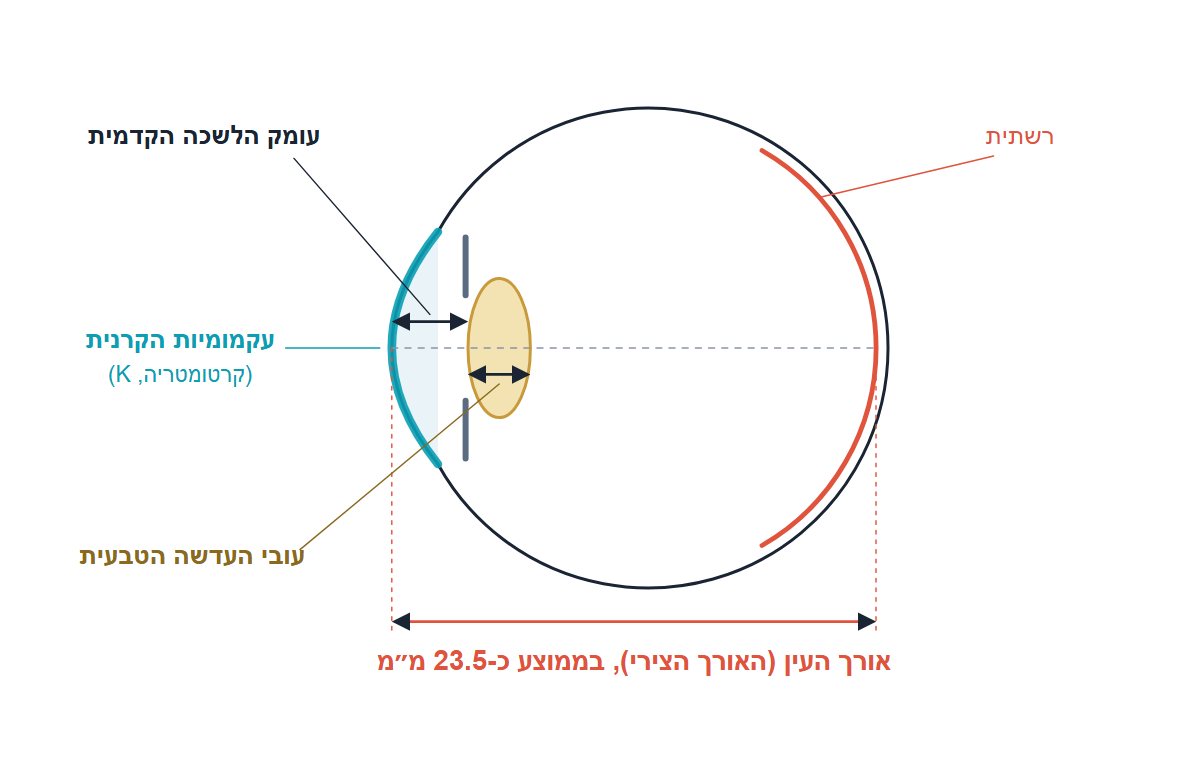
- Length of the eye (axial length): the distance from the cornea to the retina, on average about 23.5 mm. This is the most important value: an error of a tenth of a millimeter changes the result by about a quarter of a diopter.
- Curvature of the cornea (keratometry, K): the cornea is the most powerful lens in the eye. The device projects points of light onto it and measures their reflection. The measurement also gives the amount of astigmatism and its axis (see Toric Lenses).
- Anterior chamber depth and thickness of the natural lens: these help predict where the new lens will settle.
Before a toric lens or a premium lens, corneal mapping and an OCT scan of the center of the retina are usually added as well. For all the tests before surgery, see Before Cataract Surgery.
The formulas, in one paragraph
The measurements are entered into a calculation formula. The first formula was published in 1967, and dozens have been developed since. They all face the same problem: to know what power is needed, you have to know exactly where the lens will sit inside the eye after the capsular bag contracts around it, and that cannot be measured before surgery. Each formula predicts this position in a different way, from the measurements of the eye. The new-generation formulas, some of which use artificial intelligence, are more consistent in short eyes and in long eyes, which is why the European guidelines (ESCRS, 2024) recommend them. Many surgeons compare several formulas before choosing a lens.
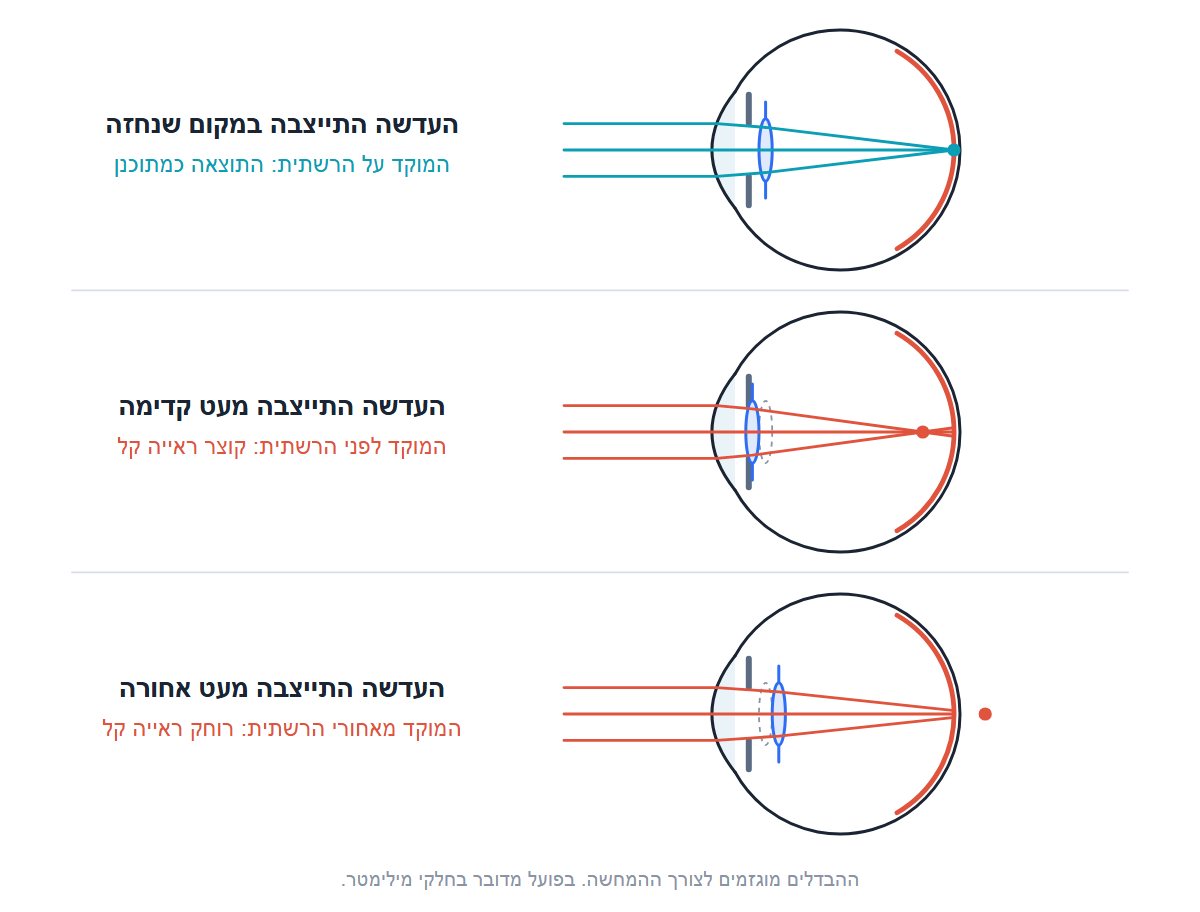
An analysis of the sources of error in the calculation found that predicting the position of the lens is the largest factor, about a third of the total error. Next come the imprecision of the refraction test after surgery, and the measurement of the length of the eye.
How accurate is the calculation? Honest numbers
Accuracy is usually measured by the proportion of eyes that end up close to the target:
- In the European registry of quality outcomes for cataract surgery (EUREQUO), in about 283,000 surgeries from 2014 and 2015, 73% of eyes were within half a diopter of the target, and 93% within one diopter.
- In an American series of more than 18,000 eyes measured with an optical biometer, between 72% and 80% were within half a diopter, depending on the formula.
- According to the review by Dr. Stern and Prof. Gatinel (2025), in centers that are meticulous about measurements and use up-to-date formulas the rate now reaches about 85%, compared with about 60% in the early years of this century, and some surgeons report more than 92%.
What does this mean in practice? A deviation of up to half a diopter usually allows good vision without glasses at the planned distance. Still, in about one in five eyes the deviation is larger than that, in most cases only slightly. A deviation of more than one diopter (a “refractive surprise”) occurs in a few percent of cases. That is why no surgeon can promise a life without glasses.
Why is it harder to be accurate in some eyes?
- After laser eye surgery (LASIK, PRK) or corneal incisions (RK): the laser changed the shape of the cornea, and the standard measurement no longer reflects its true power. Without a correction, the result after laser surgery for nearsightedness tends toward farsightedness. Dedicated formulas are used and several methods are compared, and even so the accuracy is lower: in studies, about 60% to 70% of eyes end up within half a diopter. Details on the page Cataract Surgery After Laser Eye Surgery.
- Short eyes (less than 22 mm): they need a strong lens, and with a strong lens any small deviation in the measurement or in the position of the lens translates into a larger error in the prescription.
- Long eyes (more than 26 mm, high myopia): the back wall of the eye sometimes bulges backward and is not symmetrical, and it is harder to measure the length exactly to the center of vision. The newer formulas have improved accuracy here. See Cataract Surgery with High Myopia.
- An irregular cornea (for example keratoconus): the corneal measurement is less reliable, and the formulas tend to err toward farsightedness. For this reason the target is sometimes deliberately set to mild nearsightedness.
According to the European guidelines, patients with an especially short or long eye should know in advance that their risk of ending up off target is higher.
What can you do to make the calculation more accurate?
- Stop contact lenses in time. Contact lenses temporarily change the shape of the cornea. According to Dr. Stern's instructions, soft lenses are stopped two weeks before the measurements, and rigid lenses at least three to four weeks before, and after many years of wear sometimes longer, until the measurement is stable (details here).
- Treat dry eye. An unstable tear film distorts the corneal measurement. In a study that looked at this, in patients whose tears were too concentrated the repeated measurements were less consistent, and in more of them the calculated lens power changed by more than half a diopter. If you were given treatment for dry eye before the measurements, keep to it carefully.
- Tell your doctor about previous eye surgeries, and especially about laser vision correction, even if it was done decades ago. If you still have documents, bring them.
- Come back for another measurement when asked. A repeat measurement is not a sign of a problem. It is how the results are confirmed to be consistent.
When both eyes are operated on one after the other, the result of the first eye helps refine the calculation for the second eye.
And what if the result is not accurate?
First the eye is given time to stabilize, usually about six weeks, and other causes of blur are ruled out. In most cases a small deviation is not bothersome, or it is corrected with glasses. When it is bothersome, there are three ways to correct it: laser on the cornea, an add-on lens or exchanging the lens. A full explanation on the page Lens Exchange and Add-On Lenses.
Intraocular lens power calculation is Dr. Stern's main field of research. For the surgery itself see Cataract Surgery in Jerusalem. Physicians will find a review of the formulas on the page IOL Power Calculation Formulas.
Frequently asked questions
Is the power of the intraocular lens the same as my glasses prescription?
No. The lens power is calculated from the structure of the eye: the length of the eye, the curvature of the cornea and the expected position of the lens. Two people with the same glasses prescription may receive very different lenses.
Is the biometry test painful?
No. With an optical biometer the measurement is done with a beam of light, without touching the eye, and takes just a few minutes. Only when the cataract is very dense is the measurement completed with ultrasound.
How accurate is the lens calculation?
In large series, about 70% to 85% of eyes end up within half a diopter of the target, and more than 90% within one diopter. A larger deviation occurs in a few percent of cases, and it can be corrected.
Why do contact lenses have to be stopped before the measurements?
Contact lenses temporarily change the shape of the cornea, and the measurement may come out wrong. According to Dr. Stern's instructions, soft lenses are stopped two weeks before the measurements, and rigid lenses at least three to four weeks before. After many years of wear, longer is sometimes needed, and the measurement is repeated until it is stable.
I have had laser vision correction. Can an accurate lens be calculated for me?
Yes, with dedicated formulas and a full measurement of the cornea. The accuracy is slightly lower than in an eye that has not had surgery, so it is important to know in advance that glasses or an additional correction may be needed.
Can it be guaranteed that I will not need glasses for distance after surgery?
No. Even with the best measurements and formulas, about one in five eyes ends up more than half a diopter from the target, usually only slightly. That is why we speak of a high likelihood, not a promise.
References
- Wanten JC, Till V, Findl O, Cochener-Lamard B, Kohnen T, Nuijts RM. ESCRS guideline for cataract surgery 2024: executive summary. J Cataract Refract Surg. 2026;52(9):e1-e13. Link
- Lundström M, Dickman M, Henry Y, Manning S, Rosen P, Tassignon MJ, et al. Risk factors for refractive error after cataract surgery: analysis of 282 811 cataract extractions reported to the European Registry of Quality Outcomes for Cataract and Refractive Surgery. J Cataract Refract Surg. 2018;44(4):447-452. Link
- Melles RB, Holladay JT, Chang WJ. Accuracy of intraocular lens calculation formulas. Ophthalmology. 2018;125(2):169-178. Link
- Stern B, Gatinel D. Presbyopia correction in lens replacement surgery: a review. Clin Exp Ophthalmol. 2025;53(6):668-681. Link
- Norrby S. Sources of error in intraocular lens power calculation. J Cataract Refract Surg. 2008;34(3):368-376. Link
- American Academy of Ophthalmology. Basic and Clinical Science Course, Section 3: Clinical Optics. Chapter on intraocular lenses: biometric formula requirements.
- Ma JX, Tang M, Wang L, Weikert MP, Huang D, Koch DD. Comparison of newer IOL power calculation methods for eyes with previous radial keratotomy. Invest Ophthalmol Vis Sci. 2016;57(9):OCT162-OCT168. Link
- Epitropoulos AT, Matossian C, Berdy GJ, Malhotra RP, Potvin R. Effect of tear osmolarity on repeatability of keratometry for cataract surgery planning. J Cataract Refract Surg. 2015;41(8):1672-1677. Link