

In brief
- An enhanced monofocal lens (“monofocal plus”) is a lens with a single focus that is stretched slightly to improve vision in the intermediate range: computer, dashboard, cooking.
- Distance vision and contrast are similar to those of a standard monofocal lens.
- In studies, the improvement in the intermediate range is, on average, about one line on the eye chart. It is a real but modest improvement, and not every patient notices it.
- It is not a reading lens: you still need glasses for a book and for small print.
- Halos and glare are similar to those of a standard monofocal lens, and less than those of a multifocal lens.
What is an enhanced monofocal lens (“monofocal plus”)?
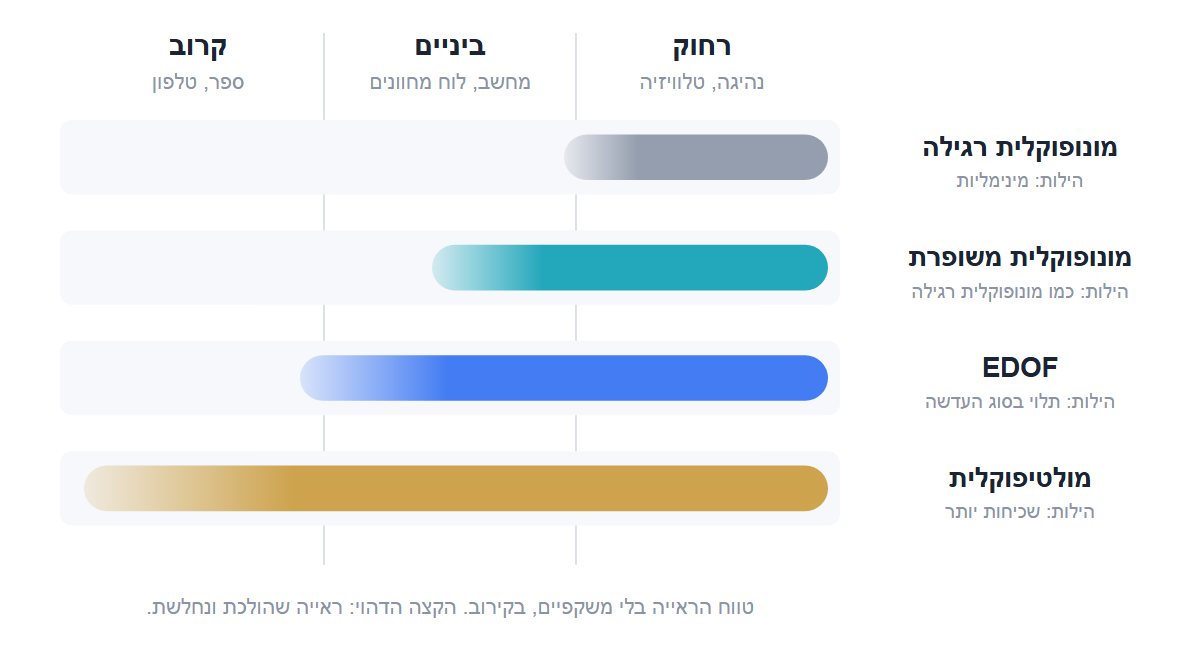
A standard monofocal lens focuses light to a single point. When it is set for distance, distance vision is very sharp, but already at the distance of a computer screen the image becomes blurred. This type of lens, the enhanced monofocal (also called monofocal plus or mono-EDOF), is a relatively new family of lenses. The first of them was approved for use in Europe in 2019. The idea: to keep all the advantages of a monofocal lens, and add a little depth of focus to it.
In terms of range, it sits between a standard monofocal lens and an EDOF lens: it elongates the focus, but by less than is required to be considered an EDOF lens. Several manufacturers offer such lenses today, and each achieves the effect in a slightly different optical way. So it is best to think of them as a technology, not as a particular brand name.
How does it work?
There are no rings and no steps on the surface of the lens. The change is far more subtle: the optical power changes gradually between the edge of the lens and its center. In one model, for example, the central zone is stronger than the rest of the lens by about half a diopter. In other models, the spherical aberration of the lens is modified, that is, the way the central rays and the peripheral rays come to a focus. In both cases the result is similar: the focus is stretched slightly toward the intermediate range, with almost no loss of sharpness at distance.
Because the effect relies on the center of the lens, it depends on pupil size and on the shape of the cornea. Dr. Stern and Prof. Gatinel tested monofocal lenses of various types in the laboratory, and found that pupil size and the spherical aberration of the cornea markedly change the sharpness, the depth of focus and even the effective power of the lens. In other words, the same lens can give good intermediate range in one eye, and a very small gain in another.
What does it add compared with a standard monofocal lens?
Two large meta-analyses, from 2022 (12 studies) and from 2025 (31 studies), compared enhanced monofocal lenses with standard monofocal lenses. The findings are consistent:
- Intermediate range: visual acuity at a distance of about 66 cm is better by about one line on the eye chart, and with both eyes together slightly more.
- Glasses for the intermediate range: more patients manage without glasses at the computer and for household tasks.
- Distance: there is no difference in distance visual acuity.
- Contrast: no difference was found in contrast sensitivity.
In other words, you get a small gain in the intermediate range without paying for it in the quality of distance vision.
What does it not give? Reading without glasses
Here it is important to set expectations. In studies, near vision is indeed slightly better than with a standard lens, but not enough for comfortable reading of a book, a newspaper or small print on a phone. Most patients continue to use reading glasses.
The gain in the intermediate range is modest too. In the review published by Dr. Stern and Prof. Gatinel (2025), they note that the improvement over a standard monofocal lens may be so subtle that the patient does not notice it, and that these lenses do not match EDOF lenses or trifocal lenses. Anyone whose main goal is to read without glasses should consider a multifocal lens. Monovision extends the range to intermediate and the phone, but glasses are still needed for small print.
Halos and glare: comparison with a multifocal lens
In a multifocal lens the light is split into several focal points, so halos around lights at night are more common with it: in a Cochrane review they were reported three to four times more often than with a monofocal lens. In an enhanced monofocal lens the light is not split. The meta-analyses found no difference in light phenomena (halos, glare, “starbursts”) between it and a standard monofocal lens.
Keep in mind that no lens is completely free of light phenomena: even with a standard monofocal lens some patients report them, mainly in the first weeks. A full explanation is on the page Halos and Glare After Cataract Surgery.
Who is an enhanced monofocal lens suitable for?
- People who want sharp distance vision and better comfort at the computer and the dashboard, and are willing to keep wearing reading glasses.
- People who drive a lot at night and are not willing to risk halos.
- Eyes in which a multifocal lens is approached with caution, for example when there is a disease of the retina or optic nerve. These lenses have few contraindications, but here too the decision is individual.
- People interested in mini-monovision: one eye is targeted for mild nearsightedness, and the lens extends the range further. A 2025 systematic review found that the combination improves intermediate and near vision without significantly compromising distance vision, although the results were not uniform across studies.
Like the other lenses, the enhanced monofocal lens also comes in a toric version, which corrects astigmatism. In an eye that has previously had corneal laser surgery, the spherical aberration of the cornea is different from usual, and the lens may behave differently than expected. That is why, in such eyes, the model is chosen on the basis of a measurement of the cornea (Cataract Surgery After Laser Eye Surgery).
How do you decide?
Ask yourself three questions: How much do reading glasses bother you? How much do you drive at night? And how much time a day do you spend in front of a screen? If the answers are “they don't,” “a lot” and “a lot,” an enhanced monofocal lens is a sensible option. If the dream is a life with no glasses at all, it will not fulfill it.
At the planning visit, Dr. Stern combines these answers with the measurements of your eye: pupil size, the corneal map and the health of the retina. The full comparison of the lens types appears on the page Types of Lenses in Cataract Surgery, and for the surgery itself see Cataract Surgery in Jerusalem.
Frequently asked questions
What is the difference between a standard monofocal lens and an enhanced monofocal lens?
Both have a single focus and similar distance vision. In the enhanced lens the focus is stretched slightly, so vision in the intermediate range (computer, dashboard) is better, on average by about one line on the eye chart. Halos and contrast are similar.
Can you read without glasses with an enhanced monofocal lens?
Usually not. Near vision is only slightly better than with a standard lens, and most patients continue to use reading glasses for a book and for small print.
Are there halos with a monofocal plus lens?
Studies found no difference in halos and glare between it and a standard monofocal lens, and they are less than those of a multifocal lens. However, no lens is completely free of light phenomena, mainly in the first weeks.
What is the difference between monofocal plus and an EDOF lens?
Both elongate the focus, but to a different degree. An EDOF lens gives a fuller intermediate range, sometimes at the cost of more light phenomena, depending on the type of lens. Monofocal plus gives a smaller gain, with behavior close to that of a standard monofocal lens.
Can an enhanced monofocal lens be combined with mini-monovision?
Yes. One eye is targeted for mild nearsightedness, which gains additional range for near. In studies the combination improved intermediate and near vision without significantly compromising distance vision, but the results are not uniform, and it is suitable only for people who adapt to the difference between the eyes.
References
- Fernández J, Ribeiro F, Burguera N, Rodríguez-Calvo-de-Mora M, Rodríguez-Vallejo M. Visual and patient-reported outcomes of an enhanced versus monofocal intraocular lenses in cataract surgery: a systematic review and meta-analysis. Eye (Lond). 2025;39(5):883-898. Link
- Wan KH, Au ACK, Kua WN, Ng ALK, Cheng GPM, Lam NM, et al. Enhanced monofocal versus conventional monofocal intraocular lens in cataract surgery: a meta-analysis. J Refract Surg. 2022;38(8):538-546. Link
- Stern B, Gatinel D. Presbyopia correction in lens replacement surgery: a review. Clin Exp Ophthalmol. 2025;53(6):668-681. Link
- Stern B, Gatinel D. Impact of pupil size and corneal spherical aberrations on the performance of monofocal intraocular lenses: an experimental model. Biomed Opt Express. 2024;15(11):6433-6448. Link
- Wanten JC, Till V, Findl O, Cochener-Lamard B, Kohnen T, Nuijts RM. ESCRS guideline for cataract surgery 2024: executive summary. J Cataract Refract Surg. 2026;52(9):e1-e13. Link
- de Silva SR, Evans JR, Kirthi V, Ziaei M, Leyland M. Multifocal versus monofocal intraocular lenses after cataract extraction. Cochrane Database Syst Rev. 2016;12:CD003169. Link
- Trusiak ZH, Leoniuk A, Tomaszuk A, Sawicki M, Konopińska J. Enhanced monovision intraocular lenses: current status and future perspectives - systematic review. Biomedicines. 2025;14(1):74. Link