

In brief
- A toric lens is an intraocular lens that, during cataract surgery, also corrects the astigmatism (cylinder) of the cornea, and not only nearsightedness or farsightedness.
- According to the European guidelines for cataract surgery (ESCRS, 2024), a toric lens is considered from about one diopter of corneal astigmatism. The benefit is especially clear from 1.5 to 2 diopters and up.
- The lens has to sit exactly on the planned axis: every degree of misalignment takes away about 3% of the correction.
- Today's lenses are very stable. In roughly one to three of every hundred eyes, a short procedure is needed to bring the lens back to its axis.
- A small amount of residual astigmatism is possible even when everything is done precisely. Usually it is not noticeable, and when necessary it is corrected with glasses or with laser.
What is a toric lens, and how does it correct astigmatism?
In astigmatism (cylinder), the cornea is not round like a basketball but shaped a little like a rugby ball: it is steeper in one direction and flatter in the direction perpendicular to it. As a result, light does not focus at a single point, and vision is blurred or “smeared” at all distances.
In cataract surgery, the cloudy natural lens is replaced with an intraocular lens. A standard lens corrects only the spherical part of the prescription. The astigmatism of the cornea remains, and with it the need for glasses even for distance. A toric lens is built differently: it has a different power in two perpendicular directions, in other words a “reverse cylinder” that cancels out the astigmatism of the cornea. For this to work, the lens has to sit in the eye at a precise angle, which is why it carries tiny dots that mark its axis.
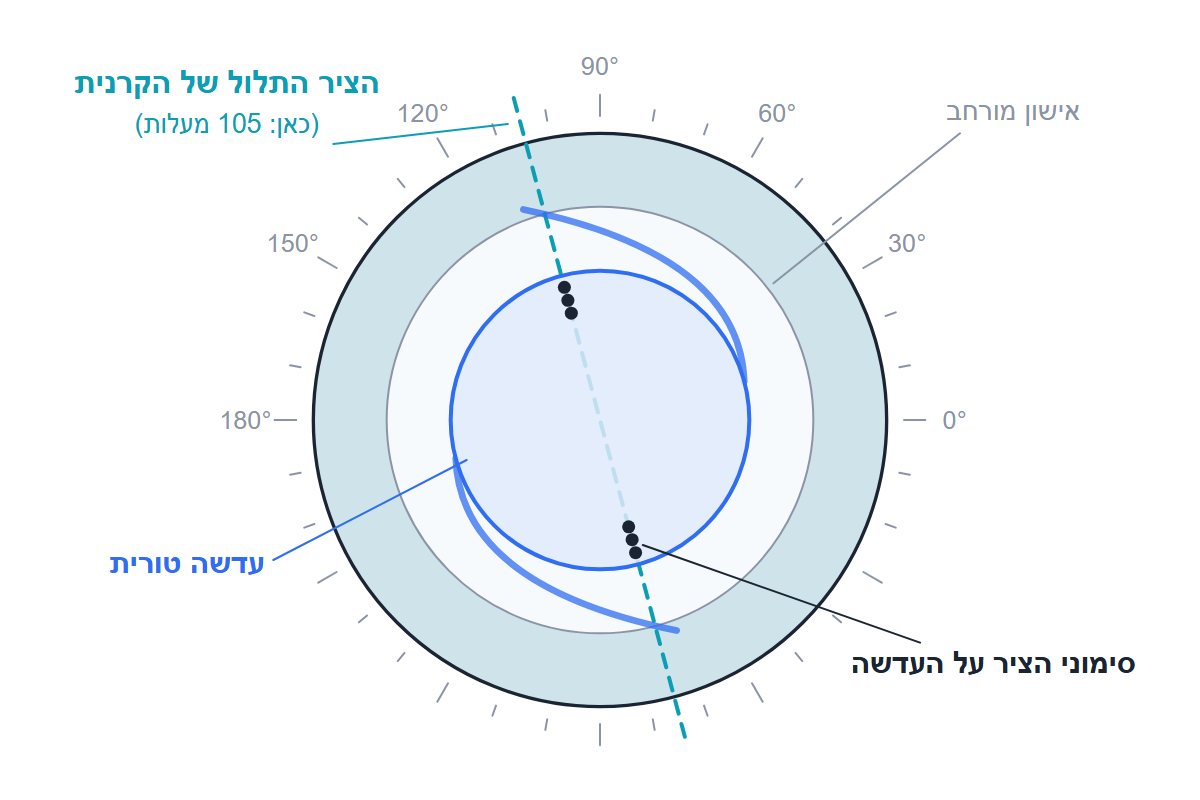
Toricity is a feature that can be added to any type of lens: there are toric monofocal lenses (a single focus), and there are toric multifocal and EDOF lenses. The comparison between the types appears on the page Types of Lenses in Cataract Surgery.
Who is a toric lens suitable for, and how much astigmatism does it take?
What counts is the astigmatism of the cornea, not the cylinder written in your glasses prescription. The number in your glasses also includes the contribution of the natural lens, and that lens is removed during surgery. So your doctor may recommend a toric lens even if your glasses have almost no cylinder, and the other way around.
Corneal astigmatism is very common: in large series of candidates for cataract surgery, about four in ten have one diopter or more of astigmatism, and about one in five have a diopter and a half or more.
- What the guidelines say: according to the guidelines of the European Society of Cataract and Refractive Surgeons (ESCRS, 2024), a toric lens is worth considering when corneal astigmatism is one diopter or more. The greatest benefit was found above 2 diopters, with meaningful benefit already from 1.5 diopters. Between 1 and 1.5 diopters there may be an advantage, but the evidence is more limited.
- What the studies show: a meta-analysis of 13 controlled trials (Kessel et al., 2016) found that with a toric lens, distance vision without glasses is better, fewer patients need glasses for distance, and residual astigmatism is lower, with no increase in complications.
- With a premium lens: multifocal lenses are especially sensitive to leftover astigmatism, and a residual of about 0.75 diopters or more already affects vision and satisfaction. That is why even a small amount of astigmatism is corrected with these lenses. See how to choose a multifocal lens.
Important to know: a monofocal toric lens corrects astigmatism and distance vision, but not reading. Reading glasses will usually still be needed with it.
How are the astigmatism and the axis measured before surgery?
The result of a toric lens depends first and foremost on the measurements. That is why several tests are combined:
- Optical biometry: measures the curvature of the cornea along its two axes, together with the length of the eye. On lens calculation, see how the lens power is calculated.
- Corneal mapping (topography or tomography): the guidelines recommend it before every toric lens. The map shows whether the astigmatism is regular and symmetric, and whether the axis measured by the different devices is the same.
- The back surface of the cornea: it too contributes a small amount of astigmatism, about 0.3 diopters on average. Today's lens calculators take it into account. Without this adjustment, “with-the-rule” astigmatism tends to be overcorrected and “against-the-rule” astigmatism undercorrected.
A dry eye surface and contact lenses distort the measurement of the cornea. So dry eye is treated before the measurements, and contact lens wear is stopped in advance, following the instructions on the page Before Cataract Surgery. When the measurements are not consistent, they are repeated.
How is the axis marked and the lens aligned during surgery?
When you go from sitting to lying down, the eye rotates slightly: 2 to 4 degrees on average, and more in some people. To keep this rotation from shifting the axis, reference points are set while the patient is sitting. There are two accepted ways of doing this:
- Manual marking: before surgery, with the patient sitting, tiny ink dots are placed at the edge of the cornea.
- Digital marking: a computerized system photographs the eye before surgery, identifies blood vessels and details of the iris, and projects the planned axis into the operating microscope.
According to the European guidelines, digital marking is slightly more accurate, but the difference in visual outcomes between the two methods is not clinically significant. Dr. Stern always uses an advanced guidance system during surgery. In the operation itself, the lens is inserted through the same tiny incision, and the surgeon rotates it until the marks on it lie on the axis.
What happens if the toric lens rotates?
Every degree of deviation from the axis takes away about 3% of the astigmatism correction. A deviation of 10 degrees cancels about one third of the correction, and at 30 degrees the correction is lost entirely. Beyond that, the lens may even add astigmatism in a new direction.
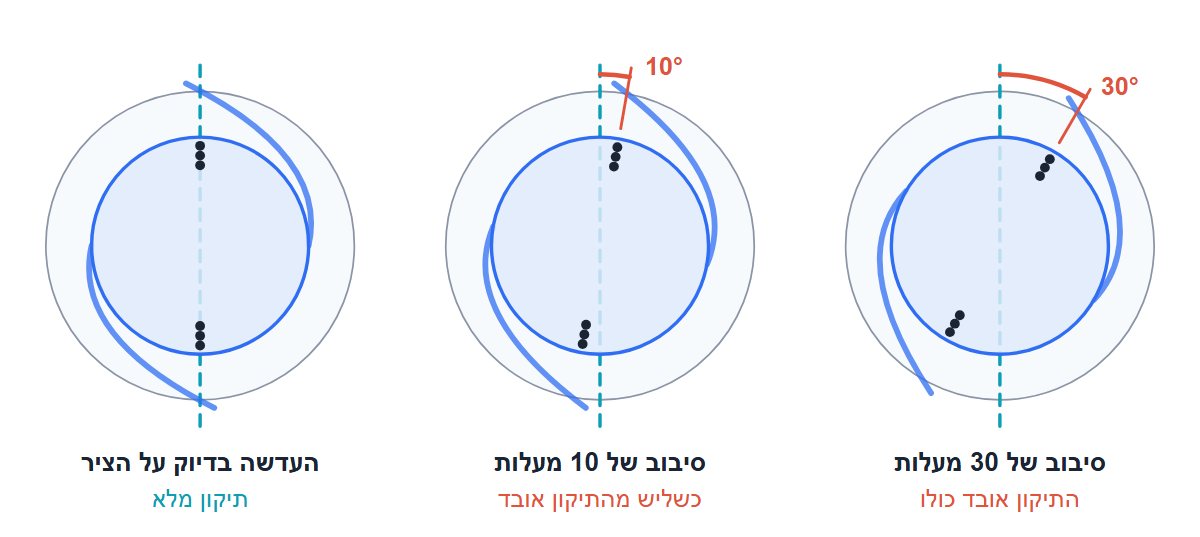
How common is it? Today's lenses are very stable. In a meta-analysis of 51 studies, which included about 4,900 eyes, the average rotation was only about 2.4 degrees. Most of the rotation happens in the first hours and days after surgery, before the capsular bag in which the lens sits tightens around it. The risk is slightly higher in long eyes (high myopia), in which the bag is larger.
How can you tell? The sign is blurred vision or doubled outlines in the first days and weeks. At the exam, after the pupil is dilated, the marks on the lens can be seen and compared with the planned axis.
What is done? When the deviation is significant, the lens can be brought back to its axis in a short procedure in the operating room. This is usually done in the first weeks, before the bag adheres to the lens. In a U.S. database of about 6,500 eyes with a toric lens, such a procedure was needed in 1.3% of eyes in the first year.
And what is in your hands? In the first days, do not rub the eye or press on it, and avoid unusual physical exertion, as detailed on the page After Cataract Surgery.
Residual astigmatism after a toric lens
Even when the lens sits exactly in place, a small amount of astigmatism sometimes remains. The reasons: every measurement has a small margin of error; the surgical incision slightly changes the shape of the cornea; and toric lenses are manufactured in “steps” of power, so there is not always a lens that fits exactly. A residual of up to about half a diopter is usually not noticeable.
When residual astigmatism is bothersome, the options are glasses, bringing the lens back to its axis if it has rotated, or a laser touch-up on the cornea once the eye has stabilized. Only rarely does the lens need to be exchanged. More detail is on the pages about vision correction after cataract surgery and lens exchange and add-on lenses.
The cornea continues to change slowly with age, and its astigmatism tends to drift gradually toward “against the rule.” So years after a successful operation, a small amount of astigmatism may appear, even though the lens has not moved.
Alternatives to a toric lens: relaxing incisions and laser enhancement
| Method | How it works | What you need to know |
|---|---|---|
| Relaxing incisions in the cornea (LRI, arcuate incisions) | Small incisions at the periphery of the cornea, made with a blade or a femtosecond laser, that flatten the steep axis | Suited mainly to low astigmatism. The result is less predictable, and part of the effect may fade over time |
| Laser enhancement on the cornea (PRK or LASIK) | A separate procedure, once the eye has stabilized | Accurate for small residuals, but it is an additional procedure, and it requires a suitable cornea |
| Glasses | A cylinder lens in glasses after surgery | A simple, safe solution for anyone who does not mind wearing glasses for distance as well |
In head-to-head comparisons the toric lens is more accurate than incisions: in the Kessel meta-analysis, residual astigmatism was lower with a toric lens than with a standard lens plus relaxing incisions, and a 2025 meta-analysis reached a similar conclusion for arcuate incisions made with a femtosecond laser as well. Incisions remain a reasonable alternative when astigmatism is low or when a toric lens is not suitable.
Who is a toric lens less suitable for?
A toric lens is designed for regular astigmatism, in which the two axes are perpendicular to each other and the map is symmetric. In irregular astigmatism, for example in keratoconus or after a corneal scar, a toric lens corrects only part of the distortion, and the result is less predictable. In such cases the decision is based on the corneal map and on how stable the condition is.
Dr. Stern chooses a toric lens based on the measurements of your eye and on what matters to you in everyday life. On the surgery itself, see cataract surgery in Jerusalem.
When should you see a doctor?
If your vision is blurred after a toric lens has been implanted, or outlines look doubled and do not improve, mention it at your follow-up visit and do not wait months: the axis of the lens is easier to correct in the first weeks. A sudden drop in vision, pain or increasing redness after surgery calls for an urgent exam by an ophthalmologist or at an eye emergency room.
Frequently asked questions
How much astigmatism justifies a toric lens?
According to the European guidelines (ESCRS, 2024), a toric lens is considered from about one diopter of corneal astigmatism. The benefit is especially clear from 1.5 to 2 diopters and up. What counts is the astigmatism of the cornea, not the number written in your glasses prescription.
Will I be free of glasses after a toric lens?
For distance, most patients need glasses much less, but there is no guarantee. A monofocal toric lens does not correct reading, so reading glasses will usually still be needed with it.
How will I know if the toric lens has rotated?
The sign is blur or doubled outlines in the first days and weeks after surgery. The doctor checks the axis marks on the lens after dilating the pupil. When the deviation is significant, the lens can be brought back to its axis in a short procedure.
Can astigmatism be corrected in cataract surgery without a toric lens?
Yes. Low astigmatism can be reduced with relaxing incisions in the cornea, and a residual can be corrected after surgery with glasses or with laser on the cornea. In comparative studies the toric lens was more accurate than incisions.
Can astigmatism come back years after surgery?
The lens itself hardly moves after the first weeks. But the cornea continues to change slowly with age, so a small amount of astigmatism can appear gradually over the years. It is usually corrected with glasses.
References
- Wanten JC, Till V, Findl O, Cochener-Lamard B, Kohnen T, Nuijts RM. ESCRS guideline for cataract surgery 2024: executive summary. J Cataract Refract Surg. 2026;52(9):e1-e13. Link
- Kessel L, Andresen J, Tendal B, Erngaard D, Flesner P, Hjortdal J. Toric intraocular lenses in the correction of astigmatism during cataract surgery: a systematic review and meta-analysis. Ophthalmology. 2016;123(2):275-286. Link
- American Academy of Ophthalmology. Basic and Clinical Science Course, Section 11: Lens and Cataract. 2022-2023 ed. Chapter 9: Optimizing refractive outcomes of cataract surgery.
- Li ES, Vanderford EK, Xu Y, Kang PC. Rotational stability of toric intraocular lenses by lens model and haptic design: systematic review and single-arm meta-analysis. J Cataract Refract Surg. 2024;50(9):976-984. Link
- Kramer BA, Berdahl J, Gu X, Merchea M. Real-world incidence of monofocal toric intraocular lens repositioning: analysis of the American Academy of Ophthalmology IRIS Registry. J Cataract Refract Surg. 2022;48(3):298-303. Link
- Koch DD, Ali SF, Weikert MP, Shirayama M, Jenkins R, Wang L. Contribution of posterior corneal astigmatism to total corneal astigmatism. J Cataract Refract Surg. 2012;38(12):2080-2087. Link
- Lin X, Ma D, Yang J. Insights into the rotational stability of toric intraocular lens implantation: diagnostic approaches, influencing factors and intervention strategies. Front Med (Lausanne). 2024;11:1349496. Link
- Yen WT, Weng TH, Lin TY, Tai MC, Chen YH, Chang Y. Femtosecond laser-assisted astigmatic keratotomy versus toric IOL implantation for correcting astigmatism in cataract patients: a systematic review and meta-analysis with trial sequential analysis. Br J Ophthalmol. 2025;109(3):324-332. Link