

In brief
- In high myopia the eye is longer than usual. Cataract often appears earlier in people with high myopia, and surgery can also correct the nearsightedness itself.
- In a long eye it is harder to calculate the lens power. Newer formulas or a special correction for the length of the eye are used, and it is usually preferable to end up mildly nearsighted rather than farsighted.
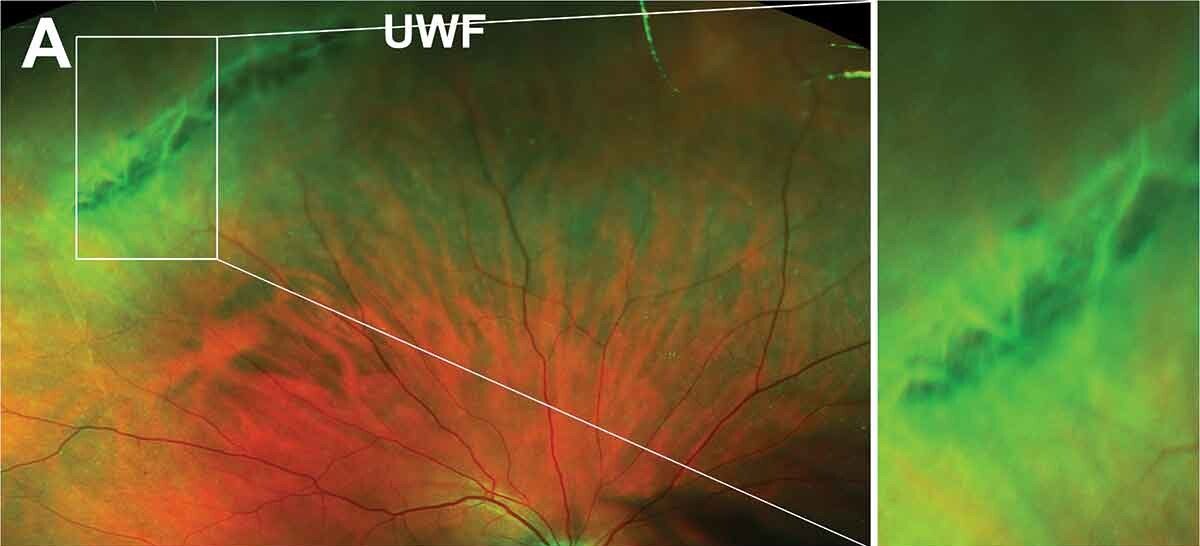
- The risk of retinal detachment after cataract surgery is higher in a long eye, especially at a relatively young age. That is why the edges of the retina are examined before surgery, and why you should know the warning signs afterward.
- When only one eye has a cataract, how the two eyes will be balanced has to be planned in advance.
- If the macula has been damaged by the nearsightedness, visual acuity after surgery is limited accordingly, and a monofocal (single-focus) lens is usually chosen.
What is special about an eye with high myopia?
In most cases high myopia (usually more than 6 diopters) results from the eyeball being longer than usual. The average length of an eye is about 23 to 24 millimeters, and in high myopia it reaches 26 millimeters or more. As the eye lengthens, the retina is stretched and becomes thinner, mainly at the edges and at the center of vision. You can read about nearsightedness in general on the page Nearsightedness (Myopia).
High myopia is also linked to earlier onset of cataract, mainly in the nucleus of the lens and in its back part. A familiar early sign is an increase in the glasses prescription: the nearsightedness gets worse in adulthood, because the hardening nucleus focuses light more strongly.
Lens calculation in a long eye: why is it more complicated?
The power of the artificial lens is calculated from the length of the eye and the curvature of the cornea, using a formula. In long eyes there are several difficulties:
- Older formulas tend to err toward farsightedness. In a long eye they quite often recommend a lens that is too weak, and the patient ends up mildly farsighted, a less comfortable result than mild nearsightedness. To correct this, newer formulas and special corrections for the length of the eye have been developed. A 2024 meta-analysis, which pooled studies of more than a thousand long eyes, found that in such eyes the new-generation formulas, and older formulas with a correction for the length of the eye, are more accurate, although the differences between them are small.
- Measuring the length. In a very long eye the back wall sometimes bulges backward, and it is hard to measure exactly to the center of vision. Optical measurement, in which the patient looks at a point of light, measures the length to the macula itself, so it is preferred whenever possible.
- Lenses of very low power. In very high myopia the calculated lens power can be close to zero or even negative. A lens is implanted in that case too, because it stabilizes the structures of the eye and separates its front part from its back part.
More on the measurements and the formulas on the page lens power calculation and biometry.
Which prescription to aim for? Usually mild nearsightedness
Because the error in long eyes tends toward farsightedness, and because most people prefer mild nearsightedness to mild farsightedness, many surgeons aim for mild nearsightedness. Other considerations:
- Reading without glasses. People with nearsightedness are used to reading up close without glasses, by taking them off. After surgery that aims for distance, they will need reading glasses. Some people prefer to aim both eyes for moderate nearsightedness and keep reading without glasses, with glasses for distance. It is worth thinking about this in advance and discussing it at the consultation.
- Balance between the eyes. If only one eye has a cataract, surgery that corrects it for distance will leave a very large difference between the eyes, which glasses cannot bridge comfortably. The solutions: operate on the second eye later, wear a contact lens in the second eye, or aim the operated eye close to the prescription of the second eye.
Retinal detachment after cataract surgery: what is the risk in nearsightedness?
Retinal detachment is a rare complication of cataract surgery, but it is more common in a long eye. In a French population study of more than two million surgeries, the overall risk of retinal detachment within four years was about 1%. In people with high myopia the risk was about six times higher, and it was higher still at a young age, in men and after a complication during surgery. In series of people with high myopia who had cataract surgery, the detachment rate over several years ranged from about 1.5% to 3%.
The main reason is the gel that fills the eye (the vitreous). With age it liquefies and separates from the retina, and in a long eye, with a thin retina, this separation can tear it. Cataract surgery sometimes brings the process forward.
The retinal exam before surgery
Before surgery the back of the eye is examined with the pupils dilated, including the edges of the retina. If a tear or a thin, suspicious area is found, a retina specialist decides whether to treat it with laser before the surgery. Tell your doctor if you have ever had laser treatment to the retina or a retinal detachment in either eye, or if there is retinal detachment in your family.
How is the surgery itself different?
The surgery is done by the same method, but the surgeon adapts it to the long eye. The front part of the eye is deeper, and the lens and its capsular bag tend to move forward and backward with the flow of fluid, so the machine settings are changed and sharp changes in pressure inside the eye are avoided. In a long eye, an anesthetic injection behind the eyeball is usually avoided, and anesthesia with drops and inside the eye is preferred.
Which lens is suitable in high myopia?
- A monofocal lens is the most common choice. When there is significant astigmatism, a toric lens can be chosen.
- A multifocal lens is possible in some patients, when the macula is completely healthy. When the macula has been damaged by the nearsightedness, it is not recommended, because it reduces contrast further.
A full comparison of the lenses is on the page Types of Lenses in Cataract Surgery. If you have had laser surgery in the past to correct your nearsightedness, the calculation is even more complex. See Cataract Surgery After Laser Eye Surgery.
What can you expect?
In most people with high myopia, surgery greatly improves vision and quality of life, and for many of them it is the first time they see in the distance without thick glasses. One possible limitation is the state of the macula: if it has degenerative changes caused by the nearsightedness, sharpness of vision after surgery is limited accordingly, which is why it is checked before surgery with an OCT scan. The rest of the instructions are the same as for any cataract surgery, and they are set out in the complete guide to cataract and on the page instructions after cataract surgery.
Frequently asked questions
Does cataract surgery also correct the nearsightedness?
Yes. The power of the artificial lens is chosen so that it also corrects the nearsightedness. Many people with high myopia see in the distance after surgery without thick glasses, but most will need reading glasses, unless they chose to aim for a certain amount of nearsightedness in order to read without glasses.
Why aim for mild nearsightedness and not for zero?
In a long eye the calculation error tends toward farsightedness, and most people prefer mild nearsightedness to mild farsightedness. Aiming for mild nearsightedness gives a safety margin, and leaves good vision at near and intermediate range.
I have high myopia and a cataract in only one eye. What can be done?
Surgery that corrects the eye for distance will leave a large difference between it and the second eye, which is hard to correct with glasses. It is possible to operate on the second eye later, to wear a contact lens in the second eye, or to aim the operated eye close to the prescription of the second eye. It is best to decide on this in advance.
Does cataract surgery raise the risk of retinal detachment?
Yes, to some extent, and in a long eye the risk is higher than in a normal eye. Most patients will not develop a retinal detachment, but it is important to examine the retina before surgery and to know the warning signs: flashes of light, many new floaters or a shadow in the visual field.
Is laser treatment to the retina needed before cataract surgery?
Only if a tear or a suspicious area is found, and as decided by a retina specialist. In most cases a retinal exam with the pupils dilated is enough, and no preliminary treatment is needed.
References
- Daien V, Le Pape A, Heve D, Carriere I, Villain M. Incidence, risk factors, and impact of age on retinal detachment after cataract surgery in France: a national population study. Ophthalmology. 2015;122(11):2179-2185. Link
- Ma Y, Xiong R, Liu Z, et al. Network meta-analysis of intraocular lens power calculation formula accuracy in 1016 eyes with long axial length. Am J Ophthalmol. 2024;257:178-186. Link
- Wang L, Shirayama M, Ma XJ, Kohnen T, Koch DD. Optimizing intraocular lens power calculations in eyes with axial lengths above 25.0 mm. J Cataract Refract Surg. 2011;37(11):2018-2027. Link
- Neuhann IM, Neuhann TF, Heimann H, et al. Retinal detachment after phacoemulsification in high myopia: analysis of 2356 cases. J Cataract Refract Surg. 2008;34(10):1644-1657. Link
- Alio JL, Ruiz-Moreno JM, Shabayek MH, Lugo FL, Abd El Rahman AM. The risk of retinal detachment in high myopia after small incision coaxial phacoemulsification. Am J Ophthalmol. 2007;144(1):93-98. Link
- Spaide RF, Ohno-Matsui K, Yannuzzi LA, eds. Pathologic Myopia. New York: Springer; 2014. Chapter 21: Special considerations for cataract surgery in the face of pathologic myopia. Link
- Tsai LM, Afshari NA, Brasington CR, et al. 2022-2023 Basic and Clinical Science Course, Section 11: Lens and Cataract. San Francisco: American Academy of Ophthalmology; 2022.