

In brief
- In an eye of normal length the differences between formulas are small. The gap opens up in short and long eyes, in flat or steep corneas and with a shallow or deep anterior chamber.
- In the large comparative studies, Kane, Barrett Universal II and Olsen (the 4-factor version) are more accurate than the third-generation formulas (SRK/T, Holladay 1, Hoffer Q): a gain of 3 to 15 percentage points in the proportion of eyes within ±0.50 D, depending on the study.
- The largest source of error is not the optics but the prediction of postoperative lens position (ELP). This is why a modern formula takes more variables as input.
- Optimizing the constant for each lens model is a prerequisite for any formula, old or new.
- The evidence is retrospective, some of it was written by the formula developers, and most of the new formulas have not been published in full. It is worth calculating with two modern formulas and checking any discrepancy between them.
Where does refractive error come from?
Every formula does two things: an optical calculation (vergence or ray tracing), and a prediction of where the lens will settle inside the eye. The first part is physics. The second is a statistical estimate, because lens position cannot be measured before surgery.
In the error analysis by Norrby (2008), three factors explained most of the error: prediction of lens position (about 35%), determination of the postoperative refraction (about 27%) and measurement of axial length (about 17%). Even a perfect formula will not correct an inaccurate refraction or a faulty measurement, so quality control of the biometry comes before the choice of formula. On this, see the page Pitfalls in Optical Biometry.
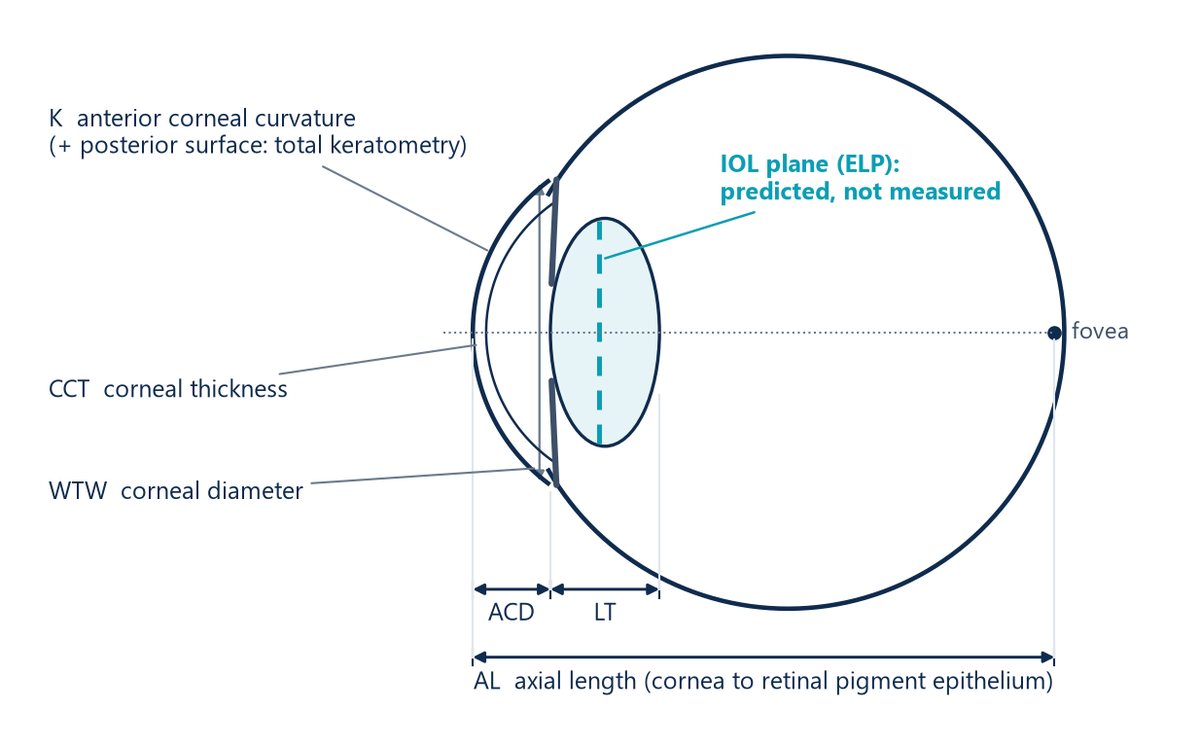
The formula generations and what each one takes as input
The division into “generations” is convenient but misleading, because it conflates age with method. It is more useful to ask how the formula works: vergence formulas (Gaussian optics), ray tracing, artificial intelligence, or a combination of these. Among the vergence formulas the main difference is the number of variables from which the ELP is predicted: two in the third-generation formulas, and up to seven in Holladay 2.
| Formula | Approach | Variables | Notes |
|---|---|---|---|
| SRK/T, Holladay 1, Hoffer Q | Vergence, third generation | AL, K | Published in full. SRK/T is sensitive to a flat or steep cornea, Hoffer Q to chamber depth |
| Haigis | Vergence | AL, K, ACD | Three constants (a0, a1, a2). Without optimization of all three it is a different formula |
| Holladay 2 | Vergence | Up to 7 variables | Unpublished |
| Barrett Universal II | Vergence, thick-lens model | AL, K, ACD, and optionally LT, WTW | Unpublished. The most extensively tested of the modern formulas |
| Olsen | ray tracing | ACD, LT (2-factor), and in the 4-factor version also AL, K | The version on the biometer is not identical to the standalone version, which was found to be more accurate |
| Hill-RBF | Artificial intelligence (pattern recognition) | AL, K, ACD, and in version 3.0 also LT, WTW, CCT and sex | Flags a warning when the eye falls outside its database |
| Kane | Optics, regression and artificial intelligence | AL, K, ACD, sex, and optionally LT, CCT | Unpublished |
| EVO 2.0 | Thick lens, based on the theory of emmetropization | AL, K, ACD, and optionally LT, CCT | Unpublished |
| PEARL-DGS | Thick lens and machine learning | AL, K, ACD, LT, WTW, CCT | Open source, construction method published |
| Hoffer QST | Hoffer Q with a machine-learning component | AL, K, ACD, sex | Includes an adjustment for long eyes |
Most modern formulas are available free online, and the ESCRS calculator runs several of them side by side from the same data.
Comparative accuracy in normal eyes
The standard metrics are the standard deviation of the prediction error, the mean absolute error (MAE) and the proportion of eyes within ±0.50 D of the prediction, after optimization that zeroes the mean error.
| Study | Eyes | Most accurate | Within ±0.50 D |
|---|---|---|---|
| Melles 2018 (Kaiser, USA) | 18,501 | Barrett Universal II | Barrett 80.8%, Haigis 77.1%, SRK/T 74.0%, Hoffer Q 73.0% (one model, 13,301 eyes) |
| Melles 2019 (same database, new formulas) | 18,501 | Kane, followed by Olsen (4-factor) and Barrett | Kane 83.1% |
| Darcy 2020 (NHS, UK) | 10,930 | Kane | Kane 72.0%, Barrett 70.7%, SRK/T 69.1%, Hoffer Q 68.1% |
| Kane & Chang 2021 (review, 37 studies) | 52,049 | Kane, followed by Barrett and Olsen | The leading formula in each study: 62.7% to 90.4% |
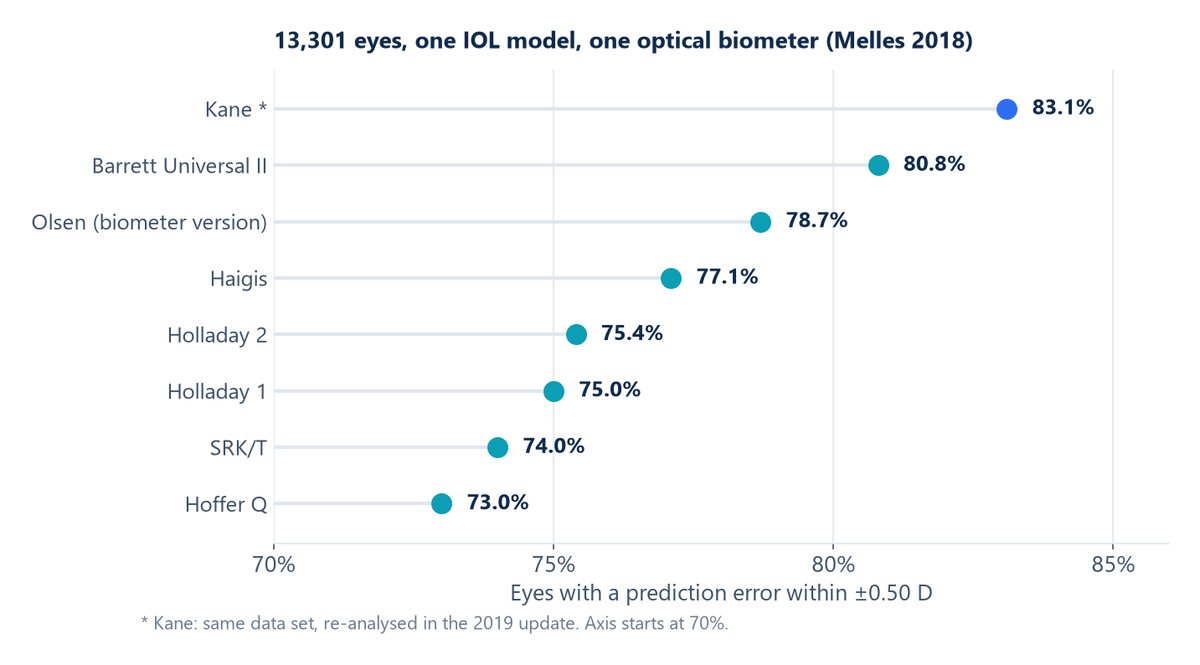
Three things emerge from the numbers. First: the gap between the best and the weakest formula within the same database is about 4 to 10 percentage points, while the gap between one database and another is larger. The quality of the measurements, the refraction and the surgical population matter no less than the formula. Second: in Melles 2018, at axial lengths of 23 to 25 mm all seven formulas predicted within 0.1 D of one another on average, and the difference between them arose outside this range. Third: the systematic review by Stopyra (2023, 29 studies) found that Barrett Universal II, Kane and PEARL-DGS are the ones most often reported as the most accurate. Younger formulas, such as EVO and Hoffer QST, have joined the comparisons only in recent years, and the data on them are more limited.
Constant optimization
The constant (A constant, surgeon factor, pACD, lens factor) translates the lens model, the biometer and the surgical environment into an average lens position. Optimization is the process that brings the mean prediction error to zero, and it is done separately for each lens model. According to Hoffer and Savini (2021) it should preferably be based on at least 100 eyes, and 50 is a reasonable minimum when there is no alternative.
- The manufacturer's constant is only a starting point. Even in the Melles database the optimized constants differed from the manufacturers' constants. Public databases of constants optimized for optical biometry (IOLCon, and before it ULIB) are closer to reality.
- A consistent postoperative offset (for example −0.25 D on average) is a constant problem, not a formula problem. A wide spread is a measurement or formula problem.
- Unpublished formulas cannot be optimized in an independent spreadsheet, only through the developer's calculator or the biometer software.
- The refraction also feeds into the constant. A refraction measured at 4 meters differs by about 0.08 D from one measured at 6 meters, the recommended distance, so it is worth setting a uniform testing distance.
Which formula for which eye?
| The eye | What the evidence says |
|---|---|
| Normal axial length and K | Any modern formula with an optimized constant. Third-generation formulas are acceptable when there is no alternative (ESCRS 2024 guidelines) |
| Short eye (AL ≤ 22 mm) | Accuracy is lower with every formula. In the review, Kane led in the two largest studies. Details: Calculation in Short and Long Eyes |
| Long eye (AL ≥ 26 mm) | Kane, Barrett or Olsen, or Holladay 1 with the updated Wang-Koch adjustment. Third-generation formulas without adjustment tend toward a hyperopic surprise |
| Steep (>46 D) or flat (<42 D) cornea | Avoid SRK/T. According to the ESCRS, Barrett or EVO with total keratometry may be considered |
| Shallow or deep anterior chamber | A formula that takes ACD as input. In Melles 2018, Barrett had the smallest bias across the ACD range. Among the older formulas, the ESCRS suggests Haigis for an ACD above 3.5 mm and Hoffer Q below 2.5 mm |
| After corneal refractive surgery | Dedicated formulas only: Calculation After LASIK, PRK and RK |
| Keratoconus | Dedicated formulas and a mildly myopic target: Calculation in Keratoconus |
Two additions that are not formulas. The first is the first eye: the prediction error in one eye partly predicts the error in the second eye, so it is worth performing a careful refraction before the second eye. The second is intraoperative aberrometry: according to the review by Kane and Chang it improves outcomes compared with the third-generation formulas, but not when Barrett Universal II or Hill-RBF is used.
Limits of the evidence
- Retrospective studies. There are no randomized trials comparing formulas. The ESCRS guidelines (2024) grade the recommendations on formula choice as very low certainty.
- Developer involvement. Some of the large studies, and also the main review in the field, were co-authored by formula developers. Kane and Chang themselves note that the first publication of a new formula usually shows an advantage that is not always replicated.
- Black box. Barrett, Kane, EVO, Olsen and Holladay 2 have not been published in full, and the versions are updated over time. A result for one version does not necessarily hold for the next: Hill-RBF 2.0, for example, was found to be less accurate than its predecessor in short eyes.
- Generalizability. Most of the data come from a handful of lens models, a single biometer and particular populations. In subgroups (very short or very long eyes) the samples are small.
- Methods. Studies that included both eyes of the same patient, or that did not zero the mean error, bias the comparison. The protocol of Hoffer and Savini defines the rules, and it is worth checking whether a study meets them before adopting its conclusion.
Key points
- Choose two modern formulas that have been tested in independent centers, and use them consistently. A discrepancy of 0.5 D or more between them is a sign of an unusual eye or a suspect measurement.
- Track your own outcomes: mean error, spread, and the proportion of eyes within ±0.50 D. This is the basis for optimizing the constant.
- Switching formulas will not compensate for unstable keratometry or an incorrect axial length.
- Give the patient a range, not a number: even under optimal conditions, one eye in five to ten will be off by more than half a diopter. When that happens: Management of Refractive Surprise.
Frequently asked questions
Which IOL formula is the most accurate?
In the large comparative studies (up to about 18,500 eyes), Kane, Barrett Universal II and the 4-factor version of Olsen lead, with about 80% to 83% of eyes within half a diopter of the prediction under good measurement conditions. The differences between them are small, and the evidence is retrospective.
Is a different formula still needed for a short eye and a long eye?
Not necessarily. The modern formulas maintain their accuracy across the entire range of axial lengths, and the authors of the updated Kaiser study (2019) wrote that switching between Hoffer Q, Holladay 1 and SRK/T can be abandoned. In extreme eyes accuracy is still lower with every formula.
How many eyes are needed to optimize a constant?
Preferably at least 100 eyes for each lens model, and 50 as a minimum when there is no alternative, with an accurate refraction after stabilization and a uniform testing distance.
References
- Kane JX, Chang DF. Intraocular lens power formulas, biometry, and intraoperative aberrometry: a review. Ophthalmology. 2021;128(11):e94-e114. Link
- Melles RB, Holladay JT, Chang WJ. Accuracy of intraocular lens calculation formulas. Ophthalmology. 2018;125(2):169-178. Link
- Melles RB, Kane JX, Olsen T, Chang WJ. Update on intraocular lens calculation formulas. Ophthalmology. 2019;126(9):1334-1335. Link
- Darcy K, Gunn D, Tavassoli S, Sparrow J, Kane JX. Assessment of the accuracy of new and updated intraocular lens power calculation formulas in 10 930 eyes from the UK National Health Service. J Cataract Refract Surg. 2020;46(1):2-7. Link
- Stopyra W, Langenbucher A, Grzybowski A. Intraocular lens power calculation formulas: a systematic review. Ophthalmol Ther. 2023;12(6):2881-2902. Link
- Hoffer KJ, Savini G. Update on intraocular lens power calculation study protocols: the better way to design and report clinical trials. Ophthalmology. 2021;128(11):e115-e120. Link
- Norrby S. Sources of error in intraocular lens power calculation. J Cataract Refract Surg. 2008;34(3):368-376. Link
- Wanten JC, Till V, Findl O, Cochener-Lamard B, Kohnen T, Nuijts RM. ESCRS guideline for cataract surgery 2024: executive summary. J Cataract Refract Surg. 2026;52(9):e1-e13. Link