

In brief
- Halos, glare, starbursts or streaks of light around light sources (“positive dysphotopsia”), as well as a dark shadow at the outer side of the visual field (“negative dysphotopsia”), are well-known phenomena after cataract surgery, even when the surgery went perfectly.
- In the first weeks they are common: in surveys, up to about half of patients noticed some kind of light phenomenon. In the great majority they are mild and fade over time.
- Complaints that persist and are truly bothersome are rare.
- With a multifocal lens, halos at night are part of the optics of the lens. They do not disappear completely, but in most patients the brain gets used to them within months.
- Before blaming the lens, the doctor looks for a treatable cause: a residual prescription, dry eye or secondary cataract.
What are these phenomena, and why do they appear after cataract surgery?
Ophthalmologists call these phenomena dysphotopsia (dysphotopsia): unwanted light phenomena that appear after completely uneventful cataract surgery. There are three types:
- Positive dysphotopsia: “extra” light. Halos, glare, starbursts, streaks or arcs of light, and sometimes a flash in the center. They appear only when there is an external light source, usually light coming from the side.
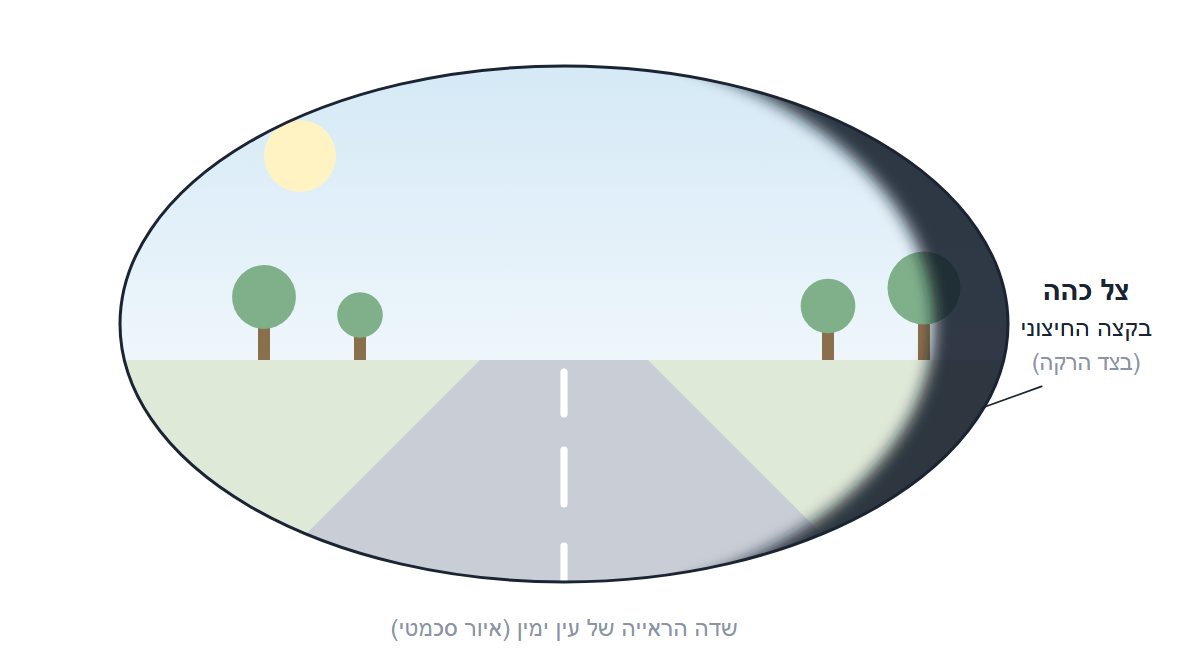
- Negative dysphotopsia: “missing” light. A dark shadow shaped like an arc or a crescent at the outer edge of the visual field, on the temple side.
- Halos from multifocal and EDOF lenses: rings of light around lamps at night, which result from the way these lenses divide the light.

How common is it?
- In a telephone survey of about 300 people who had undergone surgery, about half reported that they had noticed some kind of light phenomenon at some point after surgery. In another study, about one in five reported it as early as the day after surgery.
- A dark shadow at the side: about 15% to 20% of patients ask about it in the first days. One year after surgery, about 3% still have it.
- Severe complaints that persist are rare. In a series of more than 6,600 people who had undergone surgery, only about 0.2% had persistent phenomena.
The numbers are taken from a review published in the journal Ophthalmology in 2021, and they refer to standard monofocal lenses. Some of the studies are old, and lens design has improved since then.
Why does it happen?
Positive light phenomena: the edge of the lens
The intraocular lens is much smaller and thinner than the natural lens: its optical part is about 6 mm in diameter, and its posterior edge is sharp and square. Light that enters the eye at an angle, from the side, can strike this edge and be reflected onto the retina as a streak, an arc or a flash. The material also plays a part: materials with a high refractive index reflect more light.
So why not round off the edge? Because the sharp edge is what slows the clouding of the capsule behind the lens (secondary cataract). This is a deliberate compromise, and manufacturers continue to improve edge design to reduce the reflections.
The dark shadow at the side: an “illumination gap”
The accepted explanation is that at the edge of the retina, on the side nearest the nose, a narrow strip forms that no light reaches: on one side the retina receives the light that passed through the lens, on the other side the light that passed beside it, and a gap remains between them. The brain sees this gap as a shadow on the temple side. Surprisingly, the phenomenon has been described only when the lens sits exactly in place, inside the capsular bag. It is more noticeable when the pupil is small, for example in bright light, and less noticeable when the light coming from the side is blocked.
Multifocal and EDOF lenses
A multifocal lens creates several focal points at once. When you look at a distant lamp, the out-of-focus images appear as rings of light around it. That is why halos are three to four times more common with these lenses than with a monofocal lens, according to the Cochrane review. With EDOF lenses, the halos depend on the type of lens. For details, see the pages How to Choose a Multifocal Lens and EDOF Lenses.
Other causes, which can be treated
Not every halo comes from the lens. Glare and halos after surgery can also result from a residual prescription or residual astigmatism, from dryness of the surface of the eye, from clouding of or a wrinkle in the capsule behind the lens, and from mild corneal edema in the first days. All of these can be treated.
Does it go away? The natural course
- The dark shadow: fades in most patients in the first months, probably because the brain learns to ignore it. Of the 15% to 20% who notice it at first, about 3% still have it after one year.
- Streaks, arcs and glare: in most cases they are mild and do not interfere with daily function. According to the review, the brain adapts to them less well than to the dark shadow, so people who are very troubled by them sometimes need treatment.
- Halos from a multifocal lens: they are a property of the lens and do not disappear, but they become less and less bothersome as the brain adapts. Most of the improvement is felt within three to six months, and it sometimes continues for up to a year.
What can be done?
- Check whether there is a treatable cause. Glasses or correction of a residual prescription, treatment of dry eye, and YAG laser when the capsule has become cloudy. In a study of patients who were dissatisfied with a multifocal lens, a treatable cause was found in more than 80%, and the lens was exchanged in only about 4%.
- Give it time. When the phenomenon is tolerable, the approach is to wait a few months. Most phenomena fade.
- Simple measures. For positive light phenomena, drops that constrict the pupil sometimes help, by a doctor's prescription. For the dark shadow, glasses with a thick frame, which block the light from the side, sometimes help.
- Surgery, in rare cases. When the phenomenon is severe and persists for months, there are surgical solutions. For positive phenomena: exchanging the lens for one made of a different material or with a different edge design, which helped most patients in the published series. For the dark shadow: moving the optical part of the lens in front of the opening of the capsular bag, implanting a thin add-on lens in front of the existing lens, or laser treatment of the edge of the anterior capsule. Exchanging the lens for another lens in the same position did not help the dark shadow. For details, see the page Lens Exchange and Add-On Lenses.
When should you see a doctor?
Mention these phenomena at your routine follow-up visit, even if they are mild: your description is the main diagnostic tool, because no test measures them. Go urgently to an ophthalmologist or an eye emergency room if you have flashes of light even in the dark or with your eyes closed, a “shower” of black dots, a curtain or a shadow that keeps growing, a sudden drop in vision, pain or increasing redness. These are not dysphotopsia, and they may indicate a problem with the retina or another complication.
Physicians will find professional details on the page Diagnosis and Management of Dysphotopsia.
Frequently asked questions
Do halos and glare after cataract surgery go away?
In most patients they fade in the first weeks and months. Severe complaints that persist are rare. If the phenomenon does not improve, it is worth being examined: sometimes the cause is a residual prescription, dry eye or secondary cataract, and it can be treated.
What is the dark shadow at the side of the eye after cataract surgery?
This is negative dysphotopsia: a crescent-shaped shadow at the outer edge of the visual field. About 15% to 20% of patients notice it in the first days, and after one year about 3% still have it. A shadow of this kind, which appears immediately after surgery and does not grow, does not indicate damage to the eye. A new shadow that appears later or that keeps growing requires an urgent examination.
Why do I see rings of light around lamps at night after a multifocal lens was implanted?
A multifocal lens creates several focal points at once, and the out-of-focus images appear as rings of light. This is a property of the lens, not a defect. In most patients the brain adapts, and most of the improvement is felt within three to six months.
Does YAG laser solve halos and glare?
Only when the cause is clouding of or a wrinkle in the capsule behind the lens. If the cause is the lens itself, the laser will not help, and it also complicates a future lens exchange. That is why the cause is established first.
When is a lens exchange considered because of halos or glare?
Only when the phenomenon is severe, persists for months, and no other treatable cause has been found. This happens in a small minority of patients. For the dark shadow at the side there are other solutions, such as an add-on lens, and an ordinary lens exchange does not help it.
References
- Masket S, Fram NR. Pseudophakic dysphotopsia: review of incidence, cause, and treatment of positive and negative dysphotopsia. Ophthalmology. 2021;128(11):e195-e205. Link
- de Silva SR, Evans JR, Kirthi V, Ziaei M, Leyland M. Multifocal versus monofocal intraocular lenses after cataract extraction. Cochrane Database Syst Rev. 2016;12:CD003169. Link
- Wanten JC, Till V, Findl O, Cochener-Lamard B, Kohnen T, Nuijts RM. ESCRS guideline for cataract surgery 2024: executive summary. J Cataract Refract Surg. 2026;52(9):e1-e13. Link
- Alio JL, Plaza-Puche AB, Fernandez-Buenaga R, Pikkel J, Maldonado M. Multifocal intraocular lenses: an overview. Surv Ophthalmol. 2017;62(5):611-634. Link
- de Vries NE, Webers CA, Touwslager WR, Bauer NJ, de Brabander J, Berendschot TT, et al. Dissatisfaction after implantation of multifocal intraocular lenses. J Cataract Refract Surg. 2011;37(5):859-865. Link
- Leysen I, Bartholomeeusen E, Coeckelbergh T, Tassignon MJ. Surgical outcomes of intraocular lens exchange: five-year study. J Cataract Refract Surg. 2009;35(6):1013-1018. Link