

In brief
- A light adjustable lens (LAL) is an intraocular lens whose power can be changed after surgery, by exposure to ultraviolet (UV) light, with no further surgery.
- This makes it possible to fine-tune the prescription and the astigmatism according to the actual result, and even to “try out” monovision before deciding.
- In studies, more than 90% of eyes ended up within half a diopter of the target after the adjustment.
- The trade-off is mainly in time and diligence: several visits with pupil dilation, and glasses that protect against UV radiation until a full day after the last treatment.
- The availability of the lens varies widely between countries and between centers. It is worth asking in advance whether it is offered at the center where you will have your surgery.
What is a light adjustable lens?
In standard cataract surgery the lens power is set before surgery, based on measurements and a calculation. The calculation is very accurate, but not perfect: in about one fifth of eyes the result is more than half a diopter away from the target. And if the result is not accurate, correcting it requires glasses, laser on the cornea or further surgery.
The light adjustable lens reverses the order. A lens with a power calculated in the usual way is implanted, and a few weeks after surgery, when the eye has healed and the prescription is stable, the lens is adjusted until the desired result is reached. The lens was approved for use in the United States in 2017, and a second generation, with improved protection against UV radiation from the environment, came out in 2021.
How does it work?
The lens is made of silicone, and small molecules that are sensitive to UV light are dispersed within the material. A special device shines UV light onto the lens in a precise pattern, through the dilated pupil. In the illuminated area the molecules link to one another, and molecules from the other areas migrate into it. This area thickens slightly, which changes the curvature of the lens and, with it, its power. When the center of the lens is illuminated, the center thickens and the lens becomes stronger. Other light patterns weaken it or correct astigmatism.
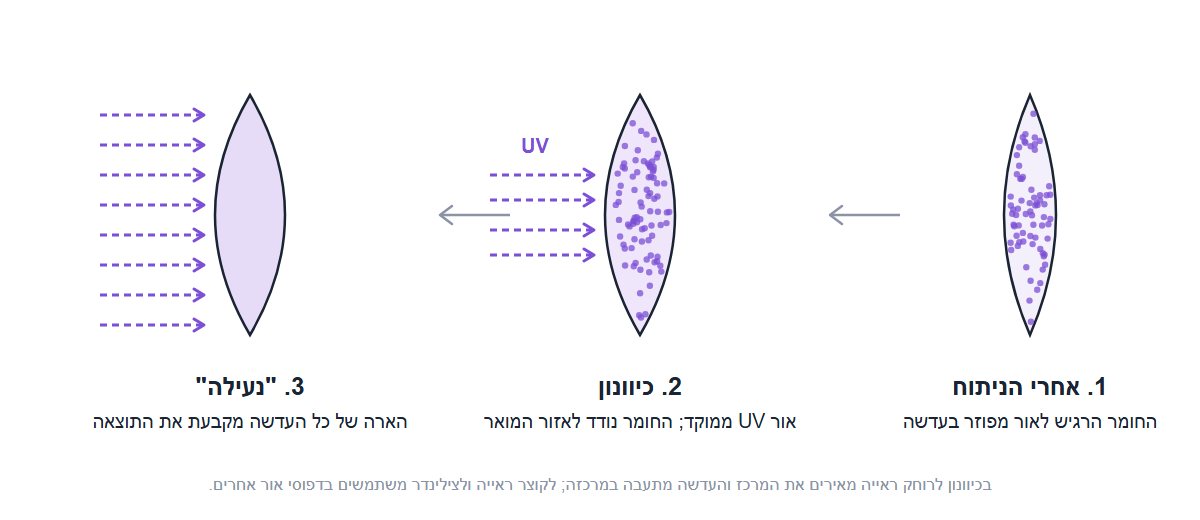
At the end of the process a “lock-in” is performed: the entire lens is exposed to the light, so that all the remaining molecules link up, and the power will no longer change. From that moment on it is an ordinary lens in every respect.
What does the process look like, and what are the UV glasses?
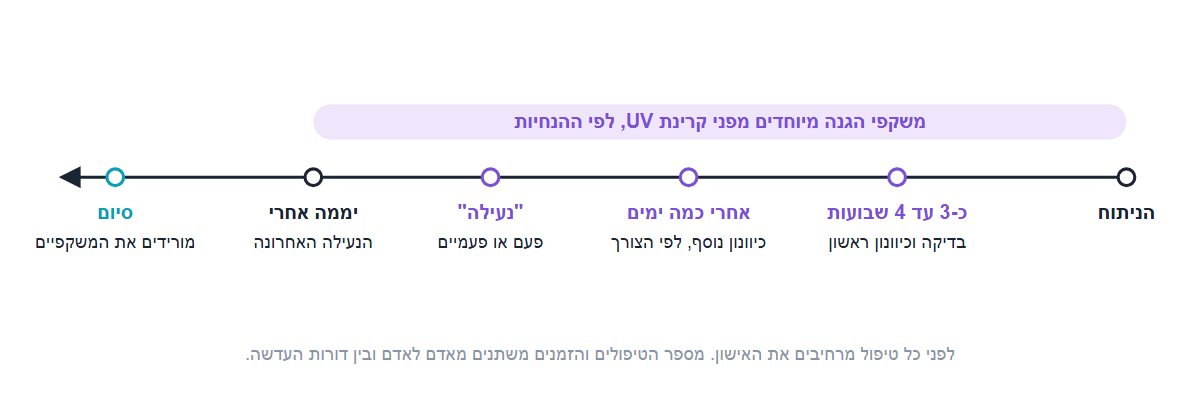
- The surgery: standard cataract surgery, with implantation of the adjustable lens.
- Protective glasses: from the day of surgery you wear special glasses that block UV radiation, until a full day after the last treatment. Sunlight contains UV radiation, and without protection it may change the lens in an uncontrolled way.
- Adjustment: this usually begins about three to four weeks after surgery. At each visit your vision and prescription are checked, the pupil is dilated and the lens is exposed to the light. Up to three adjustments are done as needed, and the whole process usually ends about five to six weeks after surgery.
- Lock-in: one or two treatments, once the desired result has been reached. A day later you can stop wearing the glasses.
What do the studies say?
- Accuracy: in a multicenter data registry published in 2025, 91% to 94% of eyes were within half a diopter of the target, compared with about 70% to 85% with standard lenses in large series.
- Compared with a standard lens: in the trial that led to the approval of the lens in the United States, eyes with the adjustable lens achieved 20/20 vision without glasses about twice as often as eyes with a standard monofocal lens. In a small controlled trial in patients with astigmatism, 79% reached 20/20 compared with 33%.
- After laser eye surgery: this is one of the interesting indications, because in these eyes the calculation is less accurate (see Cataract Surgery After Laser Eye Surgery). In a series of 76 eyes, 86% were within half a diopter. However, other studies in such eyes showed less favorable results, and the picture is still not clear-cut.
- “Customized” monovision: one eye can be adjusted for distance and the other for near, you can see how it feels in everyday life, and it can be changed before lock-in. In one series, 25 of 26 patients who chose this saw 20/20 at distance and read small print without glasses. On monovision, see Monovision and Mini-Monovision.
- Long term: in a follow-up of about seven years the power remained stable, and no problems related to the lens were found.
Advantages and disadvantages
| Advantages | Disadvantages and limitations |
|---|---|
| The power and the astigmatism are adjusted after the eye has healed | Several additional visits, each with pupil dilation |
| High accuracy, even when the calculation before surgery is difficult | UV-protective glasses are mandatory until a full day after lock-in |
| You can “try out” monovision before deciding | After the treatments, in some patients colors look reddish for a while; in most cases this passes |
| The treatment itself is non-invasive | A silicone lens: less suitable for people who may need retinal surgery with silicone oil in the future |
| Requires a pupil that dilates well, and is not suitable for an irregular cornea |
In the trial that led to the approval of the lens, rare events were also described: a persistent change in color vision, and in one case temporary damage to the retina that was attributed to a faulty filter in the first-generation light delivery device. The improvements in the second generation are intended to reduce such risks.
Who might it suit?
- People who have had laser eye surgery (LASIK, PRK) or corneal incisions (RK) in the past, in whom the lens power is hard to calculate.
- People for whom reaching the target exactly is very important, or who want to test monovision in real life.
- People who can come to several visits and be strict about the protective glasses.
It is less suitable when the pupil does not dilate well, when the cornea is irregular, and when the patient cannot commit to the visits and the glasses.
Is the lens available?
As of 2026, most of the studies of the lens from recent years were carried out in the United States. Its availability varies widely between countries and between centers, because it requires a dedicated light delivery device and a team that is skilled in the process. In the review published by Dr. Stern and Prof. Gatinel (2025), they note that it is a good option for complex eyes, but that it is still not available to many surgeons. If the lens interests you, ask your surgeon whether it is offered at the center where you will have your surgery, and what the alternatives are.
When the lens is not available, there are other ways to reach an accurate result: meticulous measurements, dedicated formulas, and a supplementary correction with laser or with an add-on lens if needed. See Lens Exchange and Add-On Lenses and Types of Lenses in Cataract Surgery.
Frequently asked questions
How is the power of the lens changed after surgery?
A special device shines UV light onto the lens in a precise pattern, through the dilated pupil. The light causes the material inside the lens to migrate and change its shape, and with it the power. At the end a lock-in is performed that fixes the result.
How long do you need to wear the UV glasses?
From the day of surgery until a full day after the last lock-in treatment, usually a few weeks. The glasses protect the lens from UV radiation from the sun, which may change it in an uncontrolled way.
Is the adjustment painful?
No. The pupil is dilated with drops, and the patient sits in front of the device during the light treatment. After the treatments some patients see colors with a reddish tint for a while, and in most cases this passes.
Is the lens suitable for people who have had laser eye surgery?
This is one of its interesting indications, because after laser surgery the lens power is hard to calculate. In studies the results were mostly good, but not uniform, so the decision is individual and also depends on the condition of the cornea.
Is the light adjustable lens available in Israel?
Its availability varies widely between countries and between centers, because it requires a dedicated light delivery device and a skilled team. Ask your surgeon whether it is offered at the center where you will have your surgery, and what the alternatives are.
References
- Jun JH, Lieu A, Afshari N. Light adjustable intraocular lenses in cataract surgery: considerations. Curr Opin Ophthalmol. 2024;35(1):44-49. Link
- Doane J, Newsom TH, Slade S, Thompson V, Bruns N, Vukich J. Clinical data registry comparing outcomes of two light adjustable lenses. J Cataract Refract Surg. 2025;51(11):948-954. Link
- Folden DV, Wong JR. Visual outcomes of an enhanced UV protected light adjustable lens using a novel co-managed, open-access methodology. Clin Ophthalmol. 2022;16:2413-2420. Link
- Moshirfar M, Wagner WD, Linn SH, Skanchy DF, Brown TW, Gomez AT, et al. Astigmatic correction with implantation of a light adjustable vs monofocal lens: a single site analysis of a randomized controlled trial. Int J Ophthalmol. 2019;12(7):1101-1107. Link
- Jones M, Terveen DC, Berdahl JP, Thompson V, Kramer BA, Ferguson TJ. Clinical outcomes of the light-adjustable lens in eyes with a history of prior corneal refractive surgery. J Cataract Refract Surg. 2024;50(9):936-941. Link
- Schojai M, Schultz T, Schulze K, et al. Long-term follow-up and clinical evaluation of the light-adjustable intraocular lens implanted after cataract removal: 7-year results. J Cataract Refract Surg. 2020;46(1):8-13. Link
- Stern B, Gatinel D. Presbyopia correction in lens replacement surgery: a review. Clin Exp Ophthalmol. 2025;53(6):668-681. Link
- Vroman J, Groat B, Werner L, Sahler R, Liu M, Mian Z. Postoperative refractive changes in second-generation light adjustable lenses possibly associated with tanning bed exposure: a bilateral case report with laboratory analyses. Am J Ophthalmol Case Rep. 2026;44:102648. Link