

In brief
- Cataract surgery is one of the safest and most successful operations in medicine. In databases of millions of surgeries, more than 90% of patients achieve good vision, and most complications can be treated.
- The most common significant complication during surgery is a tear in the posterior capsule: about one surgery in every 100. Even then, most patients achieve good vision.
- Sight-threatening complications, such as an infection inside the eye, are rare: around one case per 1,000 surgeries, and in many databases fewer than that.
- The risk is not the same for everyone. It depends on the eye, on your general health and on the type of cataract, so it is important to hear from your surgeon what your personal risk is.
- Increasing pain, a drop in vision, worsening redness, flashes or a “curtain” after surgery mean you should seek care immediately.
How safe is cataract surgery? The numbers
The numbers on this page come from national and international databases, each of which has recorded hundreds of thousands to millions of surgeries: the European registry EUREQUO, the Swedish national registry and the United Kingdom's national database. These are real-world data, including complex eyes and surgeons at the start of their careers, so they give a realistic picture rather than an overly optimistic one.
The overall picture: in the European registry, which included more than 368,000 surgeries, about 94% of patients reached a visual acuity of 20/40 or better with glasses, and about 61% reached full 20/20 vision. In fewer than 2%, vision after surgery was worse than before it. In the UK database, a considerable loss of visual acuity was recorded in about 1.5% of eyes, mainly eyes that had another disease or had a complication during surgery.
What can happen during surgery?
Posterior capsule tear
The natural lens sits inside a very thin bag, the capsule, and the artificial lens is implanted inside it. The back wall of the bag is extremely thin, and sometimes it tears during surgery. This happens in about one surgery in every 100: about 1.1% in the European registry, about 1% in the UK database in recent years, and about 0.6% in the Swedish registry. The rate has been falling steadily over the years.
When it happens, the surgeon clears the vitreous that has been pushed forward, and sometimes implants a different type of lens or places the lens in a different position. The surgery takes longer and recovery is slower, but in the European registry about 90% of the eyes in which the capsule tore still reached a vision of 20/40 or better. A capsule tear raises the risk of other complications, including infection, macular edema and retinal detachment, so follow-up afterward is closer.
Dropped lens fragments and bleeding
Rarely, pieces of the lens sink through a tear in the capsule to the back of the eye. This happened in about 7 of every 10,000 surgeries in the European registry, and it requires additional surgery by a retinal surgeon. Severe bleeding beneath the choroid (suprachoroidal hemorrhage) during surgery is rarer still: about one case in 3,500 surgeries in the UK database.
Complications in the first days and weeks
Infection inside the eye (endophthalmitis)
This is the complication surgeons fear most, because it can severely damage vision. It is rare: about 2 cases per 10,000 surgeries in the UK database and in the Swedish registry, and about 1.4 per 1,000 in U.S. public insurance data. Disinfecting the eye with iodine before surgery and an antibiotic injected into the eye at the end of it reduce the risk. In a large controlled European study, the risk of infection without the antibiotic injection was about four and a half times higher. The signs usually appear in the days after surgery: increasing pain, redness and a drop in vision. This is an emergency, and prompt treatment determines the outcome.
Corneal edema and a rise in eye pressure
Blur in the first days because of mild swelling of the cornea, and a temporary rise in pressure, are common and resolve with the drops. Significant swelling that persists was recorded in about 2 of every 1,000 uneventful surgeries in the European registry. It is more common when the cornea is weak to begin with, for example in Fuchs dystrophy.
Macular edema (CME)
Swelling at the center of the retina, which usually appears a few weeks after surgery and causes blur. In a British study of about 82,000 eyes it was diagnosed in about 1.2% of eyes that had no risk factor at all. In people with diabetes the risk is roughly double, and if there is also diabetic damage to the retina it is six times higher. The risk also rises when there is a membrane on the macula, after a retinal vein occlusion, in uveitis, and in people who already developed this kind of edema in the first eye. In most cases the edema resolves within a few months, with drops or on its own. To read more: macular edema after cataract surgery.
Late complications: months and years after surgery
Retinal detachment
Cataract surgery slightly raises the risk of retinal detachment in the years that follow. In the UK database about 0.2% of patients needed surgery for a detachment, and in a Swedish study about 0.5% within a few years. The risk is not equal for everyone: it is higher in younger people, in men, in long eyes (high myopia) and after a capsule tear. In the Swedish study, in men under age 60 with a long eye it reached about 9% within about five years, whereas in people aged 75 and over it was very low. The signs: flashes of light, a sudden increase in floaters, or a shadow advancing across the visual field.
Displacement of the artificial lens
The lens usually stays in place for life. Rarely, most often 6 to 12 years after surgery, the fibers that hold the capsule weaken and the lens moves. The cumulative rate in studies ranges from half a percent to 3%, and it is higher in pseudoexfoliation syndrome, in high myopia and after retinal surgery. See Dislocated Intraocular Lens: When the Lens Moves Out of Place.
Secondary cataract: clouding of the capsule
This is the most common late event, and it is more of a “side effect” than a complication: the capsule behind the lens becomes cloudy, and vision becomes blurred again. In the UK database it was recorded in about one in five patients within three years, and the rate keeps rising with time. The treatment is a short laser procedure in the clinic: see Secondary Cataract and YAG Laser Treatment.
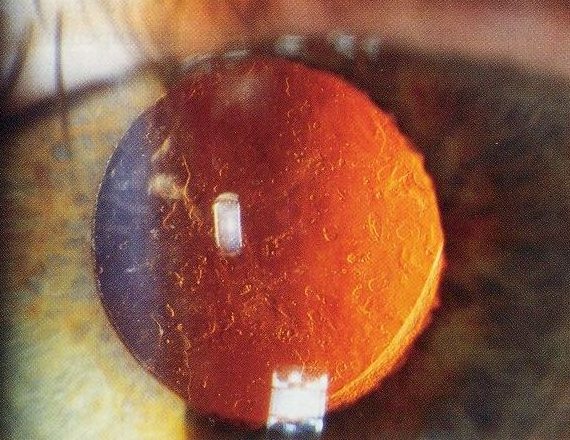
A glasses prescription different from the one planned
The lens calculation is very accurate, but it is not perfect. In the European registry, in about 73% of eyes the result was within half a diopter of the target, and in about 93% within one diopter. A larger deviation is more common after previous eye surgery, including laser vision correction, and in eyes that have another disease. In most cases the solution is glasses, and there are other options as well: see glasses after cataract surgery and vision correction after cataract surgery. On glare and halos that remain after surgery, see halos and glare after cataract surgery.
When does each complication appear?
| When | What can happen | How it shows |
|---|---|---|
| During surgery | Capsule tear, dropped lens fragments, bleeding | The surgeon recognizes it and treats it immediately, and explains it to you after the surgery |
| First days | Corneal edema, a rise in pressure, infection | Blur is expected and passes. Increasing pain, redness and a drop in vision: seek care immediately |
| Weeks | Macular edema | Vision improved, and then becomes blurred again |
| Months to years | Retinal detachment, secondary cataract, displacement of the lens | Flashes, floaters or a shadow: seek care immediately. Gradual blur: have an exam |
Who is at higher risk?
The UK database built a risk model from almost one million surgeries. The factors that raise the risk of a complication during surgery:
- Pseudoexfoliation syndrome or a loose lens: a risk of capsule tear about 3.5 times higher. See pseudoexfoliation and cataract surgery.
- A very advanced cataract, brown or white: about 2.4 times higher. This is one of the reasons not to wait for the cataract to “ripen”.
- A pupil that does not dilate well, among other reasons because of prostate medications of the alpha-blocker family. See prostate medications and cataract surgery.
- Conditions in the eye: high myopia, glaucoma, previous retinal surgery, previous injections into the eye, diabetic damage to the retina, a shallow anterior chamber.
- Difficulty lying still and cooperating during surgery.
- The surgeon's experience: among residents at the start of their training, the complication rate is higher.
A risk factor is not a reason to give up on surgery. It allows the surgeon to prepare in advance: to choose suitable anesthesia, to have devices ready for widening the pupil or stabilizing the capsule, and to plan closer follow-up. That is why it is important to mention every disease, medication and previous surgery at the consultation.
Warning signs after cataract surgery
The rule is simple: something that keeps getting better is usually part of recovery. Something that gets worse is not an ordinary side effect. For details of the ordinary side effects and what to do about them: side effects after cataract surgery and when to see a doctor immediately.
A short overview of the risks also appears in the complete guide to cataract. At the consultation, Dr. Stern goes over with every patient the risks that are relevant to that patient's eye and the ways to reduce them: cataract surgery with Dr. Stern in Jerusalem.
Frequently asked questions
What is the chance of going blind from cataract surgery?
The risk of severe vision loss is very low. Complications such as an infection inside the eye or severe bleeding happen about once in several thousand surgeries, and even when they do, prompt treatment often saves a considerable part of the vision. In the UK database, a considerable loss of visual acuity after surgery was recorded in about 1.5% of eyes, mainly eyes that had another disease.
What is the most common complication of cataract surgery?
During surgery, the most common significant complication is a tear in the posterior capsule, in about one surgery in every 100. In the months and years after surgery, the most common event is secondary cataract, a clouding of the capsule that is treated with a laser in a short procedure.
Are there more complications in very elderly people?
Slightly more. In the UK database, in people aged 90 and over the rate of capsule tear was about 2.7%, compared with about 1% to 2% on average. Even so, most patients at this age, and especially those who have no other eye disease, achieve a considerable improvement in vision, and advanced age in itself is not a reason to give up on surgery.
If I had a complication in my first eye, will it happen again in the second eye?
Not necessarily, but some complications are related to factors that are present in both eyes. For example, people who developed macular edema in the first eye are at higher risk of developing it in the second eye as well: in a British study it appeared in the second eye in about 11% of those who had developed it in the first. That is why it is important for the surgeon to know what happened in the first surgery, in order to adjust the plan and the drops.
What is the difference between a side effect and a complication?
Side effects such as a sandy feeling in the eye, mild blur, light sensitivity and dryness are common in the first days and weeks, and improve gradually. A complication is an event that departs from the usual course and requires additional treatment. The practical rule: what is improving is usually part of recovery, and what is getting worse needs to be examined immediately.
What is done to reduce the risk of infection?
Before surgery, eyelid inflammation is treated if present. In the operating room the eye and the skin are disinfected with iodine, and at the end of surgery an antibiotic is injected into the eye. After surgery it is important to put in the drops as instructed, wash your hands before every drop, not touch the eye and not swim during the first month.
References
- Segers MHM, Behndig A, van den Biggelaar FJHM, et al. Risk factors for posterior capsule rupture in cataract surgery as reflected in the European Registry of Quality Outcomes for Cataract and Refractive Surgery. J Cataract Refract Surg. 2022;48(1):51-55. Link
- Sim PY, Donachie PHJ, Day AC, Buchan J. The Royal College of Ophthalmologists' National Ophthalmology Database study of cataract surgery: Report 17, a risk factor model for posterior capsule rupture. Eye (Lond). 2024;38(18):3495-3503. Link
- Low L, Shah V, Norridge CFE, Donachie PHJ, Buchan J. Royal College of Ophthalmologists' National Ophthalmology Database, Report 10: risk factors for post-cataract surgery endophthalmitis. Ophthalmology. 2023;130(11):1228-1230. Link
- Chu CJ, Johnston RL, Buscombe C, et al. Risk factors and incidence of macular edema after cataract surgery: a database study of 81984 eyes. Ophthalmology. 2016;123(2):316-323. Link
- Thylefors J, Jakobsson G, Zetterberg M, Sheikh R. Retinal detachment after cataract surgery: a population-based study. Acta Ophthalmol. 2022;100(8):e1595-e1599. Link
- Lundström M, Barry P, Henry Y, Rosen P, Stenevi U. Visual outcome of cataract surgery; study from the European Registry of Quality Outcomes for Cataract and Refractive Surgery. J Cataract Refract Surg. 2013;39(5):673-679. Link
- Bro T, Behndig A, Viberg A, et al. Two point four million cataract surgeries: 30 years with the Swedish National Cataract Register, 1992-2021. J Cataract Refract Surg. 2023;49(8):879-884. Link
- Tsai LM, Afshari NA, Brasington CR, et al. 2022-2023 Basic and Clinical Science Course, Section 11: Lens and Cataract. San Francisco: American Academy of Ophthalmology; 2022.