

In brief
- Pseudoexfoliation is a common condition in older age in which a whitish material is deposited on the lens, on the edge of the pupil and on the fibers that hold the lens. It causes no symptoms, and is discovered at an eye exam.
- In cataract surgery it matters for three reasons: the fibers that hold the lens are weaker, the pupil dilates less, and eye pressure tends to rise.
- The surgeon prepares for this in advance, with measures to dilate the pupil and to stabilize the capsular bag. In most cases the surgery goes safely, and vision afterward is similar to vision after routine surgery.
- Even years after successful surgery, the implanted lens may move out of place. This is not common, but it is worth knowing the signs.
- Anyone with pseudoexfoliation needs regular monitoring of eye pressure, after surgery as well.
What is pseudoexfoliation?
Pseudoexfoliation (abbreviated PXF or PEX) is an age-related condition in which the body produces an abnormal fibrous material. In the eye the material is deposited as whitish flakes, resembling dandruff, on the anterior (front) capsule of the lens, on the edge of the pupil, on the zonular fibers that hold the lens in place, and in the angle through which fluid drains from the eye. The material is also found in other tissues of the body, but the problems it causes are recognized mainly in the eye.
The condition has a hereditary background (a link has been found to a gene called LOXL1), and it has also been associated with prolonged sun exposure. Its prevalence differs greatly between populations: in different studies around the world it ranges from less than 1% to more than 30% of older adults, and it rises with age. Pseudoexfoliation is not painful and cannot be felt. It is detected on a slit lamp exam, usually after the pupil is dilated, and it is often more prominent in one eye than in the other.
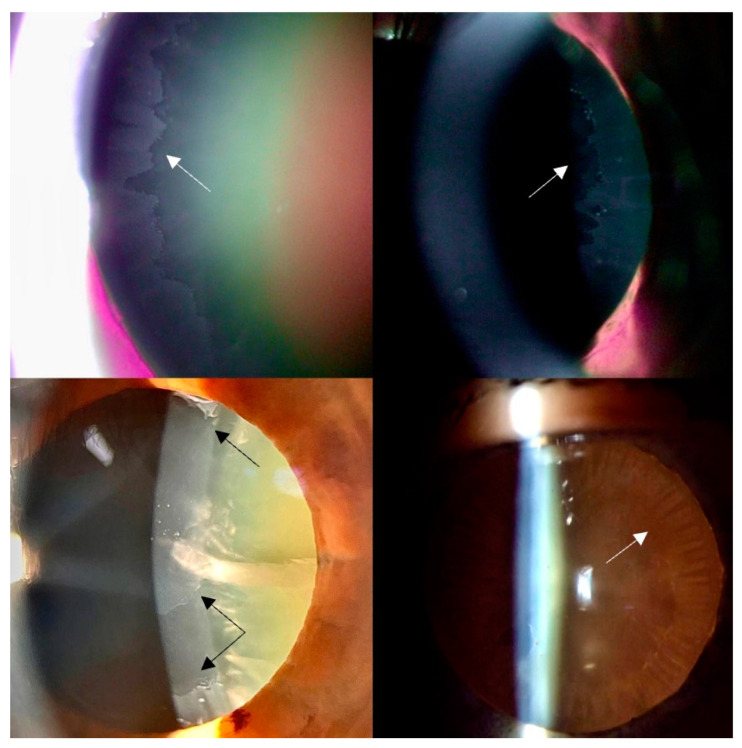
Why does pseudoexfoliation matter in cataract surgery?
In cataract surgery the contents of the cloudy lens are removed and its capsule is left in place: a thin, transparent bag into which the artificial lens is implanted. The bag hangs from a ring of delicate fibers, the zonules. Pseudoexfoliation affects several of the structures that the surgery relies on:
- The zonular fibers are weak. When the fibers are loose, the lens is less stable during surgery, and there is a higher risk of a tear in the capsule or of some of the fibers detaching.
- The pupil dilates less. Through a small pupil it is harder to reach the lens and to work safely.
- Eye pressure. The material, together with pigment from the iris, accumulates in the drainage meshwork, and the pressure tends to rise. Pseudoexfoliation is the most common identifiable cause of secondary glaucoma, and the risk of glaucoma is about three to four times higher than without it. A temporary rise in pressure in the days after surgery is also more common.
- The cornea. The number of cells in the inner layer of the cornea is slightly lower, so corneal edema (swelling of the cornea) after surgery may last a little longer.
How significant is this? In a British database of more than 170,000 cataract surgeries, detachment of the zonular fibers was about six to seven times more common in eyes with pseudoexfoliation, and a tear in the posterior capsule about twice as common. Even so, the great majority of surgeries go without a complication, and the final result is similar: about 85% of eyes with pseudoexfoliation and no other eye disease reached a visual acuity of 20/40 or better within a few weeks, compared with about 89% of eyes without it.
What does the surgeon do differently?
When the surgeon knows in advance that there is pseudoexfoliation, he plans the surgery accordingly:
- Evaluation beforehand. The surgeon checks how well the pupil dilates, whether the lens is stable, what the eye pressure is and what condition the cornea is in.
- Dilating the pupil. With a viscous gel and, if necessary, with fine hooks or a small ring that holds the pupil open during surgery and is removed at the end.
- Stabilizing the capsular bag. When the fibers are weak, a tension ring (Capsular Tension Ring) can be implanted inside the bag; it spreads the load across all the fibers and helps the lens stay centered. In more difficult cases, hooks that support the bag during surgery are used as well.
- Gentle technique. Protecting the cornea with a viscous gel, and breaking up the lens with movements that put as little force as possible on the fibers.
- A backup plan. If the support of the bag is not sufficient, the artificial lens can be fixated in another way, for example to the wall of the eye.
Sometimes the recommendation is not to postpone surgery for too long. Over the years the fibers keep weakening and the lens hardens, and late surgery becomes more complex.
Which lens is suitable?
In most cases a standard monofocal (single-focus) lens is implanted inside the capsular bag. Toric lenses and multifocal lenses are more sensitive to a slight shift or tilt of the lens, so they are considered with caution, and only when the fibers appear stable. Your surgeon will explain what suits your eye. You will find general information on the Types of Lenses in Cataract Surgery page.
After surgery: eye pressure and follow-up
In the first days eye pressure is checked, because a temporary rise is more common with pseudoexfoliation. In the long term, pressure actually tends to fall after cataract surgery: in glaucoma due to pseudoexfoliation an average drop of about 20% has been found. However, the eye keeps producing the material after surgery too, so monitoring of the pressure and the optic nerve continues for life. More on this on the page Cataract Surgery with Glaucoma.
In the months after surgery the opening in the capsule may shrink more than usual. If this happens, the tension can be released with a brief laser treatment in the clinic.
Late displacement of the implanted lens
Because the fibers keep weakening, the artificial lens, together with the bag in which it sits, may move out of place years after surgery that went without any problem. In case series of this kind, the displacement was discovered on average about 8 years after surgery, and pseudoexfoliation was the most common risk factor, in about half of the cases or more. It is important to keep a sense of proportion: among all people who have had surgery this is an uncommon complication, with a cumulative risk estimated at less than 2% even after 25 years. In people with pseudoexfoliation the risk is higher than that, so it is worth knowing the signs. In most cases the situation can be corrected with another operation, in which the lens is re-fixated or exchanged. Details on the Dislocated Intraocular Lens page.
You will find a general explanation of the surgery and how to prepare for it in The Complete Guide to Cataract and on the Before Cataract Surgery page.
Frequently asked questions
Is pseudoexfoliation a dangerous disease?
In itself it is not painful and does not harm vision. Its importance lies in the increased risk of high eye pressure and glaucoma, and in the fact that it requires special preparation for cataract surgery. That is why anyone who has been diagnosed needs regular follow-up with an ophthalmologist.
Can you have cataract surgery if you have pseudoexfoliation?
Yes. The surgery is somewhat more complex, because the pupil dilates less and the fibers that hold the lens are weaker, but the surgeon prepares for this in advance. In the great majority of cases the surgery goes without a complication, and vision afterward is similar to vision after routine cataract surgery.
Is it worth having cataract surgery earlier because of pseudoexfoliation?
Sometimes, yes. Over the years the fibers that hold the lens keep weakening and the lens hardens, and late surgery becomes more complex. The decision is individual, based on how much your vision is affected and on the condition of the eye.
Can the implanted lens move years after surgery?
It is possible, although not common. In pseudoexfoliation the fibers keep weakening after surgery too, and the lens with its bag may move, on average about 8 years after surgery. New blur, double vision in one eye or vision that changes with head position require an examination. In most cases this can be corrected with surgery.
Can a multifocal or toric lens be implanted if you have pseudoexfoliation?
Sometimes, but with caution. These lenses are sensitive to a slight shift or tilt of the lens, and in pseudoexfoliation the risk of that is higher. They are considered when the fibers appear stable, after a full explanation. In most cases the choice is a monofocal (single-focus) lens.
Do you need to continue follow-up after successful cataract surgery?
Yes. The eye keeps producing the pseudoexfoliation material after surgery too, and the risk of high eye pressure and glaucoma remains. So periodic checks of the pressure and of the optic nerve continue.
References
- Shakarchi AF, Soliman MK, Shakarchi FF, Elhusseiny AM, Yang YC, Sallam AB. Cataract surgery outcomes in pseudoexfoliation syndrome: a large multicenter database study. Front Ophthalmol. 2026;6:1687620. Link
- Fontana L, Coassin M, Iovieno A, Moramarco A, Cimino L. Cataract surgery in patients with pseudoexfoliation syndrome: current updates. Clin Ophthalmol. 2017;11:1377-1383. Link
- Ascaso FJ, Huerva V, Grzybowski A. Epidemiology, etiology, and prevention of late IOL-capsular bag complex dislocation: review of the literature. J Ophthalmol. 2015;2015:805706. Link
- Davis D, Brubaker J, Espandar L, et al. Late in-the-bag spontaneous intraocular lens dislocation: evaluation of 86 consecutive cases. Ophthalmology. 2009;116(4):664-670. Link
- Chen PP, Lin SC, Junk AK, Radhakrishnan S, Singh K, Chen TC. The effect of phacoemulsification on intraocular pressure in glaucoma patients: a report by the American Academy of Ophthalmology. Ophthalmology. 2015;122(7):1294-1307. Link
- Cassano F, Besozzi G, Rizzo T, Maffia M, Costa MC. Epidemiology, biometric features and risk factors of pseudoexfoliation syndrome among cataract patients: a hospital-based study in Apulia. Graefes Arch Clin Exp Ophthalmol. 2026;264(4):1017-1032. Link
- Ong AY, Shalchi Z. Outcomes of cataract surgery in pseudoexfoliation syndrome in England: 10-year retrospective cohort study. J Cataract Refract Surg. 2021;47(2):165-171. Link
- Tsai LM, Afshari NA, Brasington CR, et al. 2022-2023 Basic and Clinical Science Course, Section 11: Lens and Cataract. San Francisco: American Academy of Ophthalmology; 2022.