

In brief
- There is no proven way to prevent age-related cataract. You can reduce some of the risk factors, and that may delay its onset.
- The steps supported by research: stop smoking, keep diabetes under control, protect your eyes from the sun and from injuries, and use steroids only when needed and under a doctor's guidance.
- Vitamins and antioxidant supplements have not been shown to prevent cataract. The large AREDS trials did not find that they reduce the need for surgery.
- There are no drops that dissolve cataracts. Products sold as such have not been proven in controlled studies.
- Once a cataract is interfering with your vision, the only treatment is surgery, and it is a safe and effective treatment.
Can Cataracts Be Prevented?
The honest answer is: not completely. The main cause of cataract is age. Over the years the proteins of the lens change, turn yellow and clump together, and this happens to everyone, at a different pace. What you can do is reduce the effect of factors that speed up the process. The guidelines of the American Academy of Ophthalmology recommend doing so, but stress that most of the data come from observational studies. Such studies show an association, but they do not always prove that making the change prevents cataract.
Smoking: the most important step
Smoking is consistently linked to cataract, mainly the nuclear type and, according to some studies, posterior subcapsular cataract as well. The more you smoke, the higher the risk. Former smokers are at lower risk than current smokers, so quitting helps at any age, although in people who smoked heavily the increased risk may persist for years. Smokeless tobacco and heavy alcohol drinking have also been linked to cataract.
Sun protection
Cumulative exposure to the sun's ultraviolet radiation is linked mainly to the cortical type of cataract. The American Academy's textbook estimates that in a temperate climate the sun accounts for about one tenth of the risk of this type. That is a small share, but it is avoidable. Sunglasses, and also regular prescription glasses with ultraviolet protection, reduce the eye's exposure by more than 80%. A wide-brimmed hat lowers it by 30% to 50%. No controlled study has proven that this kind of protection prevents cataract, but it is simple and it also protects the eyelids and the surface of the eye. In a sun-drenched country like Israel, it is a good habit at any age.
Diabetes and general health conditions
In people with diabetes, cataract appears at a younger age and progresses faster. The guidelines note that good blood sugar control may reduce the risk. High blood pressure, obesity and metabolic syndrome have also been linked to a higher risk of cataract in observational studies, and treating them may help. That is one more reason to treat them, beyond the benefit to your general health. See also cataract and diabetes.
Steroids
Long-term treatment with steroids, whether as pills, inhalers, eye drops or injections into the eye, raises the risk of cataract. Steroid nasal sprays have been found to be less risky in this respect. If you are on steroids long term, ask your treating physician whether the dose can be lowered or whether you can switch to another medication, and have your eyes checked by an ophthalmologist from time to time. Do not stop the treatment on your own. In conditions such as asthma or inflammatory diseases, the benefit of steroids is usually far greater than the risk of cataract, which is a condition that can be operated on.
Protection from injuries
A blow or a penetrating injury to the eye can cause cataract, sometimes years after the injury. Safety glasses when working with tools, gardening, playing sports with a small ball and during any activity in which something could fly into the eye are a simple precaution.
Vitamins and dietary supplements: what did the studies show?
The idea makes sense: oxidative damage to the lens proteins plays a role in cataract formation, so antioxidants ought to help. In practice, the large trials have been disappointing:
- The AREDS study of the U.S. National Eye Institute tested a combination of vitamin C, vitamin E, beta-carotene and zinc. The supplement did not reduce the development or progression of cataract, or the need for surgery. The same supplement was shown to help in a different disease: it reduced by about a quarter the risk of worsening of macular degeneration in patients at an intermediate or advanced stage of the disease. See cataract and macular degeneration.
- The AREDS2 study tested lutein and zeaxanthin. Overall, no effect was found on the need for cataract surgery. Only in people who ate very little of these substances in their regular diet was some reduction in risk found.
- A Cochrane review that included nine trials and more than 112,000 participants did not find that high-dose vitamin E, vitamin C or beta-carotene prevents cataract or slows it. In observational studies, high doses of vitamin C and of vitamin E were even linked to an increased risk of cataract.
- Multivitamins: the data are conflicting. Some studies found a modest reduction in nuclear cataract, but a large Italian trial found, at the same time, more cases of posterior subcapsular cataract.
High-dose supplements are not always safe: in smokers, high-dose beta-carotene has been linked to an increased risk of lung cancer. The bottom line: it is not worth taking supplements to prevent cataract. A varied diet rich in fruits and vegetables and regular physical activity have been linked in observational studies to a lower risk, and they are recommended anyway for your general health.
“Cataract-dissolving” drops: do they work?
Drops are sold that promise to dissolve cataracts or slow them down, most of them based on the substance N-acetylcarnosine. A 2017 Cochrane review found no convincing evidence that they reverse cataract or prevent its progression. The publications they rely on were small, and it was not possible to establish how they had been conducted.
Another substance, lanosterol, drew worldwide attention after it was reported to clear cloudy lenses in laboratory and animal experiments, at very high concentrations. Follow-up studies were unable to reproduce the result: lanosterol did not clear cloudy human lenses removed at surgery, and it did not restore clarity to rat lenses in the laboratory. A genetic study that included tens of thousands of cataract patients in the British UK Biobank database also found no association between lanosterol and cataract.
The professional guidelines sum it up: as of today, no medication or drop has been proven to clear an existing cataract or to slow its progression. Be especially wary of products that promise to “spare you surgery,” and do not let them delay an exam by an ophthalmologist.
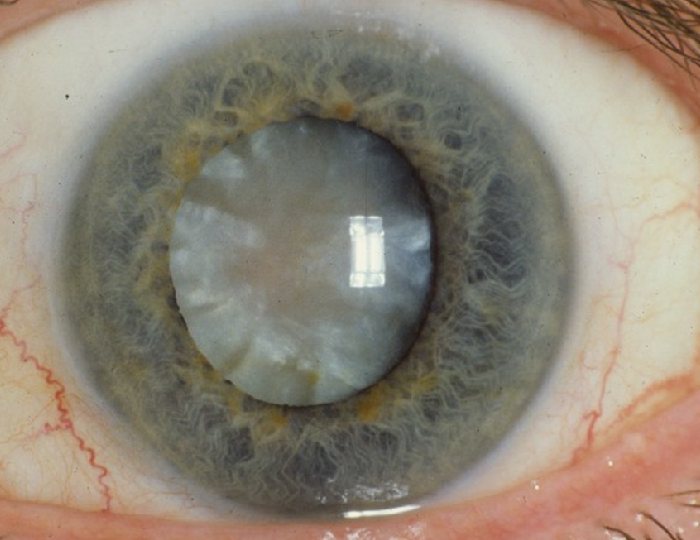
If I already have a cataract, what is the treatment?
In the early stages you can manage with updated glasses, good lighting for reading, and sunglasses or tinted lenses against glare. There is no need to operate on a cataract that is not bothering you. Once your vision is limiting you, the only treatment is surgery: the cloudy lens is removed and a clear artificial lens is implanted in its place. The surgery is short, it is usually done under local anesthesia, and most patients regain good vision. On timing, see When Should You Have Cataract Surgery?
And after surgery, does the cataract come back?
No. The cloudy lens has been removed, and the artificial lens does not turn cloudy the way it did. When vision becomes blurred again months or years after surgery, the common cause is “secondary cataract,” a clouding of the capsule behind the lens. It is treated with a laser in a short procedure in the clinic: see Secondary Cataract and YAG Laser Treatment.
Further reading: types of cataract and risk factors, cataract symptoms, the complete guide to cataract, and cataract surgery with Dr. Stern in Jerusalem.
Frequently asked questions
Are there drops that dissolve cataracts?
No. Drops based on N-acetylcarnosine and on lanosterol have been tested, and there is no convincing evidence that they clear cataract or slow its progression. The professional guidelines state that there is currently no proven medication for cataract. The only treatment for a cataract that interferes with vision is surgery.
Should I take vitamins to prevent cataract?
Not for that purpose. Large trials, including AREDS and AREDS2, did not find that vitamins C and E, beta-carotene, zinc or lutein reduce the risk of ending up needing cataract surgery. High-dose supplements may even be harmful. A varied diet rich in fruits and vegetables is recommended anyway.
Do sunglasses prevent cataract?
Cumulative sun exposure is linked to cataract, mainly the cortical type, and sunglasses reduce the eye's exposure to ultraviolet radiation by more than 80%. It has not been proven in a controlled trial that they prevent cataract, but this is simple, safe protection that also shields the eyelids and the surface of the eye.
Do screens and phones cause cataract?
There is no evidence that working in front of screens causes cataract. Screens can cause eye fatigue and dry eye, but those are different problems. The proven risk factors for cataract are age, diabetes, smoking, steroids, sun exposure and trauma to the eye.
I use a steroid inhaler for asthma. Should I stop?
No. Long-term steroid treatment raises the risk of cataract, but in conditions such as asthma the benefit is usually far greater. You can ask your treating physician whether your dose is the lowest one that is enough, and have your eyes checked by an ophthalmologist from time to time. If a cataract develops and bothers you, it can be operated on.
References
- Olson RJ, Braga-Mele R, Chen SH, et al. Cataract in the Adult Eye Preferred Practice Pattern. Ophthalmology. 2017;124(2):P1-P119. Link
- Tsai LM, Afshari NA, Brasington CR, et al. 2022-2023 Basic and Clinical Science Course, Section 11: Lens and Cataract. San Francisco: American Academy of Ophthalmology; 2022.
- Dubois VD, Bastawrous A. N-acetylcarnosine (NAC) drops for age-related cataract. Cochrane Database Syst Rev. 2017;2:CD009493. Link
- Daszynski DM, Santhoshkumar P, Phadte AS, et al. Failure of oxysterols such as lanosterol to restore lens clarity from cataracts. Sci Rep. 2019;9:8459. Link
- Hashimi M, Amin HA, Zagkos L, Day AC, Drenos F. Using genetics to investigate the association between lanosterol and cataract. Front Genet. 2024;15:1231521. Link
- Delcourt C, Cougnard-Grégoire A, Boniol M, et al. Lifetime exposure to ambient ultraviolet radiation and the risk for cataract extraction and age-related macular degeneration: the Alienor Study. Invest Ophthalmol Vis Sci. 2014;55(11):7619-7627. Link