

In brief
- In people with diabetes, cataract appears at a younger age and is more common. The surgery itself is similar to standard surgery, and the results are good when the retina is well preserved.
- Before surgery the retina is examined with dilated pupils and with an OCT scan. Macular edema or active retinopathy is treated, as far as possible, before surgery.
- The risk of macular edema after surgery is higher with diabetes, especially when there is retinopathy. It is reduced with anti-inflammatory drops, and sometimes with additional treatment.
- Eye injections are not a reason to postpone surgery. The date of surgery is coordinated with the retina specialist.
- When the macula is affected, a monofocal (single-focus) lens is usually chosen rather than a multifocal lens.
Why does cataract appear earlier in people with diabetes?
Diabetes speeds up all the changes that the lens goes through with age. High sugar levels alter the metabolism of the lens and cause fluid to build up in its fibers, and it loses its transparency earlier. According to literature reviews, the risk of cataract in people with diabetes is roughly two to five times higher than in people of the same age without diabetes, and the cataract tends to appear at a younger age.
This also has a practical implication: sharp swings in the sugar level temporarily change the glasses prescription. It is therefore better to take the measurements for surgery, from which the implanted lens is calculated, at a time when your blood sugar is stable.
What is checked before surgery? Retinal exam and OCT
The outcome of cataract surgery with diabetes depends mainly on the condition of the retina, and especially on the condition of the macula, the center of vision. So before surgery, the following are checked:
- The back of the eye (the fundus) with dilated pupils, to detect diabetic retinopathy and determine its grade.
- An OCT scan of the macula, which shows whether there is edema, even edema that is not yet noticeable.
- The iris and the pupil. In long-standing diabetes the pupil sometimes dilates less well, and the surgeon prepares for this in advance.
If macular edema is found, it is treated first, with eye injections or laser, and it is better to operate after it has subsided. This can take several months. Advanced retinopathy with new blood vessels (proliferative retinopathy) is treated with laser before surgery when possible. Sometimes the cataract is so dense that the retina cannot be examined or treated. In that situation the surgery is actually brought forward, because it makes it possible to continue treating the retina.
Macular edema after cataract surgery: the risk and how it is reduced
After any cataract surgery, macular edema that blurs vision can appear, usually a few weeks later. In a large British study of more than 80,000 surgeries, the edema appeared in about 1% of eyes that had no risk factor at all. In people with diabetes without retinopathy the risk was about 1.8 times higher, and in those with diabetic retinopathy about 6 times higher, and it rose the more severe the retinopathy was.
To reduce the risk, non-steroidal anti-inflammatory drops (NSAID) are given after surgery alongside the steroid drops. The European PREMED study (2018) found, in patients without diabetes, that the combination of the two types protects the macula better than either one alone. In the part of the study that dealt with patients with diabetes, all of whom received both types of drops, a steroid injection next to the eye at the end of surgery reduced macular thickness even further. This is not routine for every patient, and the surgeon weighs it according to the condition of the retina. When diabetic macular edema is already present, an eye injection is sometimes added close to the surgery or during it.
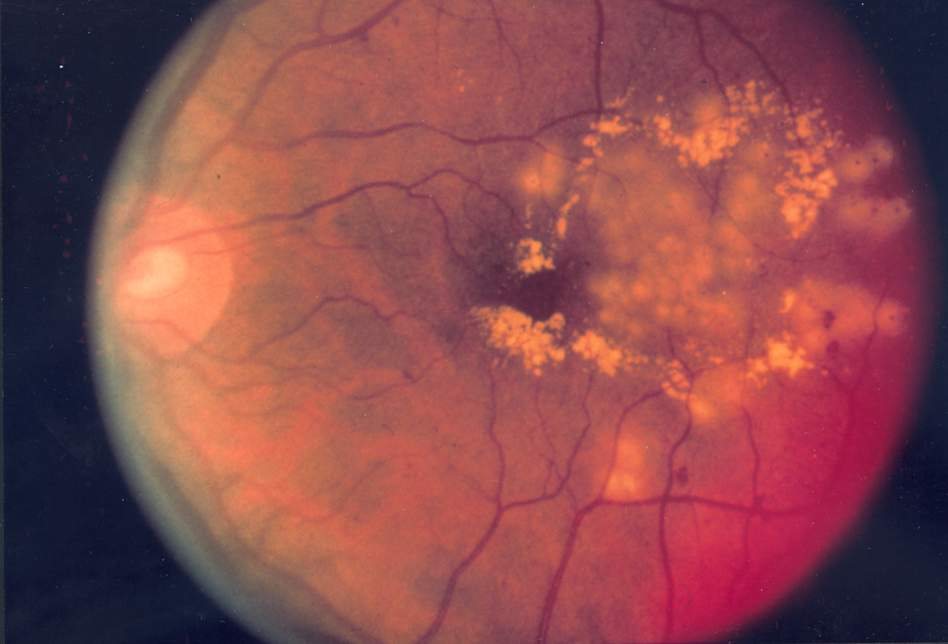
You will find a full explanation of the condition, its diagnosis and its treatment on the page Macular Edema After Cataract Surgery.
Timing surgery around eye injections and laser
- Eye injections. They are not stopped ahead of surgery. The cataract surgeon and the retina specialist coordinate the date of surgery in relation to the injections.
- Retinal laser. When it is needed, the aim is to complete it before surgery. If the cataract gets in the way, it is completed shortly after surgery.
- Tell your surgeon when you had your last injection, and bring the visit summaries from the retina clinic.
Does cataract surgery make diabetic retinopathy worse?
The studies are not consistent. Some found that in the year after surgery the retinopathy progresses more in the operated eye than in the other eye. Other studies, of surgery with today's techniques, found no real difference. What recurs in most studies is that progression is related mainly to blood sugar control and to the grade of the retinopathy before surgery. The practical conclusion: surgery is not given up when the cataract is bothersome, but care is taken to have the retina examined in the months that follow, even if the retina was normal before surgery.
Blood sugar control before surgery and on the day of surgery
Well-controlled blood sugar reduces the risk of complications in the retina, so it is worth coming to surgery as well controlled as possible, in coordination with your family doctor or diabetes doctor. There is no single agreed value of glycated hemoglobin (HbA1c) above which surgery is not performed. The decision is made according to your general condition and the condition of the macula. The goal is stable control over time, not a sharp, rapid drop in the days before surgery.
In the vast majority of cases the surgery is done under local anesthesia and without fasting. You eat and drink as usual, so there is usually no need to change your diabetes treatment on the day of surgery. Follow the personal instructions you are given, and bring a list of your medications. Only if general anesthesia with fasting has been planned for you, ask in advance for instructions about your insulin and tablets. More details on the page Before Cataract Surgery.
Infection inside the eye after cataract surgery is very rare in everyone. With diabetes the risk is slightly higher, so it is especially important to be careful about the drops, hand washing and the follow-up visits.
Which lens is suitable for people with diabetes?
- A monofocal (single-focus) lens is the usual choice when there is retinopathy or damage to the macula. It preserves the best contrast, and does not get in the way of the retina specialist examining and treating the eye. Astigmatism can be corrected with a toric lens.
- A multifocal lens slightly reduces contrast. When the macula is damaged, or may become damaged, this loss is noticeable, so it is not recommended when there is diabetic macular disease. For someone whose diabetes is well controlled and whose retina is completely normal it can be considered, after a frank conversation about the future risk.
You will find a full comparison of the lens types on the page Types of Lenses in Cataract Surgery.
Recovery after surgery: how is it different?
- The cornea recovers more slowly. Blur caused by mild corneal edema may last a little longer than usual, and the surface of the eye is more prone to dryness.
- Closer follow-up of the macula. If your vision becomes blurred again a few weeks after surgery, after it had already improved, you should be examined.
- The outcome. When there is no retinopathy, or it is mild, vision after surgery is similar to that of people without diabetes. When the macula is damaged, the improvement is limited accordingly, so it is important to set expectations in advance.
The other instructions are the same as for any cataract surgery, and they are gathered on the page Instructions After Cataract Surgery and in the Complete Guide to Cataract.
Frequently asked questions
Can people with diabetes have cataract surgery?
Yes. The surgery itself is similar to standard cataract surgery, and when the retina is normal or the retinopathy is mild the results are similar to those of people without diabetes. The difference is in the preparation: the retina and the macula are examined before surgery, and they are followed after it as well.
Do I need to fast or stop my diabetes medications before cataract surgery?
In the vast majority of cases the surgery is done under local anesthesia and without fasting, so you eat and drink as usual and there is usually no need to change your diabetes treatment. Follow the personal instructions you are given. Only if general anesthesia with fasting has been planned, ask in advance for instructions about your insulin and tablets.
I get eye injections for diabetic edema. When can I have surgery?
It is better to operate when the edema has subsided or is stable, and the date of surgery is coordinated with the retina specialist. The injections are not stopped, and sometimes an injection is added close to the surgery or during it. It is important to tell your surgeon when you had your last injection.
Will cataract surgery make my diabetic retinopathy worse?
The studies are not consistent. Some found faster progression of the retinopathy in the year after surgery, and others did not. Progression is related mainly to blood sugar control and to the grade of the retinopathy before surgery. That is why care is taken to have the retina examined in the months after surgery.
Can a multifocal lens be implanted when you have diabetes?
When there is retinopathy or damage to the macula it is usually not recommended, because a multifocal lens slightly reduces contrast. For someone whose diabetes is well controlled and whose retina is completely normal it can be considered, after a conversation about the risk that the retina will be damaged in the future.
My blood sugar is not well controlled. Will my surgery be postponed?
There is no single agreed value of glycated hemoglobin above which surgery is not performed, and the decision is individual. Better control reduces risks, so it is worth improving it in coordination with your treating doctor. On the other hand, when a dense cataract prevents examination and treatment of the retina, a long postponement of surgery is not desirable.
References
- Chu CJ, Johnston RL, Buscombe C, et al. Risk factors and incidence of macular edema after cataract surgery: a database study of 81984 eyes. Ophthalmology. 2016;123(2):316-323. Link
- Wielders LHP, Schouten JSAG, Winkens B, et al. Randomized controlled European multicenter trial on the prevention of cystoid macular edema after cataract surgery in diabetics: ESCRS PREMED Study Report 2. J Cataract Refract Surg. 2018;44(7):836-847. Link
- Wielders LHP, Schouten JSAG, Winkens B, et al. European multicenter trial of the prevention of cystoid macular edema after cataract surgery in nondiabetics: ESCRS PREMED study report 1. J Cataract Refract Surg. 2018;44(4):429-439. Link
- Kelkar A, Kelkar J, Mehta H, Amoaku W. Cataract surgery in diabetes mellitus: a systematic review. Indian J Ophthalmol. 2018;66(10):1401-1410. Link
- Hong T, Mitchell P, de Loryn T, Rochtchina E, Cugati S, Wang JJ. Development and progression of diabetic retinopathy 12 months after phacoemulsification cataract surgery. Ophthalmology. 2009;116(8):1510-1514. Link
- Garcia-Cabrera CR, Afshari NA. Cataract surgery in patients with diabetes mellitus: preoperative, intraoperative, and postoperative considerations. Curr Opin Ophthalmol. 2026;37(1):42-47. Link
- Chen KY, Chan HC, Chan CM. Do people with diabetes have a higher risk of developing postoperative endophthalmitis after cataract surgery? A systematic review and meta-analysis. J Ophthalmic Inflamm Infect. 2025;15:24. Link
- Tsai LM, Afshari NA, Brasington CR, et al. 2022-2023 Basic and Clinical Science Course, Section 11: Lens and Cataract. San Francisco: American Academy of Ophthalmology; 2022.