

In brief
- Most refractive surprises start with the measurement, not the formula. Before choosing a lens, go over the printout the way you would read a chest X-ray: one parameter after another, and always in comparison with the fellow eye.
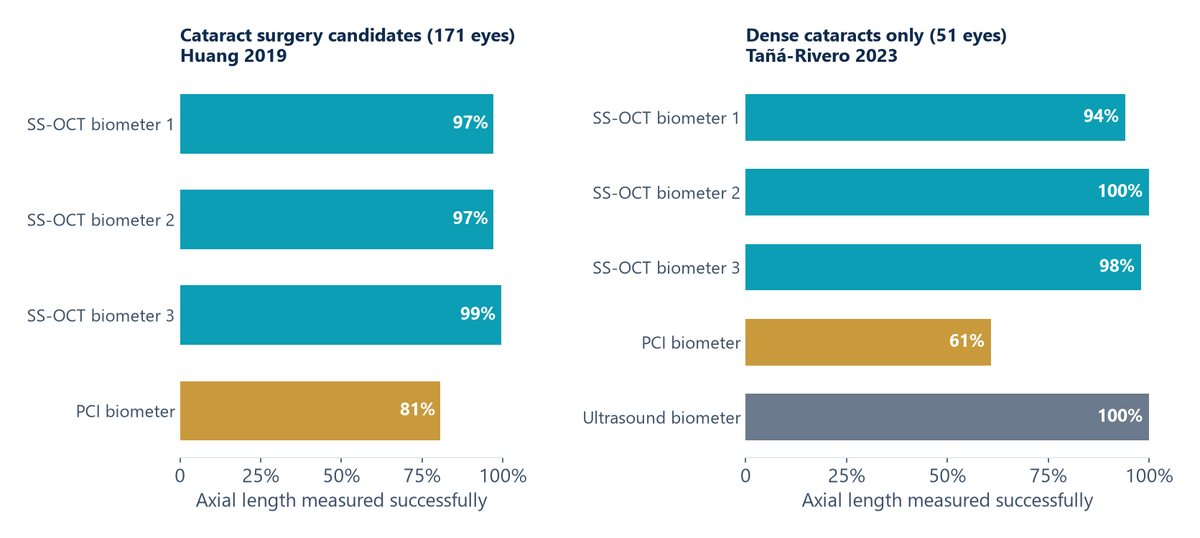
- Axial length: a difference of more than about 0.3 mm between the eyes, without anisometropia to explain it, calls for a repeat measurement. SS-OCT-based biometers obtain a measurement in 97% to 99% of eyes, compared with about 81% for the older PCI biometer.
- Keratometry: a difference of more than about 0.9 D between the eyes, K below 41 or above 47 D, or cylinder above 2.5 D: verify with a second device.
- An unstable ocular surface and contact lenses alter keratometry. Treat and measure again.
- Biometers are not interchangeable: each device and measurement method needs its own constants.
Reading the printout: signs that call for a repeat measurement
The following rules are based on the validation criteria of Warren Hill (as they appear on his website and in the review in Ophthalmology) and on the BCSC. Similar thresholds, with small differences, appear in other guidelines. They do not indicate an error; they flag when the measurement should be verified before it is used.
| Parameter | Warning sign | What to do |
|---|---|---|
| Axial length, difference between the eyes | More than about 0.3 mm, without a refractive difference to explain it | Repeat the measurement in both eyes, preferably by a different examiner. Compare with the oldest refraction available |
| Axial length, absolute value | Below about 21.3 mm or above about 26.6 mm | Repeat the measurement. In a long eye with scattered measurements: suspect a staphyloma |
| Axial length versus refraction | A short myopic eye, or a long hyperopic eye | Check again. An especially steep or flat cornea can explain the discrepancy |
| Mean K, difference between the eyes | More than about 0.9 D | Repeat measurement and a second device (topography or tomography) |
| Mean K | Below 41.0 D or above 47.0 D | Verify, and ask about previous refractive surgery or ectasia |
| Corneal astigmatism | Above 2.5 D, or an axis that differs between devices | Topography, and examination of the ocular surface |
| Corneal diameter (WTW) | Below 10.75 mm or above 13.0 mm | Verify |
| IOL power for emmetropia | A difference of more than 1 D between the eyes, or more than 3 D from the expected value | Repeat axial length and keratometry in both eyes |
| Fixation and cooperation | A patient who did not fixate, or macular disease | Check the foveal scan and repeat the measurement |
According to the BCSC, the difference in axial length between the two eyes is usually no more than 0.3 mm, and measuring both eyes is useful even when only one is being operated on.
Axial length
Optical, ultrasound, and what happens in dense cataract
Optical biometry measures to the RPE layer, along the visual axis while the patient fixates, and is therefore more accurate and more repeatable than ultrasound. Contact ultrasound (contact A-scan) indents the cornea and shortens the axial length, so if ultrasound is needed, immersion (immersion) is preferable. The ESCRS guidelines (2024) recommend ultrasound only when optical measurement is not possible, for example in an advanced cataract (mature).
The technology determines how often that happens. In a head-to-head comparison (Huang 2019, 171 eyes), three SS-OCT-based biometers measured axial length in 97% to 99% of eyes, compared with about 81% for a PCI biometer. In dense cataract the gap widens: 94% to 100% versus 61% (Tañá-Rivero 2023). And in a series of 3,668 eyes (Bettach 2024), SS-OCT measurement failed because of dense cataract in 2.8% of eyes. Pupil dilation rescued about a third of them, and the results agreed with immersion ultrasound.
A single refractive index, or segments
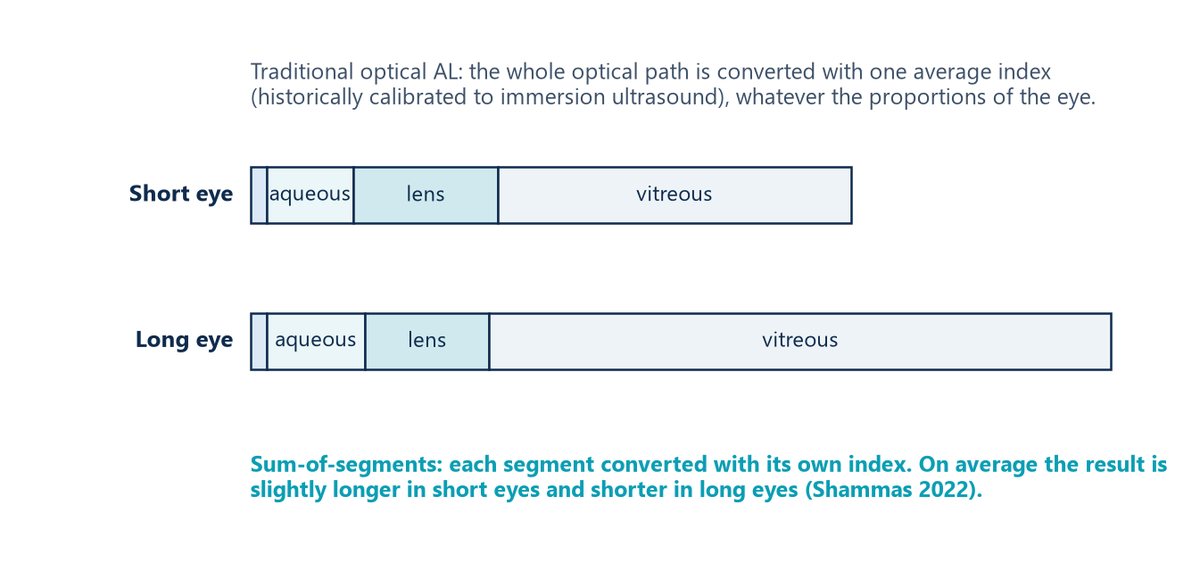
A biometer measures an optical path and converts it to a length using a refractive index. Traditional biometers use a single average index for the whole eye, originally calibrated to match immersion ultrasound. Some of the newer devices measure each segment separately, with its own index (sum-of-segments). On average, the axial length obtained this way is slightly longer in short eyes and shorter in long eyes. This improves the older formulas at the extremes, but in short eyes no improvement was found with the newer formulas (Kenny 2023). The practical implication: the formula and the constant must match the method. An axial length from one device and a constant optimized on another are a recipe for systematic bias.
Three more checks
- The foveal scan. On biometers that display an OCT section of the macula, check that the measurement passed through the fovea, that the patient fixated, and that there is no macular disease altering the picture.
- Staphyloma. In a long eye, if the measurements are scattered, suspect a staphyloma (see Long and Short Eyes).
- Silicone oil. The speed of sound in oil is very different from that in vitreous. Ultrasound without correction will give an axial length that is too long, and with optical measurement, too, the status must be set on the device.
Keratometry
The surface of the eye
Keratometry is measured on the tear film. In the study by Epitropoulos and colleagues (2015) in patients before cataract surgery, eyes with high tear osmolarity had less repeatable keratometry, more eyes with a difference of 1 D or more in astigmatism between two measurements, and more eyes with a difference of more than 0.5 D in the calculated IOL power. More recent studies have found a mixed picture: the effect depends on the device, and with some of the newer biometers no consistent association was found. The practical conclusion does not change: if the cornea looks dry, or if two measurements do not agree, treat the ocular surface and measure again before deciding, especially before a toric or multifocal lens. The ESCRS guidelines recommend topography or tomography when refractive astigmatism is present.
Look at the raw images
The final number hides the quality of the measurement. Distorted reflections on the keratometer image, wide scatter between repeated measurements, or disagreement between the biometer and the topographer point to an irregular surface, for example dry eye, pterygium or a scar. Agreement between two devices in magnitude and axis is an accepted way of validating keratometry.
Contact lenses
In the series by Meyer and colleagues (2018), in which eyes were measured before contact lens discontinuation and again after at least two weeks without lenses, mean K changed by 0.31 D on average (up to about 1 D), and astigmatism by 0.41 D. The recommended IOL power changed in 17 of 32 eyes, and the toric power in 9 of 14. Recommendations on how long to stay out of lenses are not uniform: for soft lenses, from one day to two weeks, and for rigid lenses, from two days to four weeks. The safe approach: stop, measure, and repeat the measurement until two consecutive measurements agree. On rigid lenses in keratoconus: Calculation in Keratoconus.
Devices: similar, but not identical
In the review by Kane and Chang (66 studies, 13 devices), the mean differences between biometers were small: about 0.02 mm in axial length and about 0.09 D in K, with a negligible effect on lens selection. But the largest reported difference in K between two devices was 0.65 D, equivalent to about 0.56 D of refraction. In an individual eye the gaps can be larger, and the largest were found in corneal diameter. Therefore: do not switch devices in the middle of planning for a patient without checking agreement, and optimize the constants for each biometer separately (see constant optimization).
Checklist before calculation
- Both eyes were measured, and the differences between them are within reasonable limits or explained.
- Axial length is consistent with the refraction (long myope, short hyperope), and the foveal scan is normal.
- K within the range 41–47 D, or there is an explanation (refractive surgery, keratoconus).
- Keratometry agrees between two devices in magnitude and axis, and the reflection images are regular.
- The ocular surface has been treated, and contact lenses were discontinued in time.
- The formula and the constant match the device and the measurement method.
- Two modern formulas give a similar result.
When all of this is in order and the result is still a surprise, move on to management of refractive surprise.
Frequently asked questions
What is the accepted difference in axial length between the two eyes?
According to the BCSC, the difference is usually no more than 0.3 mm. A larger difference that is not explained by a refractive difference between the eyes calls for a repeat measurement of both.
How long should contact lenses be discontinued before biometry?
There is no uniform recommendation. The literature suggests discontinuing soft lenses for one day to two weeks, and rigid lenses for two days to four weeks. The safe way is to stop, measure, and repeat the measurement until two consecutive measurements agree.
The biometer cannot measure axial length in a dense cataract. What should be done?
First try an SS-OCT-based biometer, and then a repeat measurement after pupil dilation, which rescued about a third of the failed measurements in a large series. If that fails too, immersion ultrasound is preferable to contact ultrasound.
References
- Kane JX, Chang DF. Intraocular lens power formulas, biometry, and intraoperative aberrometry: a review. Ophthalmology. 2021;128(11):e94-e114. Link
- American Academy of Ophthalmology. Basic and Clinical Science Course, Section 11: Lens and Cataract (chapter 7) and Section 3: Clinical Optics and Vision Rehabilitation. San Francisco: AAO; 2022-2023.
- Hill WE. IOL power calculations: validation guidelines. doctor-hill.com (accessed November 2026). Link
- Keshav V, Henderson BA. Astigmatism management with intraocular lens surgery. Ophthalmology. 2021;128(11):e153-e163. Link
- Huang J, Chen H, Li Y, et al. Comprehensive comparison of axial length measurement with three swept-source OCT-based biometers and partial coherence interferometry. J Refract Surg. 2019;35(2):115-120. Link
- Tañá-Rivero P, Aguilar-Córcoles S, Tañá-Sanz P, Tañá-Sanz S, Montés-Micó R. Axial length acquisition success rates and agreement of four optical biometers and one ultrasound biometer in eyes with dense cataracts. Eye Vis (Lond). 2023;10:35. Link
- Epitropoulos AT, Matossian C, Berdy GJ, Malhotra RP, Potvin R. Effect of tear osmolarity on repeatability of keratometry for cataract surgery planning. J Cataract Refract Surg. 2015;41(8):1672-1677. Link
- Meyer JJ, Kim MJ, Kim T. Effects of contact lens wear on biometry measurements for intraocular lens calculations. Eye Contact Lens. 2018;44 Suppl 1:S255-S258. Link