

In brief
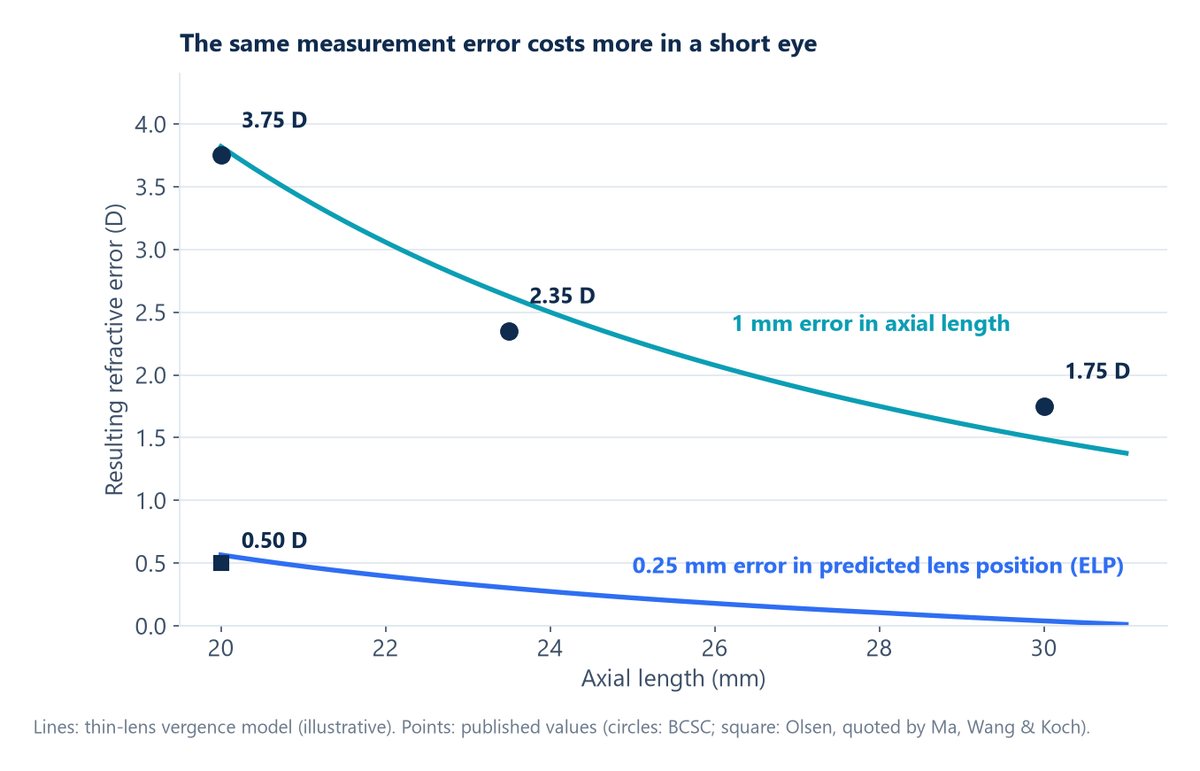
- An error of 1 mm in axial length is equivalent to about 3.75 D in a 20 mm eye, about 2.35 D in an average eye and about 1.75 D in a 30 mm eye. An error in predicting lens position is also costly in a short eye.
- Long eye: third-generation formulas tend toward a hyperopic surprise, especially with low-power lenses. Kane, Barrett, Olsen or EVO solve most of the problem. The Wang-Koch adjustment belongs to the older formulas only.
- Short eye: accuracy is lower with every formula. A formula that uses the measured ACD and lens thickness is preferable to one that assumes average proportions.
- With a staphyloma: optical biometry with fixation. If ultrasound is required, only with fixation or under B-scan guidance.
- When the required power is outside the manufactured range: a second lens (piggyback), preferably one in the bag and one in the sulcus.
Why are the extremes harder?
Two reasons. The first is sensitivity: the shorter the eye and the stronger the lens, the more diopters each error in measurement or in predicting lens position translates into. According to Olsen, an error of 0.25 mm in predicting lens position causes an error of 0.50 D in a 20 mm eye. In a long eye, with a low-power lens, the same error is barely noticeable. The second reason is the model: formulas built on average eyes assume average proportions, and extreme eyes are not like that.
Long eyes
Why does a hyperopic surprise occur?
In a long eye, third-generation formulas (SRK/T, Holladay 1, Hoffer Q) select a lens that is too weak, and the result is hyperopic. The bias grows as lens power decreases, and is especially marked with lenses of zero diopters or negative power. It persists even when axial length is measured correctly, so it is not only a measurement problem. Part of the explanation lies in the conversion of optical path length to length: traditional biometers convert it with a single average refractive index for the whole eye, originally calibrated against immersion ultrasound. Measurement by segments (sum-of-segments), with a separate index for the cornea, the anterior chamber, the lens and the vitreous, gives on average a shorter value in long eyes and a longer value in short eyes, and improves the older formulas mainly at the extremes (see Pitfalls in Biometry).
What works
- A modern formula. The ESCRS guidelines (2024) recommend new-generation formulas in very long and very short eyes. In the review by Kane and Chang (28 studies, 5,186 eyes longer than 26 mm), Kane was the most accurate in the large studies, followed by Olsen (4-factor), Barrett Universal II, and Holladay 1 with the updated Wang-Koch adjustment. In a 2024 network meta-analysis (10 studies, 1,016 eyes), Olsen, Kane and EVO were ranked above Barrett, but the differences were not significant. With newer formulas, 63% to 85% of long eyes fall within ±0.50 D.
- Low-power lenses. In an Israeli series of eyes longer than 26 mm (Abulafia 2015), when IOL power was below 6 D, only Barrett Universal II, and Holladay 1 or Haigis with axial length adjustment, met the benchmark criteria: 71% of eyes within ±0.50 D and 93% within ±1.00 D.
- The Wang-Koch adjustment. It was built to eliminate the hyperopic bias of the older formulas: the measured axial length is replaced by an “adjusted” value and the calculation is repeated. In the updated version (2018), the adjustment is intended for Holladay 1 above 26.5 mm and for SRK/T above 27.0 mm. In the Kaiser database (Melles 2018), the original version overcorrected with some formulas, turned the hyperopia into myopia, and made Haigis worse. It should not be applied to modern formulas, which already handle long eyes.
Staphyloma and fixation
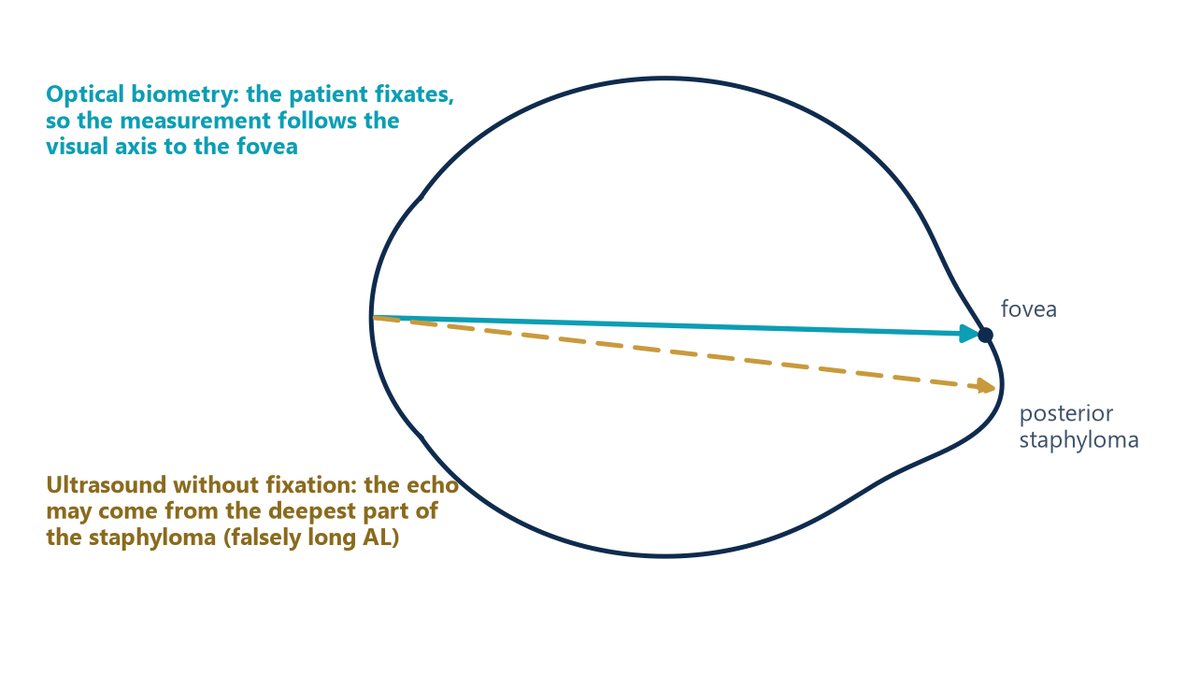
In a long eye with a posterior staphyloma, the fovea sometimes sits on a “slope” rather than at the deepest point. An optical biometer requires the patient to fixate, and therefore measures along the visual axis to the fovea, which is its great advantage in these eyes. Ultrasound without fixation may measure to the deepest point and give an axial length that is too long. If the cataract is too dense to allow optical measurement, measure with a probe that has a fixation target, or under B-scan guidance.
Target and second eye
Patients with high myopia are used to reading without glasses, and some of them prefer a mildly myopic target. It is important to clarify this before surgery. The second eye also needs to be planned: a large difference between the eyes during the interim period is hard on anyone who does not wear a contact lens in the other eye (BCSC). In very long eyes, zero power or negative power may be required, so calculate early to make sure the lens is available.
Short eyes
Lens position is the problem
In a short eye the lens is strong and the distance from it to the retina is short, so the prediction of lens position is the main source of error. A two-variable formula assumes that in a short eye the anterior chamber is also shallow, but in many short eyes the anterior segment is normal. In such cases a formula that uses the measured ACD, and preferably lens thickness as well, will predict better.
What the evidence says
| Study | Eyes | Main finding |
|---|---|---|
| Kane & Chang 2021 (review) | 23 studies, 3,276 eyes | Kane led in the two large studies. In the Kaiser database: 75.5% within ±0.50 D, compared with 69.9% for Barrett and 59.9% for Hoffer Q. Below 20 mm, Barrett and Hoffer Q had a myopic error of more than 1 D on average |
| Wendelstein 2022 | 150 | PEARL-DGS, Okulix, Kane and Castrop more accurate than Hoffer Q and SRK/T |
| Kenny 2023 (Baylor) | 278 | An artificial intelligence calculator from a biometer manufacturer led. Sum-of-segments axial length measurement did not improve the results |
| Shammas 2022 (segments) | 78 short eyes | Barrett True AL, EVO, Hoffer QST, K6, Olsen and PEARL-DGS had the lowest error |
| Gökce 2017 and Vilaltella 2023 | 86 and 100 | After zeroing the mean error, no significant difference between the formulas |
The picture is consistent: in the short eye, 54% to 80% of eyes fall within ±0.50 D, depending on the formula and the series (Ma, Wang & Koch). The newer formulas (Kane, PEARL-DGS, EVO, Hoffer QST) tend to lead, but the differences are smaller than the spread, and in small samples they are not significant. If only older formulas are available, Hoffer Q or Haigis are more suitable than SRK/T.
Nanophthalmos and a second lens (piggyback)
Nanophthalmos is usually defined as an axial length of 20 mm or less, with a thick sclera, a shallow chamber, a narrow angle and a risk of choroidal effusion during surgery. It requires special surgical preparation. When the required power is higher than the maximum power manufactured, two lenses can be implanted. Two hydrophobic acrylic lenses inside the bag may produce opacification between the lenses (interlenticular opacification), which in some cases has required explantation. It is therefore preferable to place one lens in the bag and the other in the sulcus, or to use two different materials (BCSC). The calculation for a pair of lenses differs from the calculation for a single lens, and a dedicated calculator is worth using. On an add-on lens to correct a residual error after surgery: Management of Refractive Surprise.
Key points
- At the extremes, pay particular attention to measurement quality. The rules for repeat measurement are detailed in Pitfalls in Biometry.
- Long eye: a modern formula, and the Wang-Koch adjustment only for Holladay 1 or SRK/T. With a low-power or negative-power lens, be especially wary of hyperopia.
- Short eye: a formula that uses ACD and lens thickness. Explain to the patient that accuracy is lower.
- Compare two modern formulas, and look closely into any discrepancy between them (see IOL Power Calculation Formulas).
- For patients: Cataract Surgery with High Myopia.
Frequently asked questions
Should the Wang-Koch adjustment be used with Barrett or Kane?
No. The adjustment was built to eliminate the hyperopic bias of older formulas in the long eye, and in the updated version it is intended for Holladay 1 above 26.5 mm and for SRK/T above 27 mm. The modern formulas already handle long eyes, and in a large database the original adjustment caused overcorrection with some formulas.
Which formula for an eye shorter than 22 mm?
A modern formula that uses anterior chamber depth and lens thickness, such as Kane, PEARL-DGS, EVO or Hoffer QST. If only older formulas are available, Hoffer Q or Haigis are preferable to SRK/T. In any case, accuracy is lower in the short eye.
References
- Kane JX, Chang DF. Intraocular lens power formulas, biometry, and intraoperative aberrometry: a review. Ophthalmology. 2021;128(11):e94-e114. Link
- Ma JX, Wang L, Koch DD. Intraocular lens power calculation in challenging cases. Saudi J Ophthalmol. 2025;39(4):349-353. Link
- American Academy of Ophthalmology. Basic and Clinical Science Course, Section 11: Lens and Cataract (chapters 7 and 12) and Section 3: Clinical Optics and Vision Rehabilitation. San Francisco: AAO; 2022-2023.
- Ma Y, Xiong R, Liu Z, et al. Network meta-analysis of intraocular lens power calculation formula accuracy in 1016 eyes with long axial length. Am J Ophthalmol. 2024;257:178-186. Link
- Abulafia A, Barrett GD, Rotenberg M, et al. Intraocular lens power calculation for eyes with an axial length greater than 26.0 mm: comparison of formulas and methods. J Cataract Refract Surg. 2015;41(3):548-556. Link
- Melles RB, Holladay JT, Chang WJ. Accuracy of intraocular lens calculation formulas. Ophthalmology. 2018;125(2):169-178. Link
- Wendelstein J, Hoffmann P, Hirnschall N, et al. Project hyperopic power prediction: accuracy of 13 different concepts for intraocular lens calculation in short eyes. Br J Ophthalmol. 2022;106(6):795-801. Link
- Shammas HJ, Taroni L, Pellegrini M, Shammas MC, Jivrajka RV. Accuracy of newer intraocular lens power formulas in short and long eyes using sum-of-segments biometry. J Cataract Refract Surg. 2022;48(10):1113-1120. Link