

In brief
- In 2023, 13,894 intraocular lenses of 62 models were implanted at the Rothschild Foundation Hospital in Paris, by 112 surgeons.
- CO₂ emissions from shipping the lens from the factory to the hospital ranged from 1.05 to 12.72 kg per 1,000 units: a 12-fold difference, driven by packaging weight and shipping distance.
- Packaging volume ranged from 135 to 917 cm³ (7-fold), and packaging weight from 37.5 to 142.3 grams.
- 65.9% of the lenses were standard monofocals and 21.6% “monofocal plus.” Toric lenses accounted for only 7.4%, non-toric EDOF lenses for 3.9% and non-toric multifocals for 1.3%.
- Smaller packaging saves emissions and waste, and also frees up inventory space for toric and premium lenses, so that they are available without a special order.
What does this mean for patients?
The study is not about the quality of the lenses, but about their packaging and shipping and about which lenses surgeons actually choose at a large center. Two things worth knowing: most patients there received a monofocal (single-focus) lens, and a toric lens, which corrects astigmatism, was implanted in only about 7% of surgeries, less than the proportion of people who could benefit from one. If you have astigmatism, it is worth asking about it before surgery. General information: Types of Lenses in Cataract Surgery.
The research question
Intraocular lenses are manufactured all over the world and shipped to the operating room in packaging whose size is often dictated by marketing considerations. The study, conducted at the Rothschild Foundation Hospital in Paris and published in Eye in 2025, asked two questions: what is the footprint of shipping each lens model from the factory to the hospital, and which lenses are actually implanted at a large European center where both public and private surgeons operate. It is a follow-up to the study on paper waste from lens leaflets.
Method
- All lenses implanted in 2023 were retrieved retrospectively from the inventory software of the operating room pharmacy. Phakic lenses were excluded.
- In May 2024 the packaging of each model was weighed (two boxes, averaged), its dimensions were measured and the manufacturing site printed on it was verified.
- Shipping emissions were calculated with the EcoTransIT World calculator (compliant with ISO 14083), as Well-to-Wheel emissions, and reported per 1,000 units.
- Because manufacturers do not publish their supply chains, a single, full annual shipment directly from the factory to the hospital was assumed, and the lower-emission scenario was chosen (sea and truck, or truck only). This is therefore a minimum estimate.
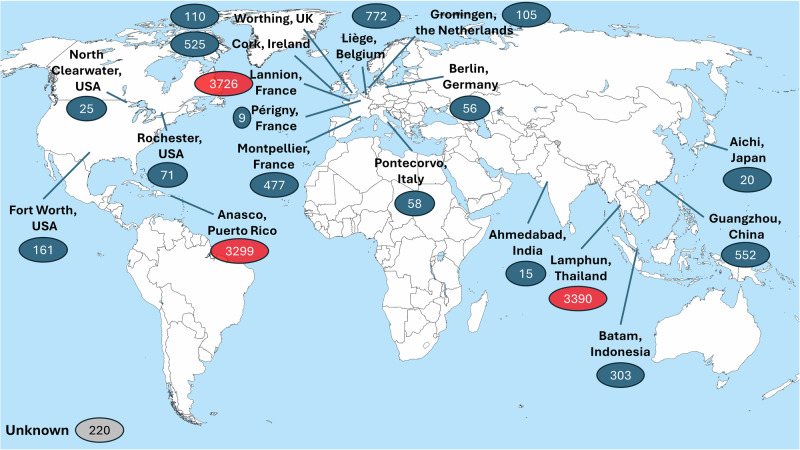
- Packaging data were unavailable for 220 lenses of rare models; the emissions calculation covered 13,674 lenses (98.4%).
Results: packaging and shipping
Shipping emissions ranged from 1.05 to 12.72 kg of CO₂ per 1,000 lenses. Two factors determine the result, distance and packaging weight, and either one can be decisive. A few examples from the tables in the paper (without model names):
| Manufacturing site and packaging type | Shipping distance to Paris (km) | Packaging weight (grams) | CO₂ per 1,000 units (kg) |
|---|---|---|---|
| Ireland, non-preloaded lens | 943 | 41.8 | 1.05 |
| Belgium, non-preloaded lens | 363 | 39.6 | 1.08 |
| France, preloaded with injector (the most common model at the center) | 846 | 52.0 | 1.55 |
| United Kingdom, hydrophilic preloaded (the heaviest packaging) | 445 | 142.3 | 2.92 |
| China, preloaded without injector | 17,988 | 37.8 | 5.20 |
| Puerto Rico, preloaded with injector | 7,120 | 83.3 | 5.89 |
| Thailand, preloaded with injector | 15,244 | 66.2 | 11.43 |
| United States, toric preloaded with injector (the highest value) | 6,504 | 133.8 | 12.72 |
Light packaging can compensate for a long distance (the example from China), and heavy packaging cancels out the advantage of a relatively nearby factory. The authors also note that a “local” brand is no guarantee of a small footprint, because some Western manufacturers have moved production to distant sites.
For perspective: this amounts to a few grams of CO₂ per lens, whereas the footprint of an entire cataract surgery was estimated at a British hospital at about 180 kg CO₂eq, a large part of it from the procurement of medical equipment and drugs. The estimate here is a minimum, and the benefit of smaller packaging also lies in waste and storage volume.
The preloaded lens
84% of the models came preloaded in a single-use injector, 5% preloaded without an injector and 11% not preloaded. The packaging of a lens with an injector weighed on average 81.2 ± 26.7 grams with a volume of 514 ± 164 cm³, almost double that of a non-preloaded lens (47.6 ± 15.3 grams, 278 ± 83 cm³). With hydrophilic lenses the weight increases further, because the entire injector is stored in fluid. 89% of the lenses implanted were preloaded: surgeons value the convenience and the reduction in lens-loading complications, but the price is plastic waste and bulky packaging. The alternative the authors propose is a preloaded cartridge with a reusable injector. A review of lens packaging in the United States likewise found that the packaging of preloaded lenses is generally heavier than that of non-preloaded lenses, and that most of the weight is paper: the box and the instruction booklet.
Results: which lenses are actually implanted
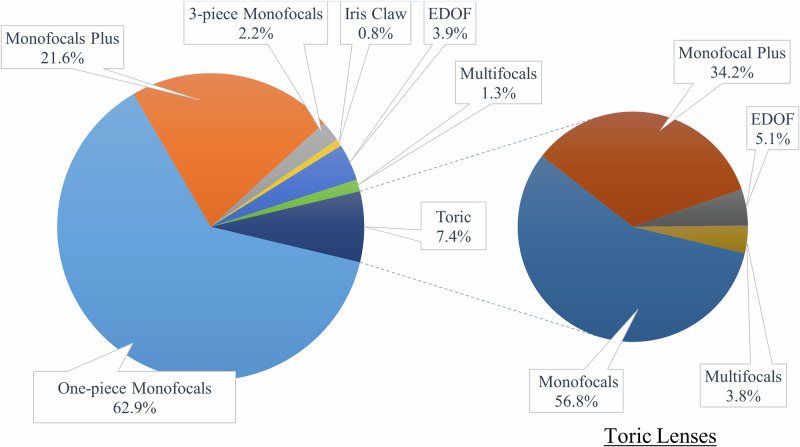
- Standard monofocals: 9,150 lenses (65.9%), of which 305 were three-piece lenses (2.2%).
- Monofocal plus: 2,998 (21.6%). They are stocked in all powers, like a standard monofocal lens, and are also suitable when there is coexisting eye disease.
- Toric (of all types): 1,033 (7.4%).
- Non-toric EDOF: 538 (3.9%). Non-toric multifocal: 175 (1.3%).
- In total, premium lenses (toric, EDOF and multifocal) accounted for 12.6% of implantations.
- Only 6% of the lenses were hydrophilic. For one monofocal lens that is stocked both with and without a yellow filter, about 45% of the lenses implanted were the version with the filter: there is no consensus among surgeons.
The proportion of toric lenses is low relative to the need: corneal astigmatism above 1.5 D is present in 16–26% of surgical candidates according to the studies cited in the paper, and market data point to 10–15% toric lenses in most developed countries. An analysis of 282,811 surgeries from the European registry EUREQUO also pointed to a considerable effect of residual astigmatism on the refractive outcome, and to the possibility of reducing it with a toric lens. The authors regard the low proportion as a missed opportunity, and attribute part of it to the extra burden: a special order before surgery and precise positioning of the lens during it.
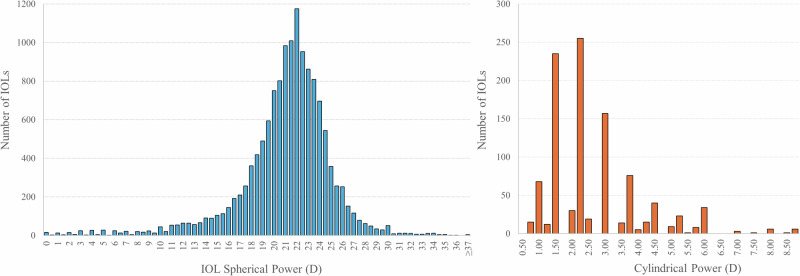
This is where the two parts of the study meet. The most common power was 22.0 D (8% of lenses), and 58% of lenses were within ±2.0 D of it. Among the toric lenses, the most common cylinder was 2.25 D (25%), and just three values (1.5, 2.25 and 3.0 D) covered 63% of cases. In other words, a relatively limited inventory of toric lenses, in small packaging, can meet most needs without a special order, and also save the separate shipments.
Limitations noted by the authors
- It was assumed that the packaging and manufacturing sites did not change between 2023 and May 2024.
- Multiple manufacturing sites, intermediate warehouses and partial shipments were not taken into account. The real emissions are higher than the estimate.
- The distances were calculated to Paris, and they are very different elsewhere in the world.
- The inventory software does not identify the rare cases in which more than one lens was opened for a patient, or lenses used for research.
- Prof. Gatinel is a consultant to BVI; the other authors have no conflicts of interest, and the study was conducted without external funding.
What a department can take from this
- Check the manufacturing site printed on the box and the size of the packaging, and take them into account when choosing suppliers.
- Reduce the variety of models and keep a larger inventory of selected models, to cut down on special orders.
- Stock toric lenses in the common powers and cylinders. On the calculation, see Toric IOL Calculation.
- Ask suppliers about preloaded cartridges with a reusable injector and about electronic instructions for use in place of a paper booklet.
On monofocal plus lenses: A Review of Enhanced Monofocal Lenses.
The paper: Stern B, Gatinel D, Nicolaos G, Grise-Dulac A. Intraocular lens models: ecological distribution footprint and usage trends at a large ophthalmology centre. Eye (Lond). 2025;39(11):2260–2268. Full article (open access).
Frequently asked questions
How much CO₂ is involved in shipping one lens?
According to the study's minimum estimate, between about one gram and 13 grams per lens (1.05 to 12.72 kg per 1,000 units), depending on packaging weight and distance from the factory. The estimate assumes a single, full and direct annual shipment; intermediate warehouses and special orders increase the actual emissions.
Is a lens from a local manufacturer necessarily more environmentally friendly?
Not necessarily. Some manufacturers have moved production to distant sites, so what matters is the manufacturing site printed on the box, together with the packaging weight, and not the brand's country of origin.
Why does the study link packaging size to the use of toric lenses?
Operating room pharmacies are limited in space. Small packaging makes it possible to stock toric and premium lenses as well. In the study, three cylinder values covered 63% of the toric lenses, and 58% of lenses were within 2 diopters of 22.0 D, so a limited inventory can avoid most special orders.
References
- Stern B, Gatinel D, Nicolaos G, Grise-Dulac A. Intraocular lens models: ecological distribution footprint and usage trends at a large ophthalmology centre. Eye (Lond). 2025;39(11):2260-2268. Link
- Stern B, Rampat R, Shahnazaryan D, Gatinel D. Paper waste from instructions for use brochures in cataract surgery implant packaging in Europe and the United States. J Cataract Refract Surg. 2024;50(1):72-77. Link
- Keyser A, Chang DF, Thiel C, Hovanesian J. Analysis of intraocular lens packaging weight and waste. J Cataract Refract Surg. 2024;50(12):1270-1274. Link
- Morris DS, Wright T, Somner JEA, Connor A. The carbon footprint of cataract surgery. Eye (Lond). 2013;27(4):495-501. Link
- Goggin M. Toric intraocular lenses: evidence-based use. Clin Exp Ophthalmol. 2022;50(5):481-489. Link
- Lundström M, Dickman M, Henry Y, et al. Risk factors for refractive error after cataract surgery: analysis of 282 811 cataract extractions reported to the European Registry of Quality Outcomes for Cataract and Refractive Surgery. J Cataract Refract Surg. 2018;44(4):447-452. Link