

In brief
- In 2024, 1,393 international patent applications related to ophthalmology and vision science were published. All of them were cataloged in an open file attached to a paper in the journal TVST.
- This is the third year of the catalog: 1,562 applications in 2022, 1,475 in 2023 and 1,393 in 2024.
- At the top of the list of applicants: eyeglass lens companies and makers of eye surgery equipment, alongside technology giants developing augmented reality glasses and eye tracking.
- Almost half of the applications are classified as medicine, about 18% as optics and about 10% as computing.
- A patent application is not an available treatment: it shows where research and industry are heading, not what you can get in the clinic today.
What does this mean for patients?
A patent protects an idea; it does not prove that the idea works. From the moment an application is filed until a medical product reaches patients, years of development, trials and approvals usually go by, and many inventions never get there at all. So the catalog is not a list of new treatments but a map of the directions in which development efforts are being invested today: eye exams, surgery, medications, lenses and display technologies. Anyone weighing a surgery or a treatment today should rely on what has already been tested and approved.
What the catalog is
The journal Translational Vision Science & Technology (TVST), published by the Association for Research in Vision and Ophthalmology (ARVO), publishes an editorial every year with a catalog of patent applications related to vision science. The idea: many technological innovations appear first, and sometimes only, as patents rather than as scientific papers, and it is worthwhile for researchers and physicians to be able to find them in one place.
The 2024 catalog was written by Guillaume Stern (Reinhold Cohn Group, Tel Aviv), Dr. Benjamin Stern, Jonathan J. Mallett of ARVO and Roy S. Chuck, the journal's editor-in-chief. The paper itself is short. Its core is an open, downloadable Excel file that gives, for each application, the title, abstract, a thumbnail image, the filing and publication dates and the International Patent Classification (IPC). It can be searched, sorted and filtered.
How it was built
- The source: international patent applications published in 2024 by the World Intellectual Property Organization (WIPO).
- The search was carried out in a professional, artificial intelligence-based tool for “patent landscape” analysis, with a query built from patent classification codes and keywords.
- An international application is published 18 months after the first filing date. So the applications published in 2024 mainly reflect ideas that were filed a year and a half earlier.
- The authors chose the international publications in order to “smooth out” differences between the patent offices of different countries.
Who files the applications
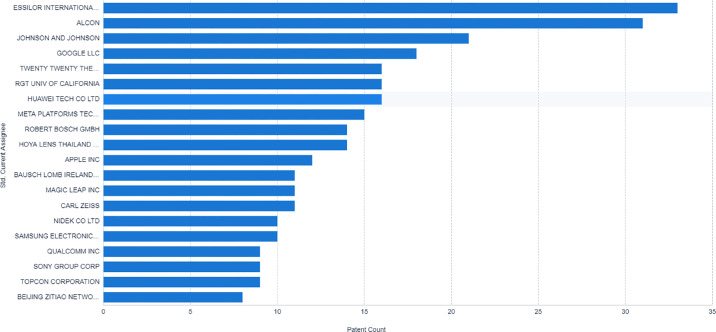
The first chart in the paper shows the top 20 applicants. At the head of the list are the eyeglass lens company Essilor (33 applications) and Alcon (31), followed by Johnson & Johnson (about 20). Further down are familiar names from the eye care world, such as Hoya, Bausch + Lomb, Carl Zeiss, Nidek and Topcon, as well as the University of California.
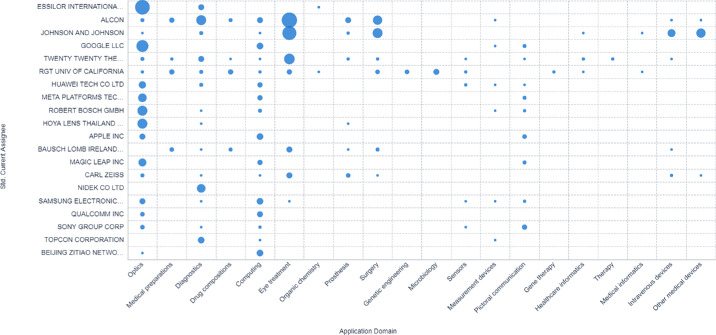
The surprise is the second half of the list: Google, Huawei, Meta, Apple, Magic Leap, Samsung, Sony and Qualcomm. These are not medical companies. According to the second chart, their applications are concentrated in optics, computing and visual communication: fields that include smart glasses, displays projected in front of the eye and eye tracking.
In which fields
The second chart shows how the applications of the top applicants are distributed across technological fields: optics, diagnostics, computing, treatment of the eye, prostheses (including intraocular lenses), surgery, medicinal preparations and more. Each company “colors” a different area: the eyeglass lens makers are concentrated in optics, the surgical equipment companies in treatment of the eye and surgery, and the technology companies in optics and computing.
The authors invite readers to extract their own information from the file. A count we performed on the catalog file by international classification gives an overall picture of all 1,393 applications:
| Field by international classification | Number of applications |
|---|---|
| Medicine (all types together) | 638 (about 46%) |
| Within medicine: instruments for examining the eye | 150 |
| Within medicine: methods and devices for treating the eye, including eye surgery | 132 |
| Within medicine: intraocular lenses | 21 |
| Optics | 244 (about 18%) |
| Within optics: displays projected in front of the eye (head-up displays) | 80 |
| Within optics: contact lenses | 15 |
| Computing | 140 (about 10%) |
The count is based on the main classification of each application, so it is a rough estimate: a single application can belong to several fields. It is not part of the paper itself.
What the catalog does not tell us
- An application is not a granted patent. Some applications will not be approved, or will be approved in a narrower scope.
- A patent is not proof of efficacy. Obtaining a patent requires novelty, not a clinical trial.
- The number of applications is not a measure of quality. One company may file many applications for small improvements, and another a single application for an important idea.
- The search is based on classification codes and keywords, so relevant applications may have been left out, and applications whose connection to the eye is loose, such as some of the displays, may have been included.
- International applications only. Inventions filed in a single country do not appear.
Why this interests an ophthalmologist
For those involved in research and technology, such as testing intraocular lenses in the lab or simulating vision through lenses, patents are an early window onto the next generation of devices and lenses. The catalog also shows just how broad the field is: from drugs and cells to smart glasses and artificial intelligence.
The paper: Stern G, Stern B, Mallett JJ, Chuck RS. A catalog of patent applications published in 2024 related to ophthalmology and vision science. Transl Vis Sci Technol. 2025;14(5):16. Go to the paper and the catalog file (open access).
Frequently asked questions
Does a patent application mean that the treatment or device is already available?
No. A patent application protects an idea. Before a medical product reaches patients, years of development, trials and regulatory approvals are usually required, and many inventions never reach the market at all.
Why do companies like Google, Meta and Apple appear on the list of applicants in the eye field?
Because the catalog covers all of vision science, not only medicine. According to the chart in the paper, the technology companies' applications are concentrated in optics, computing and visual communication, fields that include smart glasses, displays projected in front of the eye and eye tracking.
Where can I browse the catalog itself?
The catalog is attached to the paper as an open Excel file that can be downloaded from the journal's website. For each application it gives the title, abstract, a thumbnail image, dates and technological classification, and it can be searched and filtered.
Is the number of patents in the field falling?
The catalog included 1,562 applications in 2022, 1,475 in 2023 and 1,393 in 2024. The paper does not analyze the reasons, and the numbers also depend on the search method, so it is hard to draw a clear trend from them.
References
- Stern G, Stern B, Mallett JJ, Chuck RS. A catalog of patent applications published in 2024 related to ophthalmology and vision science. Transl Vis Sci Technol. 2025;14(5):16. Link
- Stern G, Mallett JJ. A catalog of patent applications published in 2023 related to ophthalmology and vision science. Transl Vis Sci Technol. 2024;13(2):3. Link
- Stern G, Chuck RS. A catalog of patent applications published in 2022 related to ophthalmology and vision science. Transl Vis Sci Technol. 2023;12(2):18. Link