

In brief
- SPH is the main number: minus for nearsightedness, plus for farsightedness. CYL and AXIS describe astigmatism: how much, and in which direction.
- ADD is the reading addition, which usually appears after age 40. PD is the distance between the centers of the pupils, needed to mount the lenses in the right place.
- OD or R is the right eye, OS or L is the left eye. Prism appears only when double vision or a misalignment between the eyes needs to be corrected.
- A contact lens prescription is different from a glasses prescription, and with high prescriptions the power itself is different too.
- 20/20 (6/6) means normal visual acuity, not “perfect.” Many people see even better.
How do you read a glasses prescription?
A glasses prescription looks like a table with abbreviations and numbers with plus and minus signs. Each row is one eye, and each column holds a different piece of information. Once you know what each column means, the prescription tells you a lot about the eye: whether there is nearsightedness or farsightedness, whether there is astigmatism, and whether presbyopia has already begun.
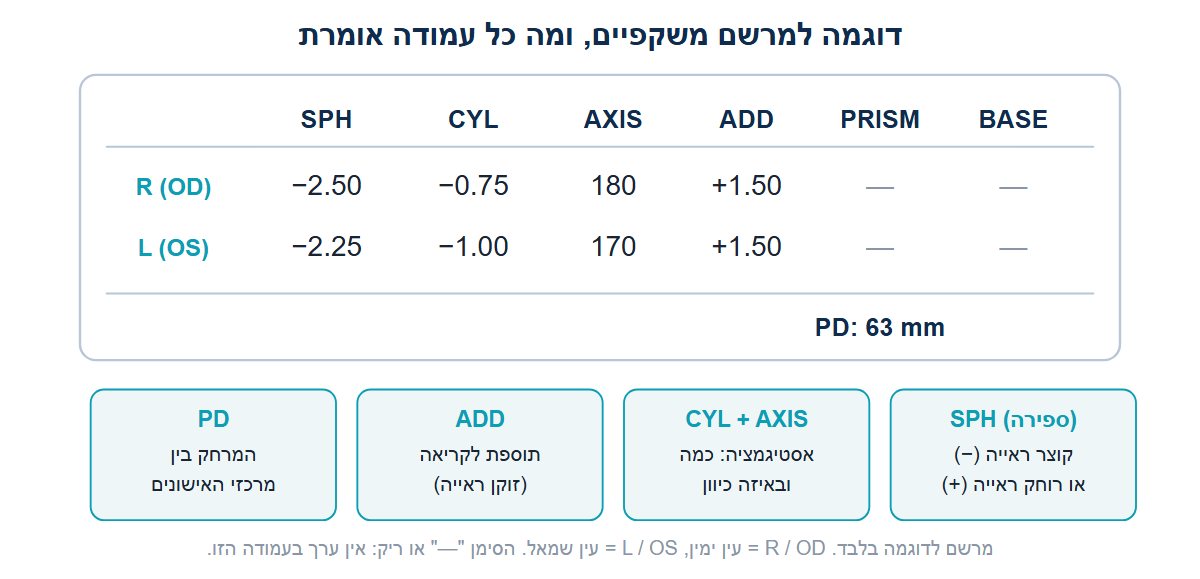
OD and OS: which eye is which?
- OD or R or RE: right eye (from the Latin oculus dexter).
- OS or L or LE: left eye (oculus sinister).
- OU: both eyes.
It is not unusual for the prescription to differ between the two eyes, so it is important not to mix them up.
SPH: what is the number with the plus or the minus?
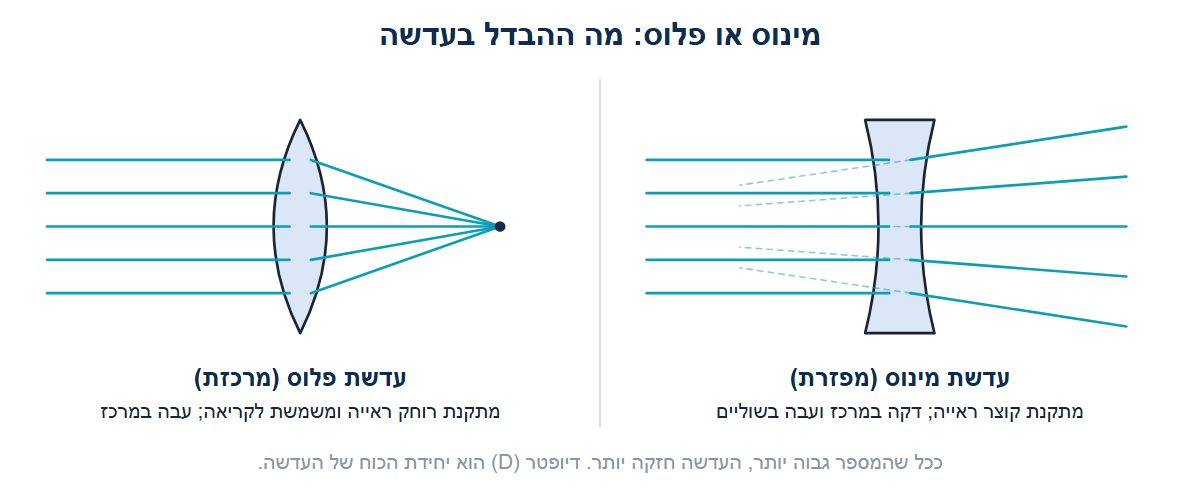
SPH (sphere) is the main power of the lens, in units of diopters (D). The numbers go up in steps of a quarter of a diopter (0.25).
- Minus (for example −2.50): nearsightedness. The lens spreads the light out, and distance vision is poor.
- Plus (for example +1.75): farsightedness. The lens converges the light.
- 0.00, or PL (plano): no correction in this direction.
The farther the number is from zero, the greater the refractive error. Minus 1 is mild nearsightedness, and minus 6 and above is considered severe nearsightedness (high myopia).
CYL and AXIS: what are cylinder and axis?
CYL (cylinder) is the correction for astigmatism: a condition in which the cornea or the lens is more curved in one direction than in another. The number states how many diopters of astigmatism there are. When there is no astigmatism the column is empty, or it says DS or SPH.
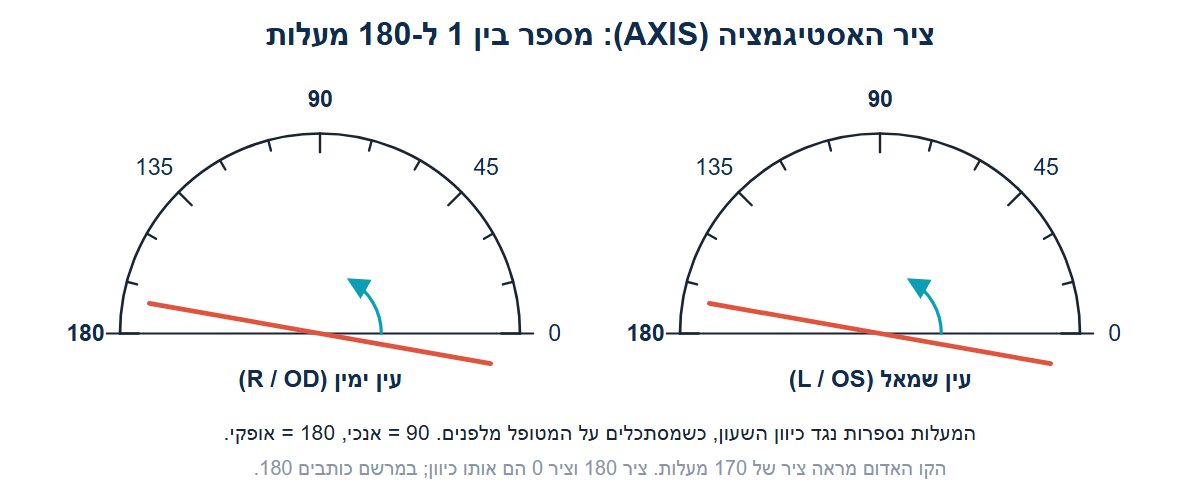
AXIS tells you in which direction to orient the cylinder lens. It is always a number between 1 and 180 degrees, and it has no units of power. In handwriting it is sometimes preceded by the sign ×, for example −0.75 × 180. The number 180 is not “higher” than 90. It is simply a different direction.
Why does the same prescription sometimes appear with a plus and sometimes with a minus in the cylinder?
The same lens can be written in two ways: in minus cylinder (the convention in most places today) or in plus cylinder. To convert from one form to the other: add the cylinder to the sphere, reverse the sign of the cylinder, and add or subtract 90 from the axis. For example, −2.00 −1.00 × 180 is the same as −3.00 +1.00 × 90. These are exactly the same glasses.
What is the “overall prescription”?
To compare prescriptions, the spherical equivalent is sometimes used: the sphere plus half of the cylinder. In the sample prescription, for the right eye: −2.50 + (−0.75 ÷ 2) ≈ −2.875, that is, a little less than 3 diopters.
ADD: the reading addition
ADD is the power added to the lower part of a multifocal lens (or to reading glasses) in order to see up close. It is always plus, and usually the same in both eyes. It appears when presbyopia begins, around age 40 to 45, and increases gradually until about age 60. For reading at a distance of 40 cm, an eye that can hardly focus on its own any more needs an addition of about 2.5 diopters.
Reading glasses are the sphere plus the ADD. In the sample prescription: −2.50 + 1.50 = −1.00 for the right eye. That is why a nearsighted person can sometimes read simply by taking off their glasses.
PD and prism
PD is the distance between the centers of the pupils, in millimeters. The optician uses it to position the center of the lens in front of the pupil. Sometimes it is written separately for each eye (for example 31/32), and sometimes two values appear: for distance and for near. A lens that is not centered creates a prism effect, which is felt mainly with high prescriptions.
PRISM and BASE appear for only a small proportion of people, usually when there is double vision or a misalignment between the eyes. A prism shifts the image, and its unit of measurement is the prism diopter. The BASE gives the direction: IN (inward, toward the nose), OUT (outward), UP or DOWN. If a prism has appeared in your prescription for the first time, it is worth finding out the reason from your ophthalmologist.
Why is a contact lens prescription different from a glasses prescription?
- Distance from the eye: glasses sit about 12 to 14 mm in front of the eye, and a contact lens sits on it. In nearsightedness of more than about 4 diopters this changes the power required. For example, glasses of minus 6 correspond roughly to contact lenses of minus 5.50. In farsightedness it is the opposite: the contact lens needs to be stronger.
- Lens dimensions: a contact lens prescription also includes the base curve (BC) and the diameter (DIA), and sometimes the type and material as well. These can only be determined by fitting the lens on the eye.
- Astigmatism: a special toric lens is required, and sometimes the cylinder is rounded or changed.
That is why contact lenses cannot be ordered from a glasses prescription. Nearsighted people who switch from glasses to contact lenses in their 40s sometimes feel presbyopia earlier, because with contact lenses the eye has to focus slightly more for near. For safe contact lens wear, see the page Contact Lenses: Safe Use.
What is 20/20 (6/6), and how is it different from a prescription?
20/20, written 6/6 in Israel, is not a prescription but the result of a visual acuity test. In 6/6, the first number is the test distance, 6 meters. The second number is the distance from which a normal eye sees the smallest letter you read. 6/6 means that you read from 6 meters what a normal eye reads from 6 meters. 6/12 means that you need to come as close as 6 meters to read a letter that a normal eye reads from 12 meters. In the United States the same thing is written in feet, 20/20, and in some places as a decimal, 1.0.
20/20 (6/6) is normal acuity, but not the ceiling: many people, especially young people, see 20/15 (6/4.5) or even better. Visual acuity is tested with and without glasses, and it does not tell you what the prescription is. You can see 20/20 with minus 3 in your glasses. The full eye exam is described on the page Eye Exam.
When should you have your prescription checked again?
When your vision has changed, when headaches or tiredness with reading appear, or when your glasses are no longer comfortable. After age 40 it is worth having a full eye exam from time to time, which also checks intraocular pressure and the retina, not just the prescription. A rapid change in prescription at an older age can be a sign of an early cataract. Anyone considering laser eye surgery needs a prescription that has been stable for at least a year (Who Is a Candidate for Laser Eye Surgery?).
Frequently asked questions
What is the difference between plus and minus in a prescription?
Minus means nearsightedness: you see better up close, and the lens spreads the light out. Plus means farsightedness, or a reading addition: the lens converges the light. The farther the number is from zero, the greater the refractive error.
What is AXIS in a prescription?
AXIS is the axis of the astigmatism correction, in degrees between 1 and 180. It tells you in which direction to position the cylinder lens, and it has nothing to do with how strong the prescription is. 90 is the vertical direction and 180 is the horizontal direction.
Can I use my glasses prescription to buy contact lenses?
No. A contact lens prescription also includes the curvature of the lens and its diameter, which are determined by fitting it on the eye. With high prescriptions the power is different too, because a contact lens sits on the eye and not at a distance from it. For example, glasses of minus 6 correspond roughly to contact lenses of minus 5.50.
Does 20/20 (6/6) mean perfect vision?
No. 20/20 (6/6) is normal visual acuity: you read from 6 meters what a normal eye reads from 6 meters. Many people see even better, for example 20/15 (6/4.5). Nor does 20/20 tell you what the prescription is: you can see 20/20 with glasses of minus 3.
Why is my prescription in the right eye different from the left eye?
This is very common. Each eye develops a little differently in length and curvature, so the prescriptions differ. A large difference between the eyes should be checked by an ophthalmologist.
References
- Brodie SE, Mauger TF, Ang M, et al. 2022–2023 Basic and Clinical Science Course, Section 3: Clinical Optics and Vision Rehabilitation. San Francisco: American Academy of Ophthalmology; 2022.
- Taravella MJ, Lee BS, Garg S, et al. 2025–2026 Basic and Clinical Science Course, Section 13: Refractive Surgery. San Francisco: American Academy of Ophthalmology; 2025.