

In brief
- Dry eye is very common at the age when cataract surgery is done, and often goes unnoticed.
- Before surgery: the tear film is the first surface that light meets. When it is unstable, the corneal measurements on which the lens calculation is based may come out inaccurate, especially for a toric or multifocal lens.
- That is why dry eye is looked for before surgery and treated, and sometimes the measurements are repeated.
- After surgery: dryness, a sandy feeling and vision that changes during the day are common in the first weeks, and sometimes last a few months. Preservative-free artificial tears help.
Why does dry eye matter before cataract surgery?
Light entering the eye first passes through the thin tear film that coats the cornea. When the film is smooth and stable, it is a perfect optical surface. With dry eye, it breaks up quickly, dry spots form in it, and the surface of the cornea becomes irregular.
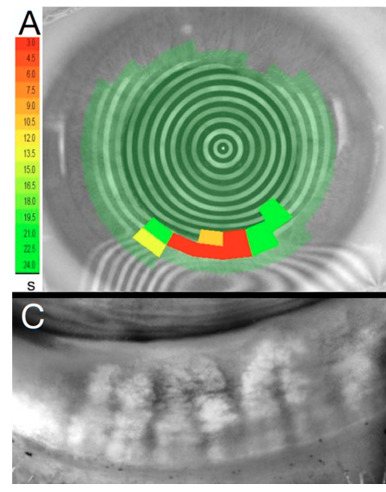
Before cataract surgery, the curvature of the cornea and the astigmatism (cylinder) are measured, and these measurements are used to calculate the power of the artificial lens and the axis of a toric lens. The devices project rings of light onto the cornea and read their reflection from the tear film. If the film is unstable, the rings are distorted, and the measurement may come out different from one test to the next.
In a study of patients before cataract surgery, in those whose tears were too concentrated (a sign of dry eye), the repeated corneal measurements were less consistent. More of them had a difference of a full diopter or more in the cylinder between two measurements, and more of them received a lens power that differed by more than half a diopter when the calculation was repeated. This matters especially when planning a toric lens, which corrects astigmatism along a precise axis, or a multifocal lens, which is sensitive to any flaw in the quality of vision.
How common is dry eye in people coming for cataract surgery?
Very common, and often without the patient knowing. In a U.S. study of patients aged 55 and older before cataract surgery, in about two-thirds the tear film broke up within five seconds or less, and in about three-quarters, staining showed signs of dryness on the cornea. Only a minority of them complained of a foreign body sensation. In another study, about 80% of patients had at least one abnormal tear test, including many who had no symptoms.
What is done before surgery?
- Detection. Questions about burning, a sandy feeling, vision that changes during the day and watery eyes, and a slit-lamp exam with fluorescein dye, which shows how quickly the tear film breaks up and whether there is damage to the surface of the cornea. Tests of the amount of tears or of the oil glands in the eyelids are sometimes added.
- Treatment. Artificial tears, preferably preservative-free, a gel for the night, and eyelid treatment when there is inflammation of the eyelid margins or blockage of the oil glands (warm compresses and cleaning). When needed, anti-inflammatory drops designed for dry eye, or small plugs that close the tear drainage openings.
- Repeating the measurements when they were not reliable, after a few weeks of treatment, when the surface of the cornea is smoother.
If you wear contact lenses, they also change the shape of the cornea, so they are stopped before the measurements according to the instructions on the Before Cataract Surgery page. You can find general information about dry eye and its treatment on the dry eye page.
Dry eye after cataract surgery: why does it happen and how long does it last?
Surgery can trigger dry eye even in people who did not have it before. The tiny incisions in the cornea cut some of the nerves that regulate tear production and blinking, the inflammation after surgery impairs the stability of the tear film, and the light of the operating microscope and the preservatives in some of the drops also contribute. In a meta-analysis of studies, about a third of patients who did not have dry eye before surgery developed it afterward. The dryness usually peaks between the first week and the first month, and sometimes lasts for months. In people who had dry eye or blockage of the oil glands before surgery, it worsens more.
The symptoms: a sandy feeling in the eye, burning, mild redness, vision that clears after a blink and then blurs again, and sometimes, surprisingly, watery eyes, as a response to the irritation. The nerves in the cornea regenerate gradually, and in most patients the symptoms improve within a few weeks to a few months.
What helps after surgery?
- Preservative-free artificial tears, several times a day, and a gel before bedtime if needed. They can be used alongside the drops prescribed after surgery, at least five minutes apart.
- Complete the course of surgery drops exactly according to the plan, and do not stop them because of the dryness. The schedule is detailed on the instructions after cataract surgery page.
- Continue the eyelid treatment if it was recommended, once the doctor confirms that the eye is ready for it.
- Environment: deliberate blinking and breaks from screens, and avoiding an air conditioner or fan aimed directly at your face.
If you have an autoimmune disease with severe dry eye, such as Sjögren syndrome, tell your surgeon before surgery. In these situations the surface of the cornea is followed more closely, and the drop treatment is tailored.
More about the surgery: The Complete Guide to Cataract.
Frequently asked questions
I have dry eye. Can I have cataract surgery?
Yes. Dry eye does not rule out surgery, but it is worth treating beforehand, so that the corneal measurements are accurate and the eye recovers comfortably. Sometimes the measurements are repeated after a few weeks of treatment.
Why are my eyes drier after cataract surgery?
The tiny incisions in the cornea cut some of the nerves that regulate the tears, and the inflammation after surgery and the preservatives in some of the drops add to it. This is especially common in the first weeks, and usually improves gradually.
How long does dry eye last after cataract surgery?
In most patients, a few weeks, peaking between the first week and the first month. In some, especially those who had dry eye before surgery, it lasts a few months. Preservative-free artificial tears help during this period.
Is it OK to use artificial tears together with the drops after surgery?
Yes, usually. Preservative-free tears are preferable, at least five minutes apart from the other drops. The surgery drops are continued exactly according to the plan, and are not stopped because of the dryness.
Why are the measurements repeated before surgery?
With dry eye, the tear film is unstable and the corneal measurements may come out different from one test to the next. After the dry eye is treated, the surface of the cornea is smoother, and the repeat measurement is more reliable. This matters especially when planning a toric or multifocal lens.
References
- Epitropoulos AT, Matossian C, Berdy GJ, Malhotra RP, Potvin R. Effect of tear osmolarity on repeatability of keratometry for cataract surgery planning. J Cataract Refract Surg. 2015;41(8):1672-1677. Link
- Trattler WB, Majmudar PA, Donnenfeld ED, et al. The Prospective Health Assessment of Cataract Patients' Ocular Surface (PHACO) study: the effect of dry eye. Clin Ophthalmol. 2017;11:1423-1430. Link
- Gupta PK, Drinkwater OJ, VanDusen KW, Brissette AR, Starr CE. Prevalence of ocular surface dysfunction in patients presenting for cataract surgery evaluation. J Cataract Refract Surg. 2018;44(9):1090-1096. Link
- Starr CE, Gupta PK, Farid M, et al. An algorithm for the preoperative diagnosis and treatment of ocular surface disorders. J Cataract Refract Surg. 2019;45(5):669-684. Link
- Miura M, Inomata T, Nakamura M, et al. Prevalence and characteristics of dry eye disease after cataract surgery: a systematic review and meta-analysis. Ophthalmol Ther. 2022;11(4):1309-1332. Link
- Lu Q, Lu Y, Zhu X. Dry eye and phacoemulsification cataract surgery: a systematic review and meta-analysis. Front Med. 2021;8:649030. Link
- Tsai LM, Afshari NA, Brasington CR, et al. 2022-2023 Basic and Clinical Science Course, Section 11: Lens and Cataract. San Francisco: American Academy of Ophthalmology; 2022.