

In brief
- After LASIK most patients see 20/20 by the next day and return to work at the computer. After PRK there are 3 to 5 days of discomfort and blur, and vision stabilizes gradually within 3 to 6 weeks.
- Driving: after LASIK you return to driving within a day or two. After PRK you do not drive for a week.
- No swimming for at least two weeks, no rubbing the eye, and no contact sports or strenuous exertion in the first weeks.
- Dry eye and vision that fluctuates during the day are common in the first months. Preservative-free artificial tears help.
- Pain that gets worse, a drop in vision or increasing redness are a reason to seek care immediately.
How long does recovery after laser eye surgery take?
It depends on the method. In LASIK the laser works beneath a flap and the surface of the cornea stays intact, so recovery is fast. In PRK the outer epithelial layer is removed, and until it regenerates the eye hurts and vision is blurred. In the end the result of the two methods is similar. The difference is in the journey. The differences between the methods are explained in the Guide to Laser Vision Correction.
The instructions here are general. The personal instructions you receive on the day of surgery and at your follow-up visits are the ones that count.
Recovery day by day: LASIK versus PRK
| When | After LASIK | After PRK |
|---|---|---|
| The day of surgery | Hazy vision, tearing and a sandy or burning feeling for a few hours. You go home to rest, and preferably to sleep. | A bandage contact lens is placed. When the numbing drops wear off, burning, tearing and light sensitivity begin. |
| The first day | Follow-up visit. Most patients see 20/20. You can return to work and to the computer. | Follow-up visit. Pain, light sensitivity and blur, usually moderate to severe. |
| Days 2 to 5 | Vision continues to sharpen. Only mild discomfort. | The epithelium grows and closes over the surface of the cornea. The pain usually eases after 3 to 4 days. Once the epithelium has closed, the lens is removed at a follow-up visit. |
| The first week | Antibiotic and steroid drops, usually for about a week. A shield during sleep. You return to driving within a day or two. | Functional vision within about a week, still fluctuating. Steroid drops, gradually tapered. No driving. |
| Weeks 2 to 4 | Return to swimming after at least two weeks, and to contact sports and strenuous exertion usually after two to four weeks. | Vision continues to improve. Steroid drops usually for up to about a month, depending on the exam. Sunglasses outdoors. |
| The first months | Dry eye and vision that fluctuates during the day, both gradually improving. Follow-up visits after about one month, three months and sometimes later as well. | Vision stabilizes within 3 to 6 weeks, and sometimes continues to improve for months more. Follow-up visits according to the recovery. |
Recovery after LASIK
The surgery takes about 10 to 15 minutes for both eyes, and afterward you go home the same day, with someone to accompany you. In the first hours the eye waters, vision is hazy and there is a sandy feeling. The best thing to do is to close your eyes and rest. The flap adheres within minutes, but in the first days it is more vulnerable, so you do not rub the eye, and for the first nights you sleep with a clear shield, so as not to rub it in your sleep.
The next day you come in for a follow-up visit. In most cases vision is already good, and you can return to work and to the computer. In the first weeks vision may fluctuate a little during the day, mainly because of dryness, and at night there may be halos around lights. Both gradually fade (Risks and Side Effects).
Recovery after PRK
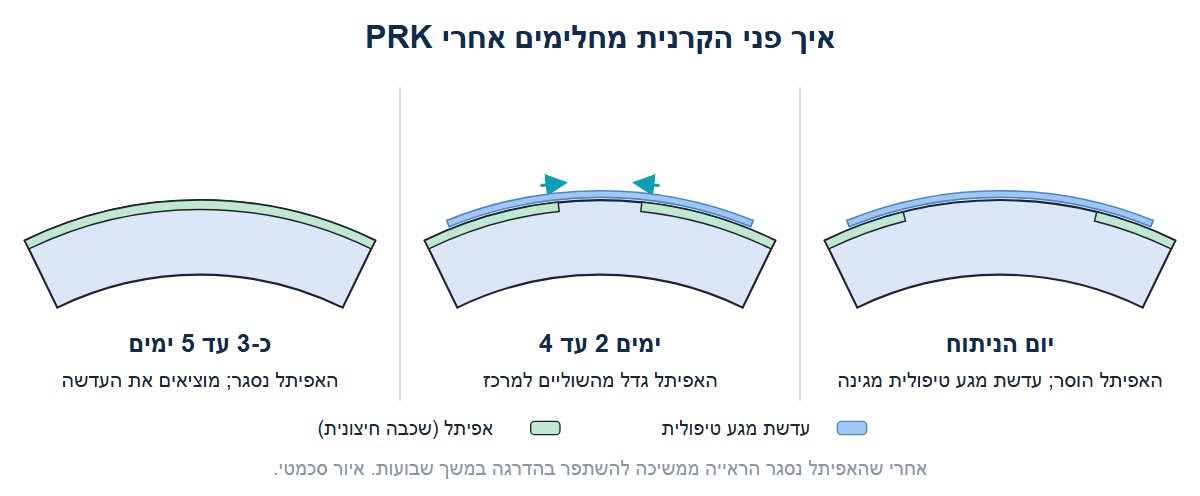
In PRK the first days are the hard part. When the numbing drops wear off, burning, a foreign-body sensation, tearing and light sensitivity appear. The intensity varies from person to person, from mild to severe, and it usually eases after 3 to 4 days. The bandage contact lens reduces pain, and pain relievers are given as well. You will usually receive clear instructions for pain relief: it is worth stocking up in advance and following them, rather than waiting for the pain to get worse.
During these days vision is blurred, so it is worth planning a few days of rest at home. Once the epithelium has closed, vision improves from day to day. Functional vision usually returns within about a week, and it continues to sharpen over weeks. The steroid drops are tapered gradually over about a month, sometimes longer, depending on the exam. Do not stop them on your own, because they affect healing and the result. In the first months you wear sunglasses outdoors, because UV radiation increases the risk of corneal haze.
Eye drops after laser surgery
- Antibiotic: to prevent infection, in the first days. After PRK, usually until the epithelium has closed.
- Steroids: against inflammation. After LASIK usually for about a week, and after PRK gradually tapered over about a month.
- Preservative-free artificial tears: frequently, for several months.
Wait a few minutes between different types of drops, and do not touch the eye with the tip of the bottle. You will receive the frequency and the duration of treatment in writing.
When do you return to work, driving and your routine?
Work and screens
After LASIK most patients return to work and to the computer the very next day. After PRK it is worth planning on about a week. Screens do not harm the eye, but in front of a screen you blink less and the dryness is felt more. So take short breaks, blink deliberately and use artificial tears. In the first days after PRK you can enlarge the font on the screen.
Driving
After LASIK most patients return to driving within a day or two. After PRK you do not drive for a week, and you may need to wait longer, until your vision is sharp and stable enough for driving. Night driving may be harder in the first weeks because of halos and glare.
Sports and physical activity
Ordinary walking is possible in the very first days. Strenuous exertion, weight lifting and contact sports are usually postponed for two to four weeks, and in sports that carry a risk of a blow to the eye you wear protective eyewear. After LASIK this is especially important, because a hard blow may displace the flap.
Swimming, the sea and hot tubs
No swimming and no going into a pool, the sea or a hot tub for at least two weeks, to reduce the risk of infection. In the shower too, take care that water and soap do not get directly into the eye.
Makeup, creams and skin care
No eye makeup, mascara or creams around the eyes until the doctor gives the go-ahead at a follow-up visit. After PRK, not before the epithelium has closed and the contact lens has been removed.
And what about after the first months?
After the prescription stabilizes, about three months after LASIK and between three and six months after PRK, the final result is checked. If a prescription that bothers you remains, this is the time to talk about an enhancement (Regression of the Prescription and Enhancement). Later in life it is worth having routine checkups with an ophthalmologist, and telling them about the surgery.
Dr. Stern performs LASIK and PRK surgery at the Ein Tal Hadassah center in Jerusalem, and sees his patients at the follow-up visits after surgery. More information is on the page Laser Eye Surgeon in Jerusalem.
Frequently asked questions
When can you return to work after laser eye surgery?
After LASIK most patients return to work and to the computer the very next day. After PRK it is worth planning on about a week, because in the first days there is pain and blur until the epithelium closes.
When are you allowed to drive after laser eye surgery?
After LASIK most patients return to driving within a day or two. After PRK you do not drive for a week, and more time may be needed, until your vision is sharp and stable enough.
How long does it hurt after PRK?
The pain, burning and light sensitivity are strongest mainly in the first 3 to 4 days, until the epithelium closes. The bandage contact lens and the pain relievers help a great deal. Pain that gets worse instead of better means you should contact the clinic.
When can you swim after laser eye surgery?
No swimming and no going into a pool, the sea or a hot tub for at least two weeks after surgery, to reduce the risk of infection. The return to swimming and water sports is approved at a follow-up visit.
Is it okay to look at screens after laser eye surgery?
Yes. Screens do not harm the result. But in front of a screen you blink less and the dryness is felt more, so it is worth taking breaks, blinking deliberately and using artificial tears.
When can you wear makeup after laser eye surgery?
No eye makeup or creams around the eye until the doctor gives the go-ahead at a follow-up visit. After PRK, not before the epithelium has closed and the contact lens has been removed.
References
- Taravella MJ, Lee BS, Garg S, et al. 2025–2026 Basic and Clinical Science Course, Section 13: Refractive Surgery. San Francisco: American Academy of Ophthalmology; 2025.
- American Academy of Ophthalmology, EyeSmart. When to resume exercise after an eye surgery or injury. Published June 10, 2026. Link
- Steigleman WA, Rose-Nussbaumer J, Al-Mohtaseb Z, et al. Management of pain after photorefractive keratectomy: a report by the American Academy of Ophthalmology. Ophthalmology. 2023;130(1):87-98. Link
- Shortt AJ, Allan BD, Evans JR. Laser-assisted in-situ keratomileusis (LASIK) versus photorefractive keratectomy (PRK) for myopia. Cochrane Database Syst Rev. 2013;(1):CD005135. Link