

In brief
- IFIS is an intraoperative triad: a flaccid, billowing iris, iris prolapse into the incisions and progressive pupil constriction. It is associated mainly with alpha-1 blockers, first and foremost tamsulosin.
- Stopping the drug before surgery probably does not help; what helps is asking every patient, anticipating the problem and planning ahead.
- Intracameral mydriatics (phenylephrine or epinephrine), an appropriate OVD and well-constructed incisions are the first line; iris hooks or a pupil expansion ring when the pupil is small or the iris prolapses.
- Pupil stretching and sphincterotomies are ineffective in IFIS: the floppy iris constricts again.
- Unanticipated IFIS raises the complication rate; IFIS that has been planned for ends with a good outcome in most cases.
What IFIS is
Intraoperative floppy iris syndrome (Intraoperative Floppy Iris Syndrome) was described in 2005 by Chang and Campbell: a flaccid iris that “billows” in the irrigation currents and tends to prolapse into the main incision and the side-port incisions, and a pupil that progressively constricts during surgery despite good dilation at the start. In the original series the syndrome occurred in about 2% of all cataract patients, and 94% of the cases in the prospective arm were taking or had previously taken tamsulosin. The presumed mechanism is blockade of α1A receptors in the iris dilator muscle. Neither stopping the drug, nor a low dose, nor a short course of treatment eliminates the risk.
Which drugs, and what is the risk
| Class | Examples | Notes |
|---|---|---|
| Selective α1A blockers | Tamsulosin, silodosin (and also the combination product tamsulosin + dutasteride) | The strongest effect on the iris. Tamsulosin is also prescribed for women (urinary stones, urinary retention). |
| Non-selective α1 blockers | Alfuzosin, doxazosin, terazosin, prazosin | Cause IFIS less often and less severely; some are prescribed for hypertension. |
| Other drugs with antiadrenergic activity | Chlorpromazine, risperidone, zuclopenthixol, mianserin, donepezil, labetalol | Cases have been reported. IFIS also occurs without known exposure, and is more common in patients with hypertension. |
Clinical importance: in a population-based study from Ontario (2009, about 96,000 men), exposure to tamsulosin in the two weeks before surgery was associated with roughly double the risk of serious postoperative complications: retinal detachment, lens fragments dropped into the vitreous or endophthalmitis (OR 2.33; number needed to harm about 255). No such association was found for other alpha-blockers. In the ASCRS review, the complications are concentrated mainly in cases in which the syndrome was not anticipated.
Grading severity
| Grade | Findings |
|---|---|
| Mild | Iris billowing only |
| Moderate | Billowing, plus iris prolapse or pupil constriction of 2 mm or more |
| Severe | All three: billowing, prolapse and constriction of 2 mm or more |
Before surgery
- Ask every patient, men and women alike, about alpha-blockers, including past use and short courses, and also about antipsychotic drugs.
- Do not stop the drug routinely: according to the BCSC and ASCRS, discontinuation has no clear effect on the severity of IFIS, and the decision about drugs that treat the urinary tract remains with the treating physician. For patient information, see Prostate Medications and Cataract Surgery.
- Measure the dilated pupil: a small dilated pupil predicts IFIS. In one series the risk was higher below 6.5 mm, and in another study the risk was present with a pupil of 7 mm or less, regardless of medication.
- Plan: intracameral mydriatics, an appropriate OVD, hooks or a ring available in the room, and adequate time allocated. Some surgeons add atropine in the days before surgery, one of the options listed in the BCSC.
Intraoperative pharmacologic measures
- Intracameral phenylephrine: in a randomized fellow-eye study (42 patients taking tamsulosin), preservative-free and bisulfite-free phenylephrine 1.5% at the start of surgery prevented signs of IFIS completely, compared with 88% in the eye that received balanced salt solution; injection in the middle of surgery restored iris rigidity and pupil size.
- Lidocaine and epinephrine solution: many surgeons use 0.5–1.0 mL of buffered lidocaine 0.75% with epinephrine 1:4000 or phenylephrine 1.5%, all preservative-free. Compounded preparations call for caution: a preparation error can cause TASS. The results are not uniform: in a series of resident-performed surgeries, prophylactic injection of lidocaine-epinephrine did not reduce the incidence of IFIS.
- Commercial preparations: phenylephrine with ketorolac as an additive to the irrigation solution (in one retrospective series, ring use fell from 7.9% to 3.0%), and a standardized intracameral combination of tropicamide, phenylephrine and lidocaine, which in a randomized trial (555 patients, not specifically with IFIS) allowed capsulorhexis without additional mydriatics in 98.9% of cases.
Technique and mechanical measures
- Incisions: not too short, not too posterior and not too wide, so that the iris does not prolapse into them.
- OVD: a high-viscosity or retentive OVD, to expand the pupil and keep the iris concave near the incisions.
- Fluidics: low flow to reduce turbulence; stop irrigation before withdrawing instruments; a bimanual technique can be considered.
- Mechanical expansion: in IFIS, the pupil will continue to constrict unless it is held open mechanically. Pupil stretching and sphincterotomies are ineffective, and increase the damage to the floppy iris.
Hooks or a ring? In a British series of 9,552 surgeries, 4.4% had a small pupil. Both devices were safe and effective, and were not associated with more intraoperative complications. Hooks added about 14 minutes to operating time for senior surgeons, and the ring about 4 minutes; the ring was associated with more postoperative inflammation and corneal edema. In another British series (1,426 small pupils), about a third were managed with intracameral phenylephrine alone, and the visual outcomes were similar with all methods, with more iris tears in the ring group. In a series of 30 eyes with IFIS, moderate to severe in 93% of them, the ring maintained a 6 mm pupil throughout surgery, with no significant complications.
A practical algorithm for the small pupil and IFIS
- Clinic: ask about alpha-blockers and antipsychotic drugs; measure the dilated pupil; check for synechiae, pseudoexfoliation and zonular stability; plan and document.
- At the start of surgery: intracameral mydriatics in everyone at risk; a pupil-expanding OVD; well-constructed incisions; low-flow parameters.
- A pupil below about 5 mm after these measures, or moderate to severe IFIS: a pupil expansion ring or hooks, before the capsulorhexis.
- IFIS that appears in the middle of surgery: stop, reinject intracameral mydriatics and OVD, gently reposit the prolapsed iris, and consider a mechanical device even at a late stage.
- After surgery: good control of inflammation; document the grade of IFIS and what helped, in preparation for surgery on the second eye.
The threshold of about 5 mm and the order of the algorithm reflect accepted practice and reviews, not a randomized trial that tested a specific threshold. The femtosecond laser also causes pupil constriction, by a different mechanism (prostaglandin release); a preoperative NSAID reduces it but does not prevent it.
Bottom line for the surgeon
- The question “Have you ever taken a prostate medication?” is part of every evaluation before cataract surgery, in women as well.
- Do not order the drug stopped routinely; plan the surgery instead.
- Preservative-free intracameral phenylephrine or epinephrine, an appropriate OVD and good incisions prevent most of the difficulties.
- In moderate to severe IFIS: an early mechanical device; no stretching and no sphincterotomies.
- Documenting the grade helps in planning the second eye.
Frequently asked questions
Should tamsulosin be stopped before cataract surgery?
Not routinely. According to the BCSC and the ASCRS review, discontinuation has no clear effect on the severity of IFIS, and it may compromise the urologic treatment. What matters is knowing about the drug in advance and planning the surgery accordingly.
Does IFIS occur without alpha-blockers too?
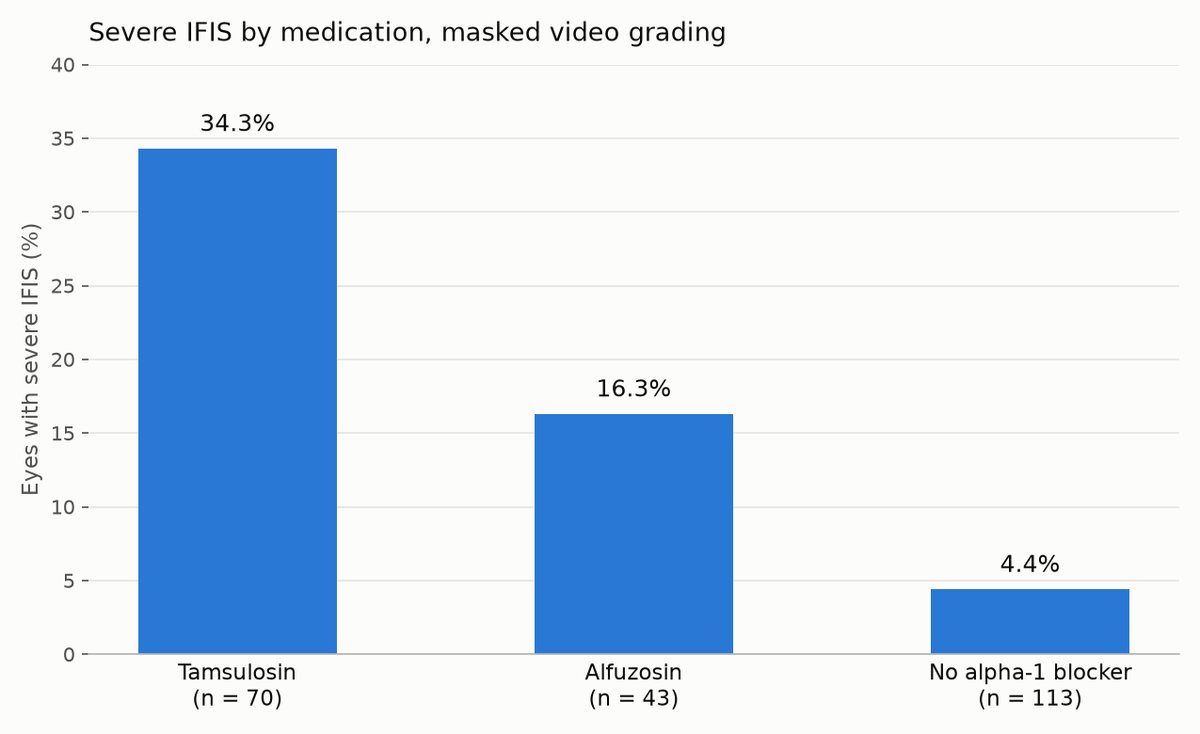
Yes. In a prospective masked study, 4.4% of eyes without alpha-blockers showed severe IFIS and 12.4% moderate to severe IFIS, when no intracameral mydriatics were given. IFIS is more common with hypertension and with a pupil that dilates poorly.
Does pupil stretching help in IFIS?
No. In IFIS the iris is floppy, and the stretched pupil constricts again during surgery; stretching even increases the damage to the iris. What keeps the pupil open is a mechanical device, hooks or a ring, alongside intracameral mydriatics.
References
- Chang DF, Campbell JR. Intraoperative floppy iris syndrome associated with tamsulosin. J Cataract Refract Surg. 2005;31(4):664-673. Link
- Chang DF, Braga-Mele R, Mamalis N, et al. ASCRS White Paper: clinical review of intraoperative floppy-iris syndrome. J Cataract Refract Surg. 2008;34(12):2153-2162. Link
- Chang DF, Campbell JR, Colin J, Schweitzer C; Study Surgeon Group. Prospective masked comparison of intraoperative floppy iris syndrome severity with tamsulosin versus alfuzosin. Ophthalmology. 2014;121(4):829-834. Link
- Bell CM, Hatch WV, Fischer HD, et al. Association between tamsulosin and serious ophthalmic adverse events in older men following cataract surgery. JAMA. 2009;301(19):1991-1996. Link
- Lorente R, de Rojas V, Vázquez de Parga P, et al. Intracameral phenylephrine 1.5% for prophylaxis against intraoperative floppy iris syndrome: prospective, randomized fellow eye study. Ophthalmology. 2012;119(10):2053-2058. Link
- Nderitu P, Ursell P. Iris hooks versus a pupil expansion ring: operating times, complications, and visual acuity outcomes in small pupil cases. J Cataract Refract Surg. 2019;45(2):167-173. Link
- Labetoulle M, Findl O, Malecaze F, et al. Evaluation of the efficacy and safety of a standardised intracameral combination of mydriatics and anaesthetics for cataract surgery. Br J Ophthalmol. 2016;100(7):976-985. Link
- American Academy of Ophthalmology. Basic and Clinical Science Course, Section 11: Lens and Cataract (2022-2023), ch. 10: Intraoperative floppy iris syndrome; ch. 12: Small pupil.