

In brief
- An intracameral antibiotic at the end of surgery is the only measure shown in a large randomized trial to reduce endophthalmitis after cataract surgery; the European guideline (ESCRS 2024) recommends it as routine.
- Povidone-iodine on the skin and in the conjunctival sac is the foundation of every protocol, with or without antibiotics.
- The contribution of antibiotic drops beyond an intracameral injection is uncertain: the randomized data and the large registries do not agree with each other.
- Posterior capsule rupture is the strongest surgical risk factor; an intracameral antibiotic reduces the risk in these eyes as well.
- TASS presents within 12–48 hours, acute endophthalmitis usually after 3–10 days. When in doubt, treat as infection.
How common is it? What the registries show
Endophthalmitis after cataract surgery is rare, so almost everything known about it comes from one large randomized trial and from national and institutional registries of hundreds of thousands of surgeries. In large registries from recent years the rate usually ranges from about 0.02% to about 0.1% (roughly 1 in 1,000 to 1 in 5,000 surgeries), and in some series it is higher. The differences between centers stem mainly from the use of intracameral antibiotics, the complication rate and the patient population. In the Swedish cataract registry, in which most patients receive an intracameral antibiotic (almost always cefuroxime), the rate over 1.46 million surgeries (2002–2017) was 0.029%.
The ESCRS study: the trial that defined the field
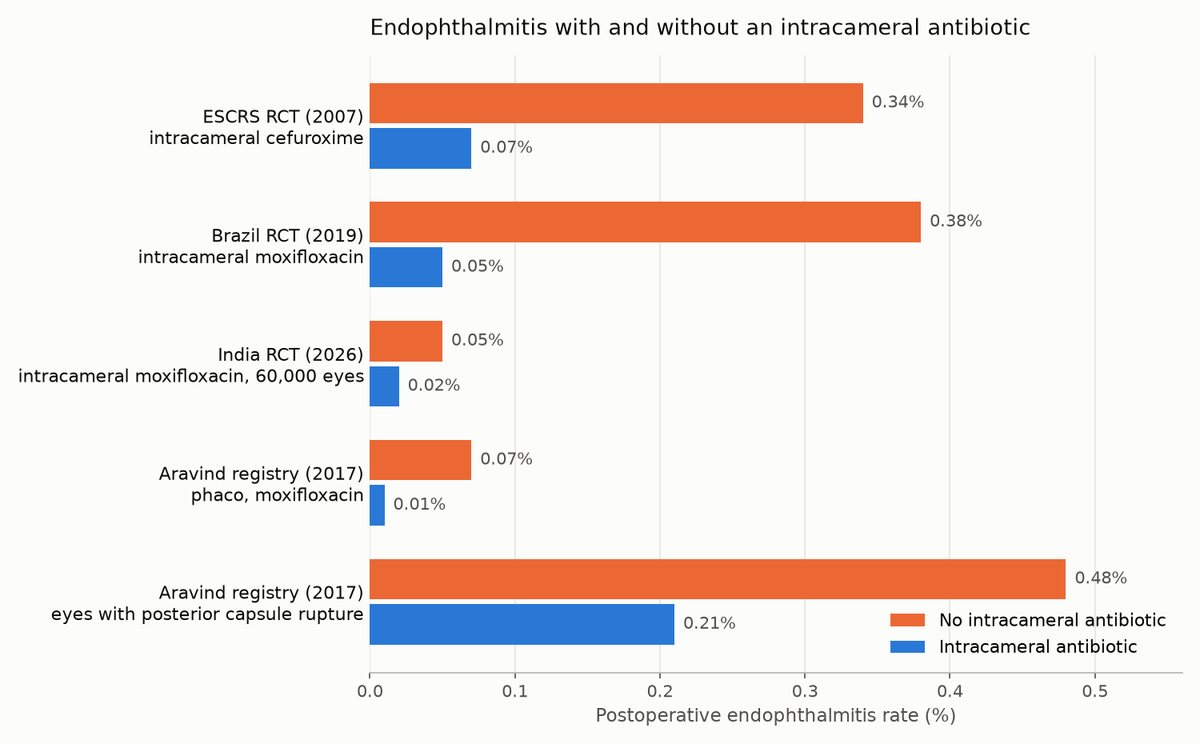
The ESCRS endophthalmitis study enrolled 16,603 patients at 24 centers in nine European countries, in a 2×2 factorial design: intracameral cefuroxime (1 mg in 0.1 mL) versus none, and perioperative levofloxacin drops versus placebo. The committee stopped recruitment early (2006) because the benefit of cefuroxime was clear: in the arms without cefuroxime the endophthalmitis rate was 0.34%, and in the arms with cefuroxime 0.07%, roughly a fivefold difference (OR 4.92 in the final analysis). No significant effect was demonstrated for levofloxacin drops alone.
The same study also identified additional risk factors: a surgical complication (OR ≈ 5), a silicone versus an acrylic lens, and male sex in the proven infections. A clear corneal incision versus a scleral tunnel was also associated with a higher risk, but this finding has not been consistently replicated; in the Swedish registry, for example, only a trend was found. The weakness of the study is the small number of events and a high rate in the control arm relative to modern registries; nevertheless, the Cochrane review (2017) rated the evidence for the benefit of intracameral cefuroxime as high-certainty evidence.
What came next: registries and further randomized trials
- Aravind, India (2017): with the move to routine intracameral moxifloxacin, the rate fell from 0.07% to 0.02% across all surgeries, and in phaco from 0.07% to 0.01%. In eyes with posterior capsule rupture the rate without an antibiotic was 0.48%, and with an antibiotic 0.21%.
- Two randomized trials of moxifloxacin: in Brazil (2019, 3,640 eyes), 0.38% without versus 0.05% with; and in India (published in 2026, 60,000 eyes), 0.05% versus 0.02%, with no difference in endothelial cell count.
- Kaiser Permanente, California (315,246 surgeries): an intracameral antibiotic was more effective than drops alone, and drops added nothing to the injection. A topical aminoglycoside was associated with twice the rate compared with gatifloxacin.
- Sweden: not giving an intracameral antibiotic, a capsule complication, age 85 and older, male sex and ocular comorbidity were independent risk factors. Same-day bilateral surgery (ISBCS) did not raise the risk; the rate with it was in fact lower (0.015%). See Cataract Surgery on Both Eyes on the Same Day.
Which intracameral antibiotic?
| Agent | Evidence | Practical notes |
|---|---|---|
| Cefuroxime 1 mg/0.1 mL | The randomized ESCRS study and national registries; the formal recommendation of ESCRS | A ready-to-use intracameral preparation is available in Europe. Most reported toxicity events resulted from dilution errors; rare cases of anaphylaxis have been reported. |
| Moxifloxacin (preservative-free) | Two randomized trials and a registry of more than 600,000 surgeries | Doses vary between protocols (in the Brazilian trial: 150 µg in 0.03 mL of undiluted 0.5% solution). In the 2021 ASCRS survey it was the most commonly used agent among US respondents. |
| Vancomycin | Observational data only | Not suitable for routine use: associated with HORV (see below), and its use has fallen sharply as a result. |
| Antibiotics in the irrigation bottle | No studies support efficacy | Concentration and duration of exposure are less predictable than with direct injection; the AAO guideline recommends avoiding it. |
In a 2022 network meta-analysis that included 6.8 million eyes, only the intracameral route significantly reduced the risk. Any compounded preparation requires dose control and strict preparation procedures, because a dilution error can cause corneal and retinal toxicity and present as TASS.
Povidone-iodine and sterile technique
Povidone-iodine is the oldest and best-established non-antibiotic means of prevention. The AAO guideline recommends a 5% solution in the conjunctival sac, and states that lower concentrations are less effective in reducing the bacterial load. In the 2024 ESCRS guideline: a 5%–10% solution on the eyelid skin three minutes before the start of surgery, while lower concentrations (0.3%–0.5%) are described for the conjunctival sac, unlike the AAO; and in iodine allergy, chlorhexidine 0.02%. Beyond that: meticulous draping of the eyelid margins and eyelashes, and watertight incisions at the end of surgery. According to the AAO guideline, preoperative antibiotic drops probably add nothing to a properly applied 5% iodine solution.
And what about antibiotic drops after surgery?
Here the evidence is not clear-cut. The Cochrane review found moderate-certainty evidence that the combination of drops and injection is probably better than either one alone, a finding that rests almost entirely on the arms of the ESCRS study. By contrast, in the large Kaiser and Swedish registries, drops added no measurable benefit over an intracameral injection, and widespread use of topical antibiotics encourages resistance. In practice, many centers continue to give a short course, but in the 2021 ASCRS survey about a quarter of the surgeons who inject an intracameral antibiotic had already given up postoperative drops. In any case, drops are not a substitute for the injection.
Risk factors and what to do about them
- Posterior capsule rupture or communication with the vitreous: the strongest surgical risk factor in all the registries (roughly 4 to 7 times). When the capsule ruptures, it is especially important to complete the intracameral injection and make sure the incisions are watertight.
- Patient factors: older age (especially 85 and older), male sex, diabetes and ocular comorbidity.
- A leaking wound and long or complicated surgery.
- Not giving an intracameral antibiotic: the only risk factor on the list that is entirely under the surgeon's control.
For the other complications of surgery, including macular edema, see Preventing Macular Edema After Cataract Surgery.
TASS, endophthalmitis and HORV: differential diagnosis
| TASS | Acute endophthalmitis | HORV | |
|---|---|---|---|
| Onset | 12–48 hours after surgery | Usually 3–10 days (median 6 days in the EVS) | 1–21 days; first-day examination normal |
| Pain | Usually mild | Usually significant, but about a quarter of the cases in the EVS presented without pain | Painless decrease in vision |
| Findings | Diffuse limbus-to-limbus corneal edema, fibrin, dilated or nonreactive pupil, high intraocular pressure; limited to the anterior segment | Vitreous inflammation is the hallmark; hypopyon, eyelid edema, sharp decrease in vision | Mild inflammation, sectoral intraretinal hemorrhages and ischemia, mainly in the periphery |
| Cause | A toxic substance: dilution error, solutions, residues on instruments, endotoxin | Bacteria from the flora of the eyelids and ocular surface, mainly coagulase-negative staphylococci | Delayed reaction to intraocular vancomycin |
| Treatment | Intensive topical steroids and close follow-up | Sampling and intravitreal antibiotic injection, or vitrectomy | Avoidance of vancomycin; the prognosis is poor in most reported cases |
Chronic endophthalmitis, which presents weeks to months after surgery, is usually caused by less virulent bacteria (C. acnes, S. epidermidis) or by fungi, and may look like chronic uveitis.
Where the guidelines stand (as of 2026)
- ESCRS (2024 guideline, summary published in 2026): an intracameral antibiotic should be used at the end of surgery; cefuroxime 1 mg in 0.1 mL receives the evidence grade GRADE +++. The guideline notes that other agents approved in other regions may be effective and safe, but they are not included in the formal recommendations. In the guideline's economic analysis, intracameral cefuroxime is cost-saving compared with no antibiotic.
- AAO (Preferred Practice Pattern): good evidence for povidone-iodine 5% in the conjunctival sac; accumulating evidence in favor of intracameral injection, but not enough evidence to recommend a specific agent; and avoid antibiotics in the irrigation bottle.
- In practice: in a 2021 global ASCRS survey, 66% of respondents used an intracameral antibiotic, compared with 30% in 2007. The main reasons for not using one were concern about errors in preparing the agent and doubt about the need.
Bottom line for the surgeon
- Povidone-iodine for every patient, meticulous draping of the eyelashes and watertight incisions.
- An intracameral antibiotic in every surgery, according to the approved and available agent, with dose control and strict preparation procedures.
- In posterior capsule rupture: do not skip the injection, and make sure the incisions are watertight.
- Postoperative antibiotic drops: a possible addition, not a substitute.
- Instruct patients to seek care immediately for worsening pain, increasing redness or decreased vision in the days after surgery. See the instructions after cataract surgery.
Frequently asked questions
Can postoperative antibiotic drops be omitted when an antibiotic is injected into the anterior chamber?
In the large Kaiser Permanente and Swedish registries, drops added no measurable benefit over an intracameral injection, and about a quarter of the surgeons who inject no longer give drops. The Cochrane review, which rests on the ESCRS study, found moderate-certainty evidence of additional benefit from the combination. The decision is a local one; the injection is the important part.
What is the main difference between TASS and endophthalmitis?
Timing and location: TASS presents within 12–48 hours, with limbus-to-limbus corneal edema and inflammation limited to the anterior segment, and responds to steroids. Acute endophthalmitis usually presents after 3–10 days, and its hallmark is vitreous inflammation. When in doubt, treat as infection.
Why not use intracameral vancomycin?
Because it has been associated with HORV, a hemorrhagic occlusive retinal vasculitis that presents days after surgery, usually without pain, and in most reported cases ends in severe visual loss. Following the reports, its use has fallen sharply.
References
- Endophthalmitis Study Group, European Society of Cataract & Refractive Surgeons. Prophylaxis of postoperative endophthalmitis following cataract surgery: results of the ESCRS multicenter study and identification of risk factors. J Cataract Refract Surg. 2007;33(6):978-988. Link
- Wanten JC, Till V, Findl O, et al. ESCRS guideline for cataract surgery 2024: executive summary. J Cataract Refract Surg. 2026;52(9):e1-e13. Link
- Gower EW, Lindsley K, Tulenko SE, et al. Perioperative antibiotics for prevention of acute endophthalmitis after cataract surgery. Cochrane Database Syst Rev. 2017;2:CD006364. Link
- Haripriya A, Chang DF, Ravindran RD. Endophthalmitis reduction with intracameral moxifloxacin prophylaxis: analysis of 600 000 surgeries. Ophthalmology. 2017;124(6):768-775. Link
- Sharma N, Sen A, Sharma M, et al. Efficacy of intracameral moxifloxacin in prevention of postcataract surgery endophthalmitis: randomized control trial. J Cataract Refract Surg. 2026;52(1):67-73. Link
- Friling E, Johansson B, Lundström M, Montan P. Postoperative endophthalmitis in immediate sequential bilateral cataract surgery: a nationwide registry study. Ophthalmology. 2022;129(1):26-34. Link
- Olson RJ, Braga-Mele R, Chen SH, et al. Cataract in the Adult Eye Preferred Practice Pattern. Ophthalmology. 2017;124(2):P1-P119. Link
- American Academy of Ophthalmology. Basic and Clinical Science Course, Section 11: Lens and Cataract (2022-2023), ch. 11: Toxic anterior segment syndrome; Endophthalmitis.